SHONGSHOY翻訳 · আর্টিকেল ← INDEX
POST 3634922 April 2024

ইসলামে দাসী সহবাসঃ ‘মা মালাকাত আইমানুকুম’ ও যৌন দাসত্বের ব্যবচ্ছেদ

ইসলামের পবিত্র ধর্মগ্রন্থ কোরআন এবং হাদিস গ্রন্থগুলোতে পরিষ্কারভাবে মালিকানাধীন বা অধিকারভূক্ত দাসীর সাথে যৌন সম্পর্ক হালাল করা হয়েছে। দাসদাসীদের কেনাবেচা, যুদ্ধবন্দী নারী হিসেবে দাসী গ্রহণ করা, এগুলো সবই ইসলামের দৃষ্টিতে সম্পূর্ণ হালাল

ভূমিকা

ইসলামী ধর্মতত্ত্বের প্রথাগত কাঠামোয় ‘মালিকানাভুক্ত’ বা ‘অধিকারভুক্ত’ দাসীদের সাথে যৌন সম্পর্ক স্থাপনের যে আইনি বৈধতা দেওয়া হয়েছে, তা আধুনিক মানবাধিকার এবং শারীরিক অখণ্ডতার (Bodily Autonomy) সংজ্ঞায় সরাসরি এবং খুব পরিষ্কারভাবে ‘যৌন দাসত্ব’ (Sexual Slavery) ও ‘পদ্ধতিগত ধর্ষণ’ হিসেবে গণ্য। ইসলামের মৌলিক উৎস কোরআনের বিভিন্ন আয়াতে অত্যন্ত সুষ্পষ্টভাবে স্বাধীন স্ত্রীদের পাশাপাশি যুদ্ধবন্দী বা ক্রয়কৃত নারীদের সাথে যৌন সম্পর্ক স্থাপনকে কেবল নৈতিকভাবে সিদ্ধই করা হয়নি, বরং একে আল্লাহর দেওয়া একটি অধিকার বা ‘হালাল’ ও 'সদকা' বা পুণ্য অর্জনের কাজ ও ব্যবস্থা হিসেবে ঘোষণা করা হয়েছে (( সূরা মুমিনুন আয়াত ৫, ৬ )) (( সূরা আল-মা’আরিজ আয়াত ২৯-৩০ )) (( সূরা আল-আহযাব, আয়াত ৫০ )) (( সূরা নিসা, আয়াত ২৪ ))। এই আয়াতগুলো একটি অমানবিক মালিকানা-দর্শনের ওপর ভিত্তি করে রচিত, যেখানে একজন মানুষের শরীরের ওপর অন্য একজন মানুষের নিরঙ্কুশ দখলদারিকে ‘পবিত্র’ আইনি কাঠামোয় মহিমান্বিত করা হয়। কুরআন ডট কম (( quran.com ))-এর অনুবাদগুলো, হাদিস, সীরাত, ফিকহ এবং ধ্রুপদী তাফসীরগুলো বিশ্লেষণ করলে এটি স্পষ্ট হয় যে, তৎকালীন আরবীয় গোত্রীয় সংঘাত ও যুদ্ধের লুঠতরাজকে ধর্মীয়ভাবে জায়েজ করার উদ্দেশ্যেই এই নিয়মগুলো প্রবর্তিত হয়েছিল। যুক্তিবাদী দৃষ্টিভঙ্গিতে, কোনো শাশ্বত নৈতিকতা মানুষের মর্যাদাকে পণ্যে রূপান্তর করতে পারে না; বরং এই টেক্সটগুলো স্পষ্টতই সপ্তম শতাব্দীর পুরুষতান্ত্রিক ও বর্বর দাস-সংস্কৃতির একটি প্রতিফলন মাত্র।


দাসী সহবাস সম্পর্কে আলেমদের বক্তব্য

আধুনিক ইসলামী দাঈ এবং আলেমগণ যখন সপ্তম শতাব্দীর যুদ্ধবন্দী নারীদের ‘ভোগ’ করার বিষয়টি ব্যাখ্যা করেন, তখন তারা প্রায়শই একে তৎকালীন ‘বাস্তবতা’ বা ‘অসহায় নারীদের উদ্ধার’ হিসেবে জায়েজ করার এক অদ্ভুত চেষ্টা চালান। কিন্তু যুক্তি এবং বৈশ্বিক মানবাধিকারের মাপকাঠিতে এই যুক্তিগুলো সম্পূর্ণ অন্তঃসারশূন্য এবং স্ববিরোধী। একজন যুদ্ধবন্দী নারীকে ‘গনিমতের মাল’ বা যুদ্ধের লুঠতরাজ হিসেবে দেখা কেবল নৈতিক অবক্ষয় নয়, বরং এটি সম্মতিহীন যৌন নিপীড়নকে প্রাতিষ্ঠানিক রূপ দেওয়ার একটি ঐতিহাসিক বহিঃপ্রকাশ। কোনো সুস্থ এবং যুক্তিনির্ভর সামাজিক কাঠামোয় একজন মানুষের শরীরকে অন্য কারো জন্য ‘পুরস্কার’ হিসেবে সংজ্ঞায়িত করা যায় না। আসুন কাফের নারীদের ‘ভোগ’ করার এই আদিম বিধানটির পেছনে তথাকথিত আলেমদের ‘যুক্তি’ কী, তা নিচের ওয়াজগুলো থেকে জেনে নিই। প্রথমেই জানি, কাফের নারীদের এই সিস্টেমেটিক ধর্ষণ যে আসলে তাদের কুফরির শাস্তি, সেটি সম্পর্কে একটি ওয়াজ,

0:00
–:––

এবারে আমরা আহমদুল্লাহ এবং অন্যান্য আলেমদের কিছু বক্তব্য বিশ্লেষণ করি, যেখানে তারা মানবিক ভালবাসা ও প্রেমের সম্পর্ককে সম্পূর্ণ হারাম ঘোষণা করে নারী পুরুষের অবাধ মেলামেশার অজুহাতে, একইসাথে যৌনদাসী ভোগকে আল্লাহ প্রদত্ত সর্বোচ্চ নৈতিক বিধান বলে মনে করে। তারা এরকম দাসী প্রথাকে একটি ‘সিস্টেম’ হিসেবে জায়েজ করার চেষ্টা করেন, যা প্রকৃতপক্ষে নারীর মানবিক সত্তাকে মুছে ফেলারই নামান্তর:

https://youtu.be/_91dFHdPMbk

0:00
–:––

0:00
–:––

0:00
–:––

0:00
–:––

0:00
–:––

0:00
–:––

একজন মানুষকে ‘উপহার’ হিসেবে লেনদেন করা আধুনিক নৈতিকতায় দণ্ডনীয় অপরাধ। অথচ ইসলামী ইতিহাসে দেখা যায়, নবী মুহাম্মদ নিজেও নারী বা দাসীকে উপহার হিসেবে গ্রহণ করতেন এবং তাঁদের সাথে যৌন সঙ্গম করাকে বৈধ মনে করা হতো, যা ইসলামি শরিয়তে আজও সমানভাবে প্রয়োগযোগ্য। মিজানুর রহমান আজহারীর বক্তব্যে মারিয়া আল-কিবতিয়ার ঘটনাটি শুনলে বোঝা যায়, কীভাবে একজন মানুষের জীবনকে স্রেফ একটি জড় বস্তুর মতো হস্তান্তর করা হতো:

0:00
–:––

এই মধ্যযুগীয় দৃষ্টিভঙ্গি আজও কতটা ভয়ঙ্কর রূপ ধারণ করতে পারে, তা বোঝা যায় যখন একজন আধুনিক পাকিস্তানি মুসলিম যুদ্ধের প্রেক্ষাপটে ভিনদেশী নারীদের ‘গনিমতের মাল’ হিসেবে ‘বুকিং’ দেওয়ার কল্পনা করেন। এটি প্রমাণ করে যে, এই ধর্মীয় শিক্ষাগুলো মানুষের অবচেতনে আজও লিঙ্গীয় সহিংসতা এবং অমানবিক লালসাকে টিকিয়ে রেখেছে:

0:00
–:––

কোরআনের বক্তব্য - দাসীর সাথে যৌনকর্ম

কোরআনের বিভিন্ন আয়াতে পুরুষদের যৌন লালসা মেটানোর জন্য দুটি সুনির্দিষ্ট উৎসের কথা বলা হয়েছে: এক, আইনিভাবে বিবাহিত স্ত্রী; দুই, যুদ্ধের মাধ্যমে বা ক্রয়সূত্রে লব্ধ 'মালিকানাধীন দাসী' (মা মালাকাত আয়মানুকুম)। আধুনিক নৈতিকতার ভাষায় যাকে 'যৌন দাসত্ব' (Sexual Slavery) বলা হয়, কোরআন তাকে কেবল বৈধই করেনি, বরং একে অত্যন্ত স্বাভাবিক একটি সামাজিক ব্যবস্থা হিসেবে উপস্থাপন করেছে। এই আয়াতগুলো বিশ্লেষণ করলে দেখা যায়, তথাকথিত ঐশ্বরিক বিধানে নারীর 'সম্মতি' (Consent) নয়, বরং পুরুষের 'মালিকানা'ই ছিল যৌন সম্পর্কের প্রধান মাপকাঠি। যুক্তিবাদী দৃষ্টিভঙ্গিতে এটি স্পষ্ট যে, এই বিধানগুলো কোনো শাশ্বত নৈতিকতার অংশ নয়, বরং সপ্তম শতাব্দীর গোত্রীয় যুদ্ধের অর্থনীতি ও পুরুষতান্ত্রিক ভোগবাদকে দীর্ঘস্থায়ী করার একটি হাতিয়ার মাত্র।


সূরা মুমিনুন আয়াত ৫,৬

এই আয়াতগুলোতে মুমিনদের সফলতার একটি শর্ত হিসেবে 'লজ্জাস্থান সংরক্ষণের' কথা বলা হয়েছে। তবে মজার বিষয় হলো, এই সংরক্ষণের বাধ্যবাধকতা থেকে দাসীদেরকে সম্পূর্ণ বাদ দেওয়া হয়েছে। অর্থাৎ, মুমিন পুরুষেরা তাদের স্ত্রীদের বাইরেও যত খুশি দাসীর সাথে যৌন সম্পর্ক স্থাপন করতে পারবে এবং এর জন্য তারা সমাজে বা ঈশ্বরের কাছে বিন্দুমাত্র নিন্দিত হবে না। এটি প্রমাণ করে যে, দাসী বা যুদ্ধবন্দী নারীদেরকে পূর্ণাঙ্গ মানুষ হিসেবে নয়, বরং স্রেফ 'যৌন সম্পত্তি' হিসেবে দেখা হতো।

যারা নিজেদের যৌনাঙ্গকে সংরক্ষণ করে
Taisirul Quran
যারা নিজেদের যৌনাংগকে সংযত রাখে
Sheikh Mujibur Rahman
আর যারা তাদের নিজদের লজ্জাস্থানের হিফাযতকারী
Rawai Al-bayan
আর যারা নিজেদের যৌনাঙ্গকে রাখে সংরক্ষিত (১),
Dr. Abu Bakr Muhammad Zakaria

নিজেদের স্ত্রী ও মালিকানাভুক্ত দাসী ব্যতীত, কারণ এ ক্ষেত্রে তারা নিন্দা থেকে মুক্ত।
Taisirul Quran
নিজেদের পত্নী অথবা অধিকারভুক্ত দাসীগণ ব্যতীত, এতে তারা নিন্দনীয় হবেনা।
Sheikh Mujibur Rahman
তবে তাদের স্ত্রী ও তাদের ডান হাত যার মালিক হয়েছে তারা ছাড়া, নিশ্চয় এতে তারা নিন্দিত হবে না।
Rawai Al-bayan
নিজেদের স্ত্রী বা অধিকারভুক্ত দাসীগণ ছাড়া, এতে তারা হবে না নিন্দিত (১),
Dr. Abu Bakr Muhammad Zakaria

সূরা আল-মা’আরিজ আয়াত ২৯,৩০

এই আয়াতগুলোতে মুমিনদের সফলতার একটি শর্ত হিসেবে 'লজ্জাস্থান সংরক্ষণের' কথা বলা হয়েছে। তবে লক্ষ্যনীয় বিষয় হলো, এই যৌনাঙ্গ সংরক্ষণের বাধ্যবাধকতা থেকে দাসীদেরকে সম্পূর্ণ বাদ দেওয়া হয়েছে। অর্থাৎ, মুমিন পুরুষেরা তাদের স্ত্রীদের বাইরেও যত খুশি দাসীর সাথে যৌন সম্পর্ক স্থাপন করতে পারবে এবং এর জন্য তারা সমাজে বা ঈশ্বরের কাছে বিন্দুমাত্র নিন্দিত হবে না। এটি প্রমাণ করে যে, দাসী বা যুদ্ধবন্দী নারীদেরকে পূর্ণাঙ্গ মানুষ হিসেবে নয়, বরং স্রেফ 'যৌন সম্পত্তি' হিসেবে দেখা হতো।

যারা নিজেদের লজ্জাস্থান সংরক্ষণ করে
Taisirul Quran
এবং যারা নিজেদের যৌনাঙ্গকে সংযত রাখে।
Sheikh Mujibur Rahman
আর যারা তাদের যৌনাংগসমূহের হিফাযতকারী।
Rawai Al-bayan
আর যারা নিজেদের যৌনাঙ্গসমূহের হিফাযতকারী (১),
Dr. Abu Bakr Muhammad Zakaria

তাদের স্ত্রী অথবা অধিকারভুক্ত দাসী ছাড়া, কেননা তাতে তারা তিরস্কৃত হবে না,
Taisirul Quran
তাদের স্ত্রী অথবা অধিকারভুক্ত দাসীদের ক্ষেত্র ব্যতীত, এতে তারা নিন্দনীয় হবেনা –
Sheikh Mujibur Rahman
তবে তাদের স্ত্রী ও তাদের ডান হাত যাদের মালিক হয়েছে সে দাসীগণের ক্ষেত্র ছাড়া। তাহলে তারা সে ক্ষেত্রে নিন্দনীয় হবে না।
Rawai Al-bayan
তাদের পত্নী অথবা অধিকারভুক্ত দাসী ছাড়া, এতে তারা নিন্দনীয় হবে না—
Dr. Abu Bakr Muhammad Zakaria

সূরা আল-আহযাব, আয়াত ৫০

এই আয়াতে স্বয়ং নবীর জন্য বিশেষ যৌন সুবিধার তালিকা দেওয়া হয়েছে। এখানে 'ফায়' বা বিনা যুদ্ধে লব্ধ কাফের নারীদেরকে নবীর জন্য 'হালাল' করা হয়েছে। একজন যুদ্ধবন্দী নারী, যার গোত্র এবং পরিবার-পরিজন হয়তো যুদ্ধে নিহত হয়েছে, ঘরবাড়ি ধ্বংস হয়ে গেছে, তাকে সহানুভূতি দেখানোর বদলে তাঁর শরীরকে বিজয়ীর জন্য বরাদ্দ করা আদিম বর্বরতার চূড়ান্ত রূপ। আধুনিক মানবাধিকারের আলোকে একে 'যুদ্ধাপরাধ' হিসেবে গণ্য করা হয়।

হে নবী (সা.)! আমি তোমার জন্য বৈধ করেছি তোমার স্ত্রীগণকে যাদের মোহরানা তুমি প্রদান করেছ; আর বৈধ করেছি আল্লাহ ফায় (বিনা যুদ্ধে লব্ধ) হিসেবে তোমাকে যা দান করেছেন তার মধ্য হতে যারা তোমার মালিকানাধীন হয়েছে তাদেরকে, আর তোমার চাচার কন্যা ও ফুফুর কন্যাকে, তোমার মামার কন্যা ও তোমার খালার কন্যাকে যারা তোমার সঙ্গে হিজরাত করেছে। আর কোন মু’মিন নারী যদি নবীর নিকট নিজেকে নিবেদন করে আর নবী যদি তাকে বিয়ে করতে চায় সেও বৈধ, এটি মু’মিনদের বাদ দিয়ে বিশেষভাবে তোমার জন্য যাতে তোমার কোন অসুবিধে না হয়। মু’মিনগণের জন্য তাদের স্ত্রী ও দাসীদের ব্যাপারে যা নির্ধারিত করেছি আমার তা জানা আছে। আল্লাহ অতি ক্ষমাশীল, পরম দয়ালু।
Taisirul Quran
হে নাবী! আমি তোমার জন্য বৈধ করেছি তোমার স্ত্রীদেরকে, যাদের মোহর তুমি প্রদান করেছ এবং বৈধ করেছি ‘ফায়’ হিসাবে আল্লাহ তোমাকে যা দান করেছেন তন্মধ্য হতে যারা তোমার মালিকানাধীন হয়েছে তাদেরকে এবং বিয়ের জন্য বৈধ করেছি তোমার চাচার কন্যা ও ফুফুর কন্যাকে, মামার কন্যা ও খালার কন্যাকে, যারা তোমার সাথে দেশ ত্যাগ করেছে এবং কোন মু’মিনা নারী নাবীর নিকট নিজেকে নিবেদন করলে, এবং নাবী তাকে বিয়ে করতে চাইলে সেও বৈধ। এটি বিশেষ করে তোমারই জন্য, অন্য মু’মিনদের জন্য নয়; যাতে তোমার কোন অসুবিধা না হয়। মু’মিনদের স্ত্রী এবং তাদের মালিকানাধীন দাসীদের সম্বন্ধে যা আমি নির্ধারিত করেছি তা আমি জানি। আল্লাহ ক্ষমাশীল, পরম দয়ালু।
Sheikh Mujibur Rahman
হে নবী, আমি তোমার জন্য তোমার স্ত্রীদেরকে হালাল করেছি যাদেরকে তুমি মোহরানা দিয়েছ, আর আল্লাহ তোমাকে ফায়* হিসেবে যা দিয়েছেন তন্মধ্যে যারা তোমার মালিকানাধীন তাদেরকেও তোমার জন্য হালাল করেছি এবং (বিয়ের জন্য বৈধ করেছি) তোমার চাচার কন্যা, ফুফুর কন্যা, মামার কন্যা, খালার কন্যাকে, যারা তোমার সাথে হিজরত করেছে, আর কোন মুমিন নারী যদি নবীর জন্য নিজকে হেবা** করে, নবী তাকে বিয়ে করতে চাইলে সেও তার জন্য বৈধ। এটি বিশেষভাবে তোমার জন্য, অন্য মুমিনদের জন্য নয়; আমি তাদের ওপর তাদের স্ত্রীদের ও তাদের ডান হাত যার মালিক হয়েছে তাদের ব্যাপারে যা ধার্য করেছি তা আমি নিশ্চয় জানি; যাতে তোমার কোন অসুবিধা না হয়। আল্লাহ ক্ষমাশীল, পরম দয়ালু। * ‘ফায়’ হচ্ছে বিনা যুদ্ধে লব্ধ কাফিরদের সম্পদ।
Rawai Al-bayan
হে নবী! আমরা আপনার জন্য বৈধ করেছি আপনার স্ত্রীগণকে, যাদের মোহর আপনি দিয়েছেন এবং বৈধ করেছি ফায় হিসেবে আল্লাহ আপনাকে যা দান করেছেন তাদের মধ্য থেকে যারা আপনার মালিকানাধীন হয়েছে তাদেরকে। আর বিয়ের জন্য বৈধ করেছি আপনার চাচার কন্যা ও ফুফুর কন্যাকে, মামার কন্যা ও খালার কন্যাকে, যারা আপনার সঙ্গে হিজরত করেছে এবং এমন মুমিন নারীকে (বৈধ করেছি) যে নবীর জন্যে নিজেকে সমৰ্পণ করে, যদি নবী তাকে বিয়ে করতে চায়--- এটি বিশেষ করে আপনার জন্য, অন্য মুমিনদের জন্য নয়; যাতে আপনার কোনো অসুবিধা না হয়। আমরা অবশ্যই জানি মুমিনদের স্ত্রী এবং তাদের মালিকানাধীন দাসীগণ সম্বন্ধে তাদের উপর যা নির্ধারিত করেছি (১)। আর আল্লাহ ক্ষমাশীল, পরম দয়ালু।
Dr. Abu Bakr Muhammad Zakaria

সূরা নিসা, আয়াত ২৪

সূরা নিসার ২৪ নম্বর আয়াতটি নৈতিকতার ইতিহাসে অন্যতম বিতর্কিত ও অন্ধকার একটি দিক উন্মোচন করে। এখানে বিবাহিত নারীদের সাথে যৌন সম্পর্ক হারাম করা হলেও একটি বীভৎস ছাড় দেওয়া হয়েছে—যদি সেই নারী যুদ্ধের ময়দানে 'মালিকানাভুক্ত দাসী' হিসেবে হস্তগত হয়। অর্থাৎ, একজন বিবাহিত নারীকে তাঁর স্বামীর কাছ থেকে ছিনিয়ে এনে তাঁর অনিচ্ছায় নতুন মালিকের শয্যাসঙ্গিনী করাকে কোরআন সরাসরি বৈধতা দিচ্ছে। এটি কেবল মানবাধিকারের চরম লঙ্ঘনই নয়, বরং এটি প্রমাণ করে যে তৎকালীন ধর্মতাত্ত্বিকরা যুদ্ধকালীন যৌন সহিংসতাকে ধর্মের আবরণে প্রাতিষ্ঠানিক রূপ দিয়েছিলেন।

নারীদের মধ্যে বিবাহবন্ধনে আবদ্ধ নারীগণও তোমাদের জন্য নিষিদ্ধ, কিন্তু তোমাদের অধিকারভুক্ত দাসীদের বাদে, আল্লাহ এসব ব্যবস্থা তোমাদের উপর ফরয করে দিয়েছেন। তোমাদের জন্য নিষিদ্ধ নারীদের ছাড়া অন্যান্য সকল নারীদেরকে মোহরের অর্থের বদলে বিবাহ বন্ধনে আবদ্ধ করতে চাওয়া তোমাদের জন্য বৈধ করা হয়েছে, অবৈধ যৌন সম্পর্কের জন্য নয়। অতঃপর তাদের মধ্যে যাদের তোমরা সম্ভোগ করেছ, তাদেরকে তাদের ধার্যকৃত মোহর প্রদান কর। তোমাদের প্রতি কোনও গুনাহ নেই মোহর ধার্যের পরও তোমরা উভয়ের সম্মতির ভিত্তিতে মোহরের পরিমাণে হেরফের করলে, নিশ্চয় আল্লাহ সবিশেষ পরিজ্ঞাত ও পরম কুশলী।
Taisirul Quran
এবং নারীদের মধ্যে বিবাহিতগণ তোমাদের জন্য নিষিদ্ধ করা হয়েছে; কিন্তু তোমাদের ডান হাত যাদের অধিকারী - আল্লাহ তোমাদের জন্য তাদেরকে বিধিবদ্ধ করেছেন, এতদ্ব্যতীত তোমাদের জন্য বৈধ করা হয়েছে অন্যান্য নারীদের; তোমরা স্বীয় ধনের দ্বারা ব্যভিচারের উদ্দেশ্য ব্যতীত বিবাহ করার জন্য তাদের অনুসন্ধান কর; অনন্তর তাদের দ্বারা যে ফল ভোগ করবে তজ্জন্য তাদেরকে তাদের নির্ধারিত দেয় প্রদান কর এবং কোন অপরাধ হবেনা যদি নির্ধারণের পর তোমরা পরস্পর সম্মত হও, নিশ্চয়ই আল্লাহ মহাজ্ঞানী, বিজ্ঞানময়।
Sheikh Mujibur Rahman
আর (হারাম করা হয়েছে) নারীদের মধ্য থেকে সধবাদেরকে। তবে তোমাদের ডান হাত যাদের মালিক হয়েছে (দাসীগণ) তারা ছাড়া। এটি তোমাদের উপর আল্লাহর বিধান এবং এরা ছাড়া সকল নারীকে তোমাদের জন্য হালাল করা হয়েছে যে, তোমরা তোমাদের অর্থের বিনিময়ে তাদেরকে চাইবে বিবাহ করে, অবৈধ যৌনাচারে লিপ্ত হয়ে নয়। সুতরাং তাদের মধ্যে তোমরা যাদেরকে ভোগ করেছ তাদেরকে তাদের নির্ধারিত মোহর দিয়ে দাও। আর নির্ধারণের পর যে ব্যাপারে তোমরা পরস্পর সম্মত হবে তাতে তোমাদের উপর কোন অপরাধ নেই। নিশ্চয় আল্লাহ মহাজ্ঞানী, প্রজ্ঞাময়।
Rawai Al-bayan
আর নারীদের মধ্যে তোমাদের অধিকারভুক্ত দাসী (১) ছাড়া সব সধবা তোমাদের জন্য নিষিদ্ধ, তোমাদের জন্য এগুলো আল্লাহর বিধান। উল্লেখিত নারীগণ ছাড়া অন্য নারীকে অর্থব্যয়ে বিয়ে করতে চাওয়া তোমাদের জন্য বৈধ করা হল, অবৈধ যৌন সম্পর্কের জন্য নয়। তাদের মধ্যে যাদেরকে তোমরা সম্ভোগ করেছ তাদের নির্ধারিত মাহ্‌র অর্পণ করবে (২)। মাহ্‌র নির্ধারণের পর কোনো বিষয়ে পরস্পর রাযী হলে তাতে তোমাদের কোনো দোষ নেই (৩)। নিশ্চয়ই আল্লাহ সর্বজ্ঞ, প্রজ্ঞাময়।
Dr. Abu Bakr Muhammad Zakaria


হাদিস সমূহ - দাসীর সহবাস হালাল

ইসলামী ধর্মতত্ত্বের প্রায়োগিক দালিলিক ভিত্তি বা হাদিস শাস্ত্রের নির্মোহ বিশ্লেষণ করলে দেখা যায়, সপ্তম শতাব্দীর সেই গোত্রীয় সমাজ ব্যবস্থায় যুদ্ধবন্দী বা ক্রয়কৃত নারীদের ওপর যৌন আধিপত্য ছিল অত্যন্ত নিয়মিত এবং প্রাতিষ্ঠানিক একটি বিষয়। আধুনিক ‘বডি অটোনমি’ বা শরীরের ওপর নিজস্ব অধিকারের ধারণা যেখানে কোনো প্রকার জবরদস্তি বা ক্ষমতার অসম ভারসাম্যকে প্রত্যাখ্যান করে, সেখানে হাদিসের বর্ণনাগুলো নারীকে স্রেফ পুরুষের ‘যৌন চাহিদাপূরণের মাধ্যম’ হিসেবে সংজ্ঞায়িত করে। এমনকি স্বয়ং নবী মুহাম্মদ নিজেও দাসী বা ‘উম্মে ওয়ালাদ’ রাখতেন এবং তাঁদের সাথে যৌন সম্পর্ক স্থাপন করতেন, যা তৎকালীন সময়ে কোনো নৈতিক বিচ্যুতি নয় বরং একটি ধর্মীয় অধিকারে পরিণত হয়েছিল। (( সূনান নাসাঈ, ইসলামিক ফাউন্ডেশন, হাদিসঃ ৩৯৬১ )) (( সূনান নাসাঈ (ইফাঃ), খণ্ড ৪, পৃষ্ঠা ১০৬ ))

পাবলিশারঃ ইসলামিক ফাউন্ডেশন
গ্রন্থঃ সূনান নাসাঈ (ইফাঃ)
অধ্যায়ঃ ৩৭/ স্ত্রীর সাথে ব্যবহার (كتاب عشرة النساء)
হাদিস নাম্বার: 3961
৩৯৬১. ইবরাহীম ইবন ইউনুস ইবন মুহাম্মাদ হারামী (রহঃ) … আনাস (রাঃ) থেকে বর্ণিত। তিনি বলেন, রাসূলুল্লাহ্ সাল্লাল্লাহু আলাইহি ওয়াসাল্লাম এর কাছে একটি বাদি ছিল যার সাথে রাসূলুল্লাহ্ সাল্লাল্লাহু আলাইহি ওয়াসাল্লাম সহবাস করতেন। এতে আয়েশা (রাঃ) এবং হাফসা (রাঃ) রাসূলুল্লাহ্ সাল্লাল্লাহু আলাইহি ওয়াসাল্লাম এর সাথে লেগে থাকলেন। পরিশেষে রাসূলুল্লাহ সাল্লাল্লাহু আলাইহি ওয়াসাল্লাম সেই বদিটিকে নিজের জন্য হারাম করে নিলেন। এর পরিপ্রেক্ষিতে আল্লাহ্ পাক নাযিল করেনঃ (يَا أَيُّهَا النَّبِيُّ لِمَ تُحَرِّمُ مَا أَحَلَّ اللَّهُ لَكَ) “হে নবী! আল্লাহ আপনার জন্য যা হালাল করেছেন তা আপনি নিজের জন্য কেন হারাম করে নিয়েছেন (সূরা তাহরীমঃ ১) ।
হাদিসের মানঃ সহিহ (Sahih)
তাহক্বীকঃ সহীহ।
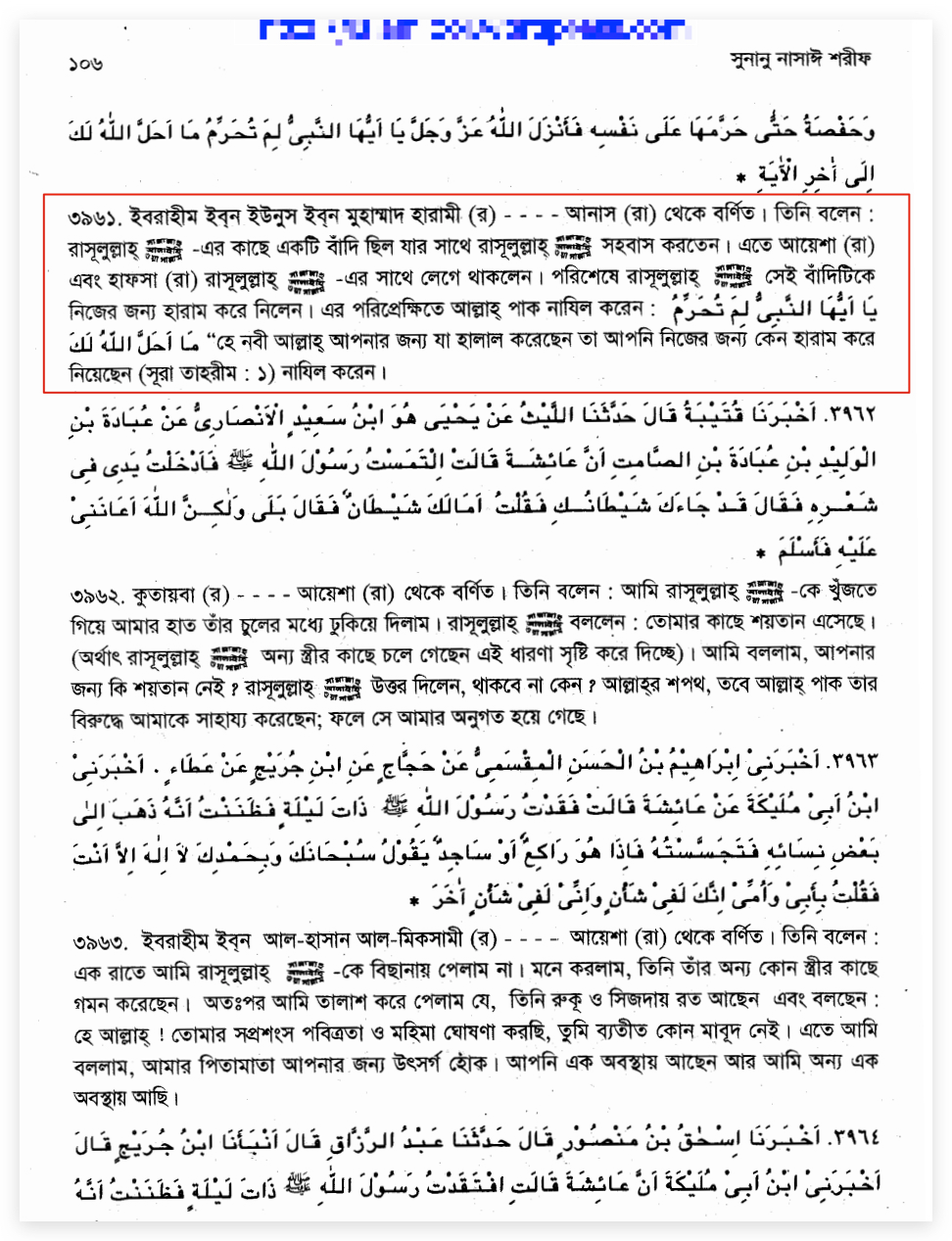
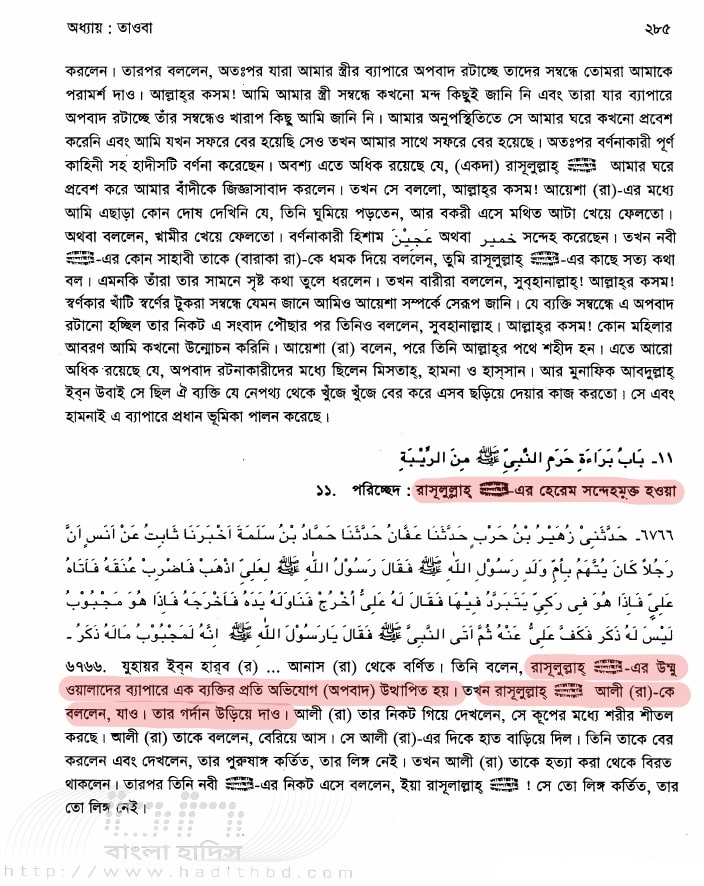
যৌক্তিক ও সংশয়বাদী দৃষ্টিভঙ্গিতে ওপরের বর্ণনাটি অত্যন্ত তাৎপর্যপূর্ণ। এখানে দেখা যাচ্ছে, নবীর স্ত্রীদের মানসিক যন্ত্রণা বা ঈর্ষার কারণে নবী দাসী ভোগ বন্ধ করার অঙ্গীকার করলেও তথাকথিত 'ঐশ্বরিক বাণী'র মাধ্যমে তাঁকে পুনরায় সেই দাসীর সাথে যৌনক্রিয়ায় লিপ্ত হওয়ার আদেশ দেওয়া হচ্ছে (( নবীর স্ত্রীদের তালাকের হুমকির নেপথ্যে )) । এটি নির্দেশ করে যে, তৎকালীন ধর্মতাত্ত্বিক ব্যবস্থায় পুরুষের যৌন ‘অধিকার’ এতটাই নিরঙ্কুশ ছিল যে, নারীদের মানবিক আবেগ বা সম্মতির সেখানে কোনো স্থান ছিল না। এমনকি সহিহ মুসলিমের একটি বর্ণনায় মারিয়া আল-কিবতিয়ার (যিনি নবীর উপহারপ্রাপ্ত দাসী ছিলেন) সাথে সম্পর্কিত একটি ঘটনায় দেখা যায়, একজন মানুষের জীবন বা মরণ নির্ধারিত হচ্ছে স্রেফ যৌন ঈর্ষা বা অপবাদের ওপর ভিত্তি করে, যা আধুনিক বিচারব্যবস্থায় চূড়ান্ত মানবাধিকার লঙ্ঘন ও বর্বরতা হিসেবে গণ্য। (( সহিহ মুসলিম, ইসলামিক ফাউন্ডেশন, খণ্ড ৬, পৃষ্ঠা ২৮৫ ))

সহীহ মুসলিম (ইসলামিক ফাউন্ডেশন)
৫১/ তাওবা
পরিচ্ছেদঃ ১১. রাসুলুল্লাহ (ﷺ) এর হেরেম সন্দেহমুক্ত হওয়া
৬৭৬৬। যুহায়র ইবনু হারব (রহঃ) ... আনাস (রাঃ) থেকে বর্ণিত। তিনি বলেন, রাসুলুল্লাহ সাল্লাল্লাহু আলাইহি ওয়াসাল্লাম এর উম্মে ওয়ালাদের সাথে এক ব্যক্তির প্রতি অভিযোগ (অপবাদ) উত্থাপিত হয়। তখন রাসুলুল্লাহ সাল্লাল্লাহু আলাইহি ওয়াসাল্লাম আলী (রাঃ) কে বললেন, যাও। তার গর্দান উড়িয়ে দাও। আলী (রাঃ) তার নিকট গিয়ে দেখলেন, সে কুপের মধ্যে শরীর শীতল করছে। আলী (রাঃ) তাকে বললেন, বেরিয়ে আস। সে আলী (রাঃ)এর দিকে হাত বাড়িয়ে দিল। তিনি তাকে বের করলেন এবং দেখলেন, তার পূরুষাঙ্গ কর্তিত, তার লিঙ্গ নেই। তখন আলী (রাঃ) তাকে হত্যা করা থেকে বিরত থাকলেন। তারপর তিনি নবী সাল্লাল্লাহু আলাইহি ওয়াসাল্লাম এর নিকট এসে বললেন, ইয়া রাসুলাল্লাহ! সে তো লিঙ্গ কর্তিত তার তো লিঙ্গ নেই।
হাদিসের মানঃ সহিহ (Sahih)
বর্ণনাকারীঃ আনাস ইবনু মালিক (রাঃ)
এই ঐতিহাসিক সূত্রগুলো থেকেই প্রমাণিত হয় যে, মারিয়া আল-কিবতিয়া এবং তাঁর সন্তান ইব্রাহিম ছিলেন একটি দাসত্বমূলক যৌন সম্পর্কের ফলাফল, যেখানে মারিয়াকে নবীর ‘স্ত্রী’র মর্যাদা দেওয়া হয়নি বরং তিনি আমৃত্যু ‘মালিকানাধীন’ এক নারী হিসেবেই জীবন কাটিয়েছেন। যা আধুনিক বিজ্ঞানের নিরিখে মানুষের জৈবিক মর্যাদাকে খাটো করে দেখার একটি প্রকৃষ্ট উদাহরণ। (( সহীহ বুখারী, তাওহীদ পাবলিকেশন্স, হাদিসঃ ১৩৮২ ))

সহীহ বুখারী (তাওহীদ)
২৩/ জানাযা
পরিচ্ছেদঃ ২৩/৯১. মুসলমানদের (অপ্রাপ্ত বয়স্ক) সন্তানদের সম্পর্কে যা বলা হয়েছে।
১৩৮২. বারাআ (রাঃ) হতে বর্ণিত। তিনি বলেন, (নাবী তনয়) ইব্রাহীম (রাঃ)-এর মৃত্যু হলে, আল্লাহর রাসূল সাল্লাল্লাহু আলাইহি ওয়াসাল্লাম বলেছেনঃ তাঁর জন্য তো জান্নাতে একজন দুধ-মা রয়েছেন। (২৩৫৫, ৬১৯০) (আধুনিক প্রকাশনীঃ ১২৯১, ইসলামিক ফাউন্ডেশনঃ ১২৯৯)
হাদিসের মানঃ সহিহ (Sahih)
বর্ণনাকারীঃ বারা'আ ইবনু আযিব (রাঃ)

যুক্তির আলোকে ‘লজ্জাস্থান’ বা প্রাইভেসি রক্ষার বিষয়টি যখন কেবল স্ত্রী এবং দাসীর সামনে উন্মুক্ত রাখার অনুমতি দেওয়া হয়, তখন এটি স্পষ্ট করে দেয় যে দাসী বা ক্রীতদাসীকে একজন স্বাধীন মানুষের মতো সম্মান বা গোপনীয়তার অধিকার দেওয়া হয়নি। এটি একটি গভীর সামাজিক বিভাজন এবং অমানবিকীকরণের বহিঃপ্রকাশ, যেখানে একজন মানুষের শরীরকে স্রেফ মালিকের ভোগের বস্তু হিসেবে সংজ্ঞায়িত করা হয়েছে। (( সূনান আত তিরমিজী (তাহকীককৃত), হাদিসঃ ২৭৬৯ )) -

সূনান আত তিরমিজী (তাহকীককৃত)
৪১/ শিষ্টাচার
পরিচ্ছেদঃ ২২. লজ্জাস্থান হিফাযত করা
২৭৬৯। বাহয ইবনু হাকীম (রহঃ) হতে পর্যায়ক্রমে তার বাবা ও তার দাদার সূত্রে বর্ণিত, তিনি বলেন, আমি প্রশ্ন করলাম, হে আল্লাহর রাসূল! আমাদের লজ্জাস্থান কতটুকু ঢেকে রাখব এবং কতটুকু খোলা রাখতে পারব? তিনি বললেনঃ তোমার স্ত্রী ও দাসী ছাড়া সকলের দৃষ্টি হতে তোমার লজ্জাস্থান হিফাযাত করবে। তিনি আবার প্রশ্ন করলেন, পুরুষেরা একত্রে অবস্থানরত থাকলে? তিনি বললেনঃ যতদূর সম্ভব কেউ যেন তোমার আবরণীয় স্থান দেখতে না পারে তুমি তাই কর। আমি আবার প্রশ্ন করলাম, মানুষ তো কখনো নির্জন অবস্থায়ও থাকে। তিনি বললেনঃ আল্লাহ তা'আলা তো লজ্জার ক্ষেত্রে বেশি হাকদার।
হাসানঃ ইবনু মা-জাহ (১৯২০)
আবূ ঈসা বলেন, এ হাদীসটি হাসান। বাহযের দাদার নাম মুআবিয়াহ ইবনু হাইদাহ আল-কুশাইরী। আল-জুরাইরী হাকীম ইবনু মু'আবিয়ার সূত্রে হাদীসটি বর্ণনা করেছেন। তিনি হলেন বাহযের বাবা।
হাদিসের মানঃ হাসান (Hasan)
বর্ণনাকারীঃ বাহয ইবনু হাকীম (রহঃ)

এমনকি সাহাবীদের বর্ণনায় সধবা (বিবাহিত) নারীদের সাথে সম্পর্ককে হারাম বলা হলেও সেখানেও ‘মালিকানাভুক্ত দাসী’দের জন্য বীভৎস ছাড় দেওয়া হয়েছে। এর অর্থ হলো, যুদ্ধে বিজয়ী হওয়ার পর অন্যের স্ত্রীকে ছিনিয়ে এনে নিজের শয্যাসঙ্গিনী করাকে বিন্দুমাত্র অনৈতিক মনে করা হতো না। এটি আধুনিক জেনেভা কনভেনশন বা যুদ্ধকালীন মানবাধিকারের চরম পরিপন্থী এবং আধুনিক সভ্য মানুষের যুক্তিতে এটি ধর্ষণেরই নামান্তর ((
যুদ্ধে বেসামরিক নারী ও শিশুর ভাগ্যঃ ইসলামে গনিমতের মাল বা লুটপাটের মাল ))। (( সহীহ বুখারী, তাওহীদ পাবলিকেশন, হাদিসঃ ৫১০৫ )) -

সহীহ বুখারী (তাওহীদ পাবলিকেশন)
৬৭/ বিয়ে
পরিচ্ছেদঃ ৬৭/২৫. কোন্ কোন্ মহিলাকে বিয়ে করা হালাল এবং কোন্ কোন্ মহিলাকে বিয়ে করা হারাম।
وَقَوْلِهِ تَعَالَى: (حُرِّمَتْ عَلَيْكُمْ أُمَّهَاتُكُمْ وَبَنَاتُكُمْ وَأَخَوَاتُكُمْ وَعَمَّاتُكُمْ وَخَالاَتُكُمْ وَبَنَاتُ الأَخِ وَبَنَاتُ الأُخْتِ) إِلَى آخِرِ الآيَتَيْنِ إِلَى قَوْلِهِ: (إِنَّ اللَّهَ كَانَ عَلِيمًا حَكِيمًا).
আল্লাহ্ তা‘আলা বলেনঃ ‘‘তোমাদের প্রতি হারাম করা হয়েছে তোমাদের মা এবং মেয়ে, বোন, ফুফু, খালা, ভাইঝি, ভাগিনী, দুধ মা, দুধ বোন, শ্বাশুড়ী, তোমাদের স্ত্রীদের মধ্যে যার সাথে সঙ্গত হয়েছ তার পূর্ব স্বামীর ঔরসজাত মেয়ে যারা তোমাদের তত্ত্বাবধানে আছে- নিশ্চয় আল্লাহ সবিশেষ পরিজ্ঞাত ও পরম কুশলী।’’(সূরাহ আন্-নিসা ৪/২৩-২৪)
وَقَالَ أَنَسٌ: (وَالْمُحْصَنَاتُ مِنَ النِّسَاءِ) ذَوَاتُ الأَزْوَاجِ الْحَرَائِرُ حَرَامٌ إِلاَّ مَا مَلَكَتْ أَيْمَانُكُمْ لاَ يَرَى بَأْسًا أَنْ يَنْزِعَ الرَّجُلُ جَارِيَتَهُ مِنْ عَبْدِهِ.
وَقَالَ: (وَلاَ تَنْكِحُوا الْمُشْرِكَاتِ حَتَّى يُؤْمِنَّ).
وَقَالَ ابْنُ عَبَّاسٍ مَا زَادَ عَلَى أَرْبَعٍ فَهْوَ حَرَامٌ، كَأُمِّهِ وَابْنَتِهِ وَأُخْتِهِ.
আনাস (রাঃ) বলেন, (وَالْمُحْصَنَاتُ مِنَ النِّسَاءِ) এ কথা দ্বারা সধবা স্বাধীনা মহিলাদেরকে বিয়ে করা হারাম বোঝানো হয়েছে; কিন্তু ক্রীতদাসীকে ব্যবহার করা হারাম নয়। যদি কোন ব্যক্তি বাঁদীকে তার স্বামী থেকে তালাক নিয়ে পরে ব্যবহার করে, তাহলে দোষ নেই। এ প্রসঙ্গে আল্লাহর বাণীঃ ‘‘মুশরিকা নারীরা ঈমান না আনা পর্যন্ত তোমরা তাদেরকে বিয়ে করো না।’’(আল-বাক্বারাহঃ ২২১) ইবনু ‘আব্বাস (রাঃ) বলেন, চারজনের অধিক বিয়ে করা ঐরূপ হারাম বা অবৈধ যেরূপ তার গর্ভধারিণী মা, কন্যা এবং ভগিনীকে বিয়ে করা হারাম।
৫১০৫. ইবনু ‘আব্বাস (রাঃ) হতে বর্ণিত। তিনি বলেন, রক্তের সম্পর্কের সাতজন ও বৈবাহিক সম্পর্কের সাতজন নারীকে বিয়ে করা হারাম। এরপর তিনি এ আয়াত পাঠ করলেনঃ ‘‘তোমাদের জন্যে তোমাদের মায়েদের বিয়ে করা হারাম করা হয়েছে।’’ (সূরাহ আন-নিসাঃ ২৪)
‘আবদুল্লাহ্ ইবনু জা‘ফর (রহ.) একসঙ্গে ‘আলী (রাঃ)-এর স্ত্রী[1]ও কন্যাকে বিয়ে বন্ধনে আবদ্ধ করেন (তারা উভয়েই সৎ-মা ও সৎ-কন্যা ছিল) ইবনু শিরীন বলেন, এতে দোষের কিছুই নেই। কিন্তু হাসান বসরী (রহ.) প্রথমত এ মত পছন্দ করেননি; কিন্তু পরে বলেন, এতে দোষের কিছুই নেই। কিন্তু হাসান ইবনুহাসান ইবনু ‘আলী একই রাতে দুই চাচাত বোনকে একই সঙ্গে বিয়ে করেন। জাবির ইবনু যায়দ সম্পর্কচ্ছেদের আশংকায় এটি মাকরূহ মনে করেছেন; কিন্তু এটি হারাম নয়। যেমন আল্লাহ্ তা‘আলা বলেন, ‘‘এসব ছাড়া আর যত মেয়ে লোক রয়েছে তা তোমাদের জন্য হালাল করে দেয়া হয়েছে।’’ (আন-নিসাঃ ২৪) ইবনু ‘আব্বাস (রাঃ) বলেন, যদি কেউ তার শালীর সঙ্গে অবৈধ যৌন মিলন করে তবে তার স্ত্রী তার জন্য হারাম হয়ে যায় না।
শা’বী এবং আবূ জা‘ফর বলেন,যদি কেউ কোন বালকের সঙ্গে সমকামে লিপ্ত হয়, তবে তার মা তার জন্য বিয়ে করা হারাম হয়ে যাবে। ইকরামাহ (রাঃ)...ইবনু ‘আব্বাস (রাঃ) হতে বর্ণিত। তিনি বলেন, কেউ যদি শাশুড়ির সঙ্গে যৌন মিলনে লিপ্ত হয়, তবে তার স্ত্রী হারাম হয় না। আবূ নাসর ইবনু ‘আব্বাস (রাঃ) থেকে বর্ণনা করেন যে, হারাম হয়ে যাবে। ‘ইমরান ইবনু হুসায়ন (রাঃ) জাবির ইবনু যায়দ (রাঃ) আল হাসান (রহ.) এবং কতিপয় ইরাকবাসী থেকে বর্ণনা করেন যে, তার স্ত্রীর সঙ্গে বিয়ের সম্পর্ক হারাম হয়ে যাবে। উপরোক্ত ব্যাপারে আবূ হুরাইরাহ (রাঃ) বলেছেন যে, স্ত্রীর সঙ্গে বিয়ের সম্পর্ক ততক্ষণ হারাম হয় না, যতক্ষণ না কেউ তার শাশুড়ির সঙ্গে অবৈধ যৌন মিলনে লিপ্ত হয়। ইবনু মুসাইয়িব, ‘উরওয়াহ (রাঃ) এবং যুহরী এমতাবস্থায় স্ত্রীর সঙ্গে সম্পর্ক রাখা বৈধ বলেছেন। যুহরী বলেন, ‘আলী (রাঃ) বলেছেন, হারাম হয় না। ওখানে যুহরীর কথা মুরসাল অর্থাৎ একথা যুহুরী ‘আলী (রাঃ) থেকে শোনেননি। (আধুনিক প্রকাশনী- অনুচ্ছেদ, ইসলামিক ফাউন্ডেশন- অনুচ্ছেদ)
[1] ফাতিমাহ (রাঃ)-এর জীবদ্দশায় ‘আলী (রাঃ) কাউকে বিয়ে করেননি। পরে তিনি বিয়ে করেন।
হাদিসের মানঃ সহিহ (Sahih)
বর্ণনাকারীঃ আবদুল্লাহ ইবনু আব্বাস (রাঃ)

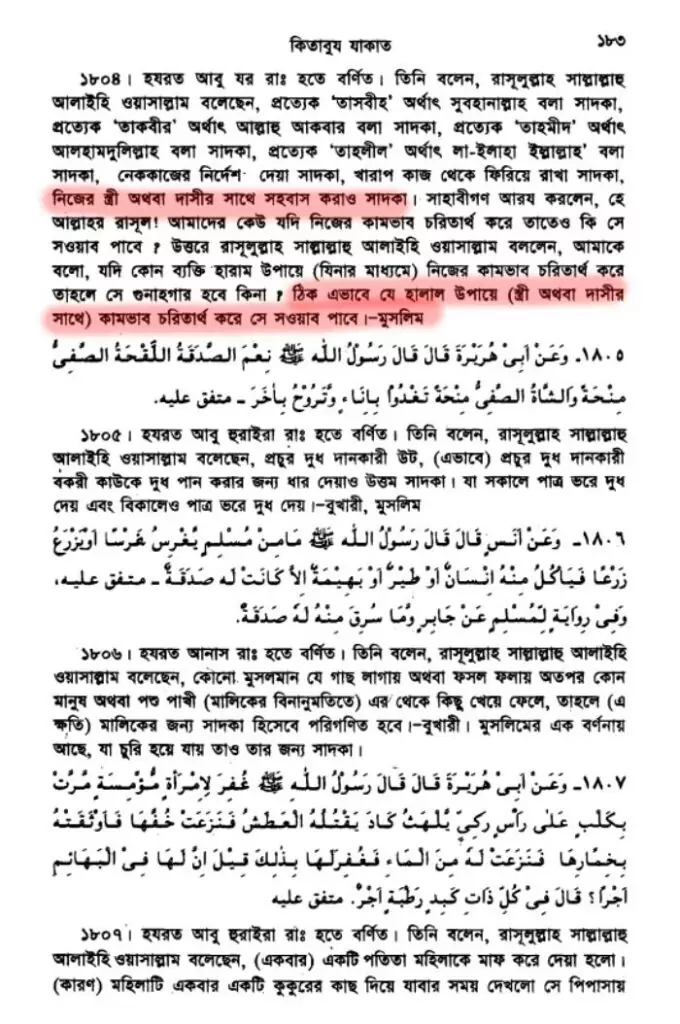
সবচেয়ে ভয়াবহ মানবিক অবক্ষয় পরিলক্ষিত হয় যখন দাসীর সাথে যৌন সম্পর্ক স্থাপনকে স্রেফ একটি শারীরিক প্রবৃত্তি নয়, বরং ‘সদাকাহ’ বা পুণ্যের কাজ হিসেবে মহিমান্বিত করা হয়। যখন কোনো শোষক তার শোষিতের (দাসীর) শরীর ভোগ করাকে ঈশ্বরের সন্তুষ্টির উপায় হিসেবে দেখে, তখন সেই ধর্মতাত্ত্বিক কাঠামোর নৈতিক ভিত্তি ধসে পড়ে। এটি জবরদস্তিমূলক যৌনতাকে একটি ধর্মীয় পবিত্রতা দান করে, যা আধুনিক মনোবিজ্ঞানের দৃষ্টিতে দাসের ওপর মালিকের একতরফা মানসিক ও শারীরিক নিপীড়ন এবং একবিংশ শতাব্দীর নৈতিকতার মাপকাঠিতে এটি চূড়ান্ত অসভ্যতা। (( মিশকাতুল মাসাবীহ (মিশকাত), হাদিসঃ ১৮৯৮ )) (( মিশকাতুল মাসাবীহ (মিশকাত), আধুনিক প্রকাশনী, তৃতীয় খণ্ড, পৃষ্ঠা ১৮৩ )) -

মিশকাতুল মাসাবীহ (মিশকাত)
পর্ব-৬: যাকাত
পরিচ্ছেদঃ ৬. প্রথম অনুচ্ছেদ - সদাক্বার মর্যাদা
১৮৯৮-[১১] আবূ যার (রাঃ) হতে বর্ণিত। তিনি বলেন, রসূলুল্লাহ সাল্লাল্লাহু আলাইহি ওয়াসাল্লাম বলেছেনঃ প্রত্যেক ‘তাসবীহ’ অর্থাৎ সুবহা-নাল্ল-হ বলা সদাক্বাহ্ (সাদাকা), প্রত্যেক ‘তাকবীর’ অর্থাৎ আল্ল-হু আকবার বলা সদাক্বাহ্ (সাদাকা), প্রত্যেক ‘তাহমীদ’ বা আলহাম্‌দুলিল্লা-হ বলা সদাক্বাহ্ (সাদাকা)। প্রত্যেক ‘তাহলীল’ বা ‘লা- ইলা-হা ইল্লাল্ল-হ’ বলা সদাক্বাহ্ (সাদাকা)। নেককাজের নির্দেশ দেয়া, খারাপ কাজ থেকে ফিরিয়ে রাখা সদাক্বাহ্ (সাদাকা)। নিজের স্ত্রী অথবা দাসীর সাথে সহবাস করাও সদাক্বাহ্ (সাদাকা)। সাহাবীগণ আরয করলেন, হে আল্লাহর রসূল! আমাদের কেউ যদি নিজের কামভাব চরিতার্থ করে তাতেও কি সে সাওয়াব পাবে? উত্তরে রসূলুল্লাহ সাল্লাল্লাহু আলাইহি ওয়াসাল্লাম বললেনঃ আমাকে বলো, কোন ব্যক্তি যদি হারাম উপায়ে কামভাব চরিতার্থ করে তাহলে সেকি গুনাহগার হবে না? ঠিক এভাবেই হালাল উপায়ে (স্ত্রী অথবা দাসীর সাথে) কামভাব চরিতার্থকারী সাওয়াব পাবে। (মুসলিম)[1]
[1] সহীহ : মুসলিম ১০০৬, আহমাদ ২১৪৮২, সুনানুল কুবরা লিল বায়হাক্বী ৭৮২৩, সিলসিলাহ্ আস্ সহীহাহ্ ৪৫৪, সহীহ আত্ তারগীব ১৫৫৬, সহীহ আল জামি‘ আস্ সগীর ২৫৮৮।
হাদিসের মানঃ সহিহ (Sahih)

তাফসীর গ্রন্থে দাসীভোগঃ যৌন দাসত্বের প্রাতিষ্ঠানিক রূপ

ইসলামী আইনের প্রয়োগ ও ব্যখ্যা বোঝার জন্য তাফসীর গ্রন্থসমূহ অত্যন্ত গুরুত্বপূর্ণ। কোরআনের অস্পষ্ট আয়াতগুলোকে এই তাফসীরকারকগণ যেভাবে ব্যাখ্যা করেছেন, তা থেকে স্পষ্ট হয় যে মধ্যযুগীয় ইসলামী চিন্তাধারায় নারীর শরীরকে স্রেফ একটি রাজনৈতিক ও সামরিক পণ্য হিসেবে বিবেচনা করা হতো। আধুনিক ‘জেনেভা কনভেনশন’ যেখানে যুদ্ধবন্দীদের মানবিক মর্যাদা এবং যৌন সহিংসতা থেকে সুরক্ষার নিশ্চয়তা দেয়, সেখানে ধ্রুপদী তাফসীরগুলো যুদ্ধবন্দী নারীদের ধর্ষণকে (যাকে তারা 'সহবাস' বলে সংজ্ঞায়িত করে) একটি বৈধ অধিকার হিসেবে প্রতিষ্ঠিত করেছে।


ইবনে কাসীরের তাফসীরঃ মালিকানা বনাম অধিকার

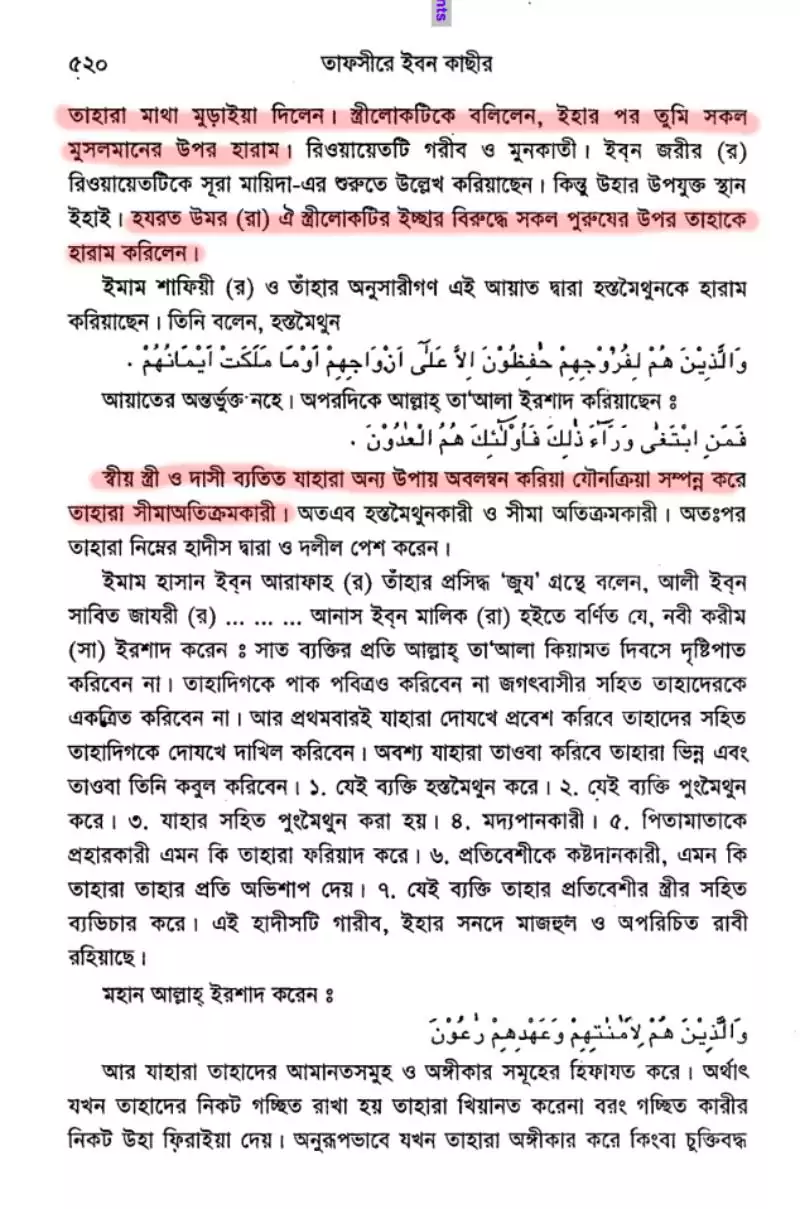
প্রখ্যাত তাফসীরকারক ইবনে কাসীর সূরা মুমিনুনের ৫-৬ নম্বর আয়াতের ব্যাখ্যায় যা বলেছেন, তা আধুনিক নৈতিকতার মাপকাঠিতে চরম অমানবিক। তাঁর ব্যাখ্যা অনুযায়ী, মুমিন পুরুষদের জন্য তাদের লালসা মেটানোর ক্ষেত্রে স্ত্রী এবং দাসীর মধ্যে কোনো পার্থক্য নেই। যুক্তিবাদী বিশ্লেষণে এটি স্পষ্ট যে, এখানে ‘মালিকানা’ বা ‘ডান হাতের অধিকার’ বলতে এমন এক ক্ষমতা কাঠামোকে বোঝানো হয়েছে যেখানে একজন মানুষের ইচ্ছা বা অনিচ্ছার কোনো মূল্য নেই। একজন মানুষকে স্রেফ কেনা বা জয় করার মাধ্যমেই তার গোপনাঙ্গের মালিক হয়ে যাওয়া কোনো ‘ঐশ্বরিক ন্যায়বিচার’ হতে পারে না, বরং এটি আদিম লুণ্ঠন সংস্কৃতিরই প্রতিফলন। (( তাফসীরে ইবনে কাসীর, ইসলামিক ফাউন্ডেশন, সপ্তম খণ্ড, পৃষ্ঠা ৫১৪, ৫১৯, ৫২০ )) -
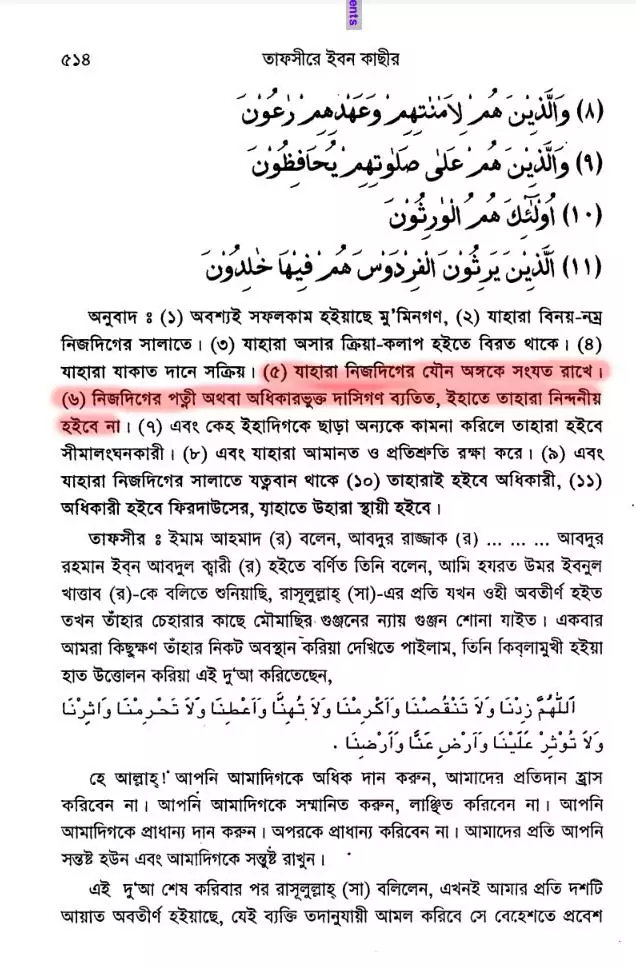
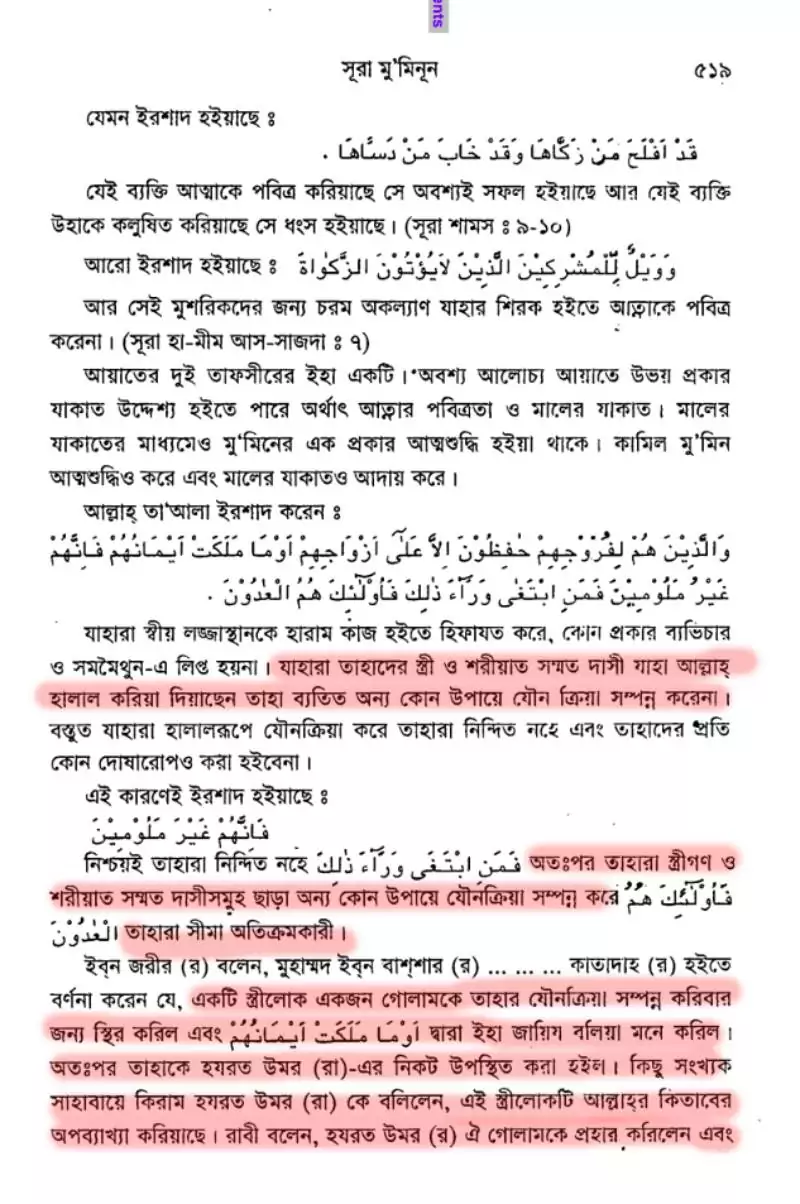
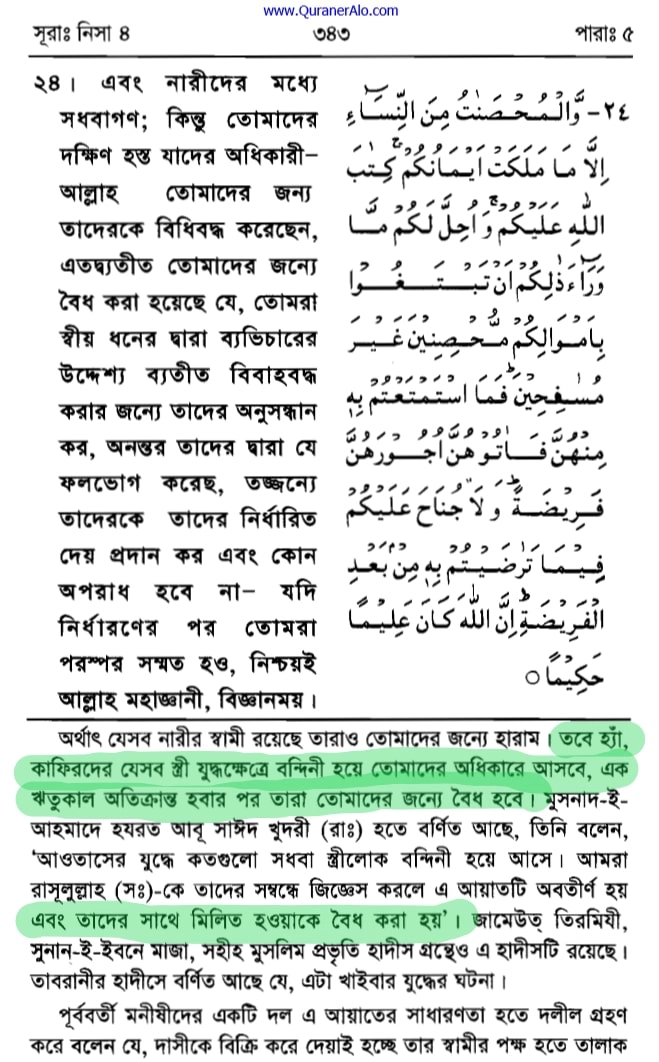
একইভাবে সূরা নিসার ২৪ নম্বর আয়াতের তাফসীরে ইবনে কাসীর যা বর্ণনা করেছেন, তা আরও ভয়াবহ। সেখানে স্পষ্টভাবে বলা হয়েছে যে, যুদ্ধবন্দী নারীরা যদি বিবাহিতও হয়, তবুও তারা তাদের নতুন মুসলিম মালিকদের জন্য ‘হালাল’ বা ভোগযোগ্য। এই বিধানটি বৈবাহিক সম্পর্কের পবিত্রতা এবং নারীর সম্মতির ওপর এক চরম কুঠারাঘাত। আধুনিক আইনে একে ‘যুদ্ধাপরাধ’ (War Crime) হিসেবে গণ্য করা হয়, কিন্তু তাফসীরে একে সওয়াবের কাজ হিসেবে দেখানো হয়েছে। (( তাফসীর ইবনে কাসীর, তাফসীর পাবলিকেশন্স কমিটি, খণ্ড ৪,৫,৬,৭, পৃষ্ঠা নম্বরঃ ৩৪৩ )) -

তাফসীরে জালালাইনঃ অমানবিকতার চূড়ান্ত দলিল

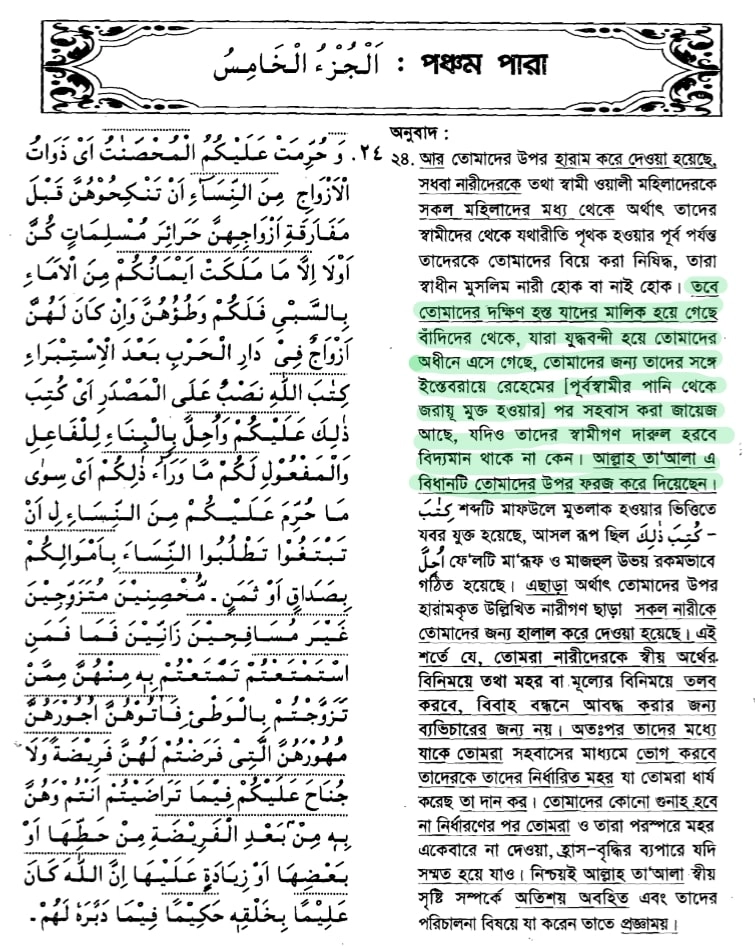
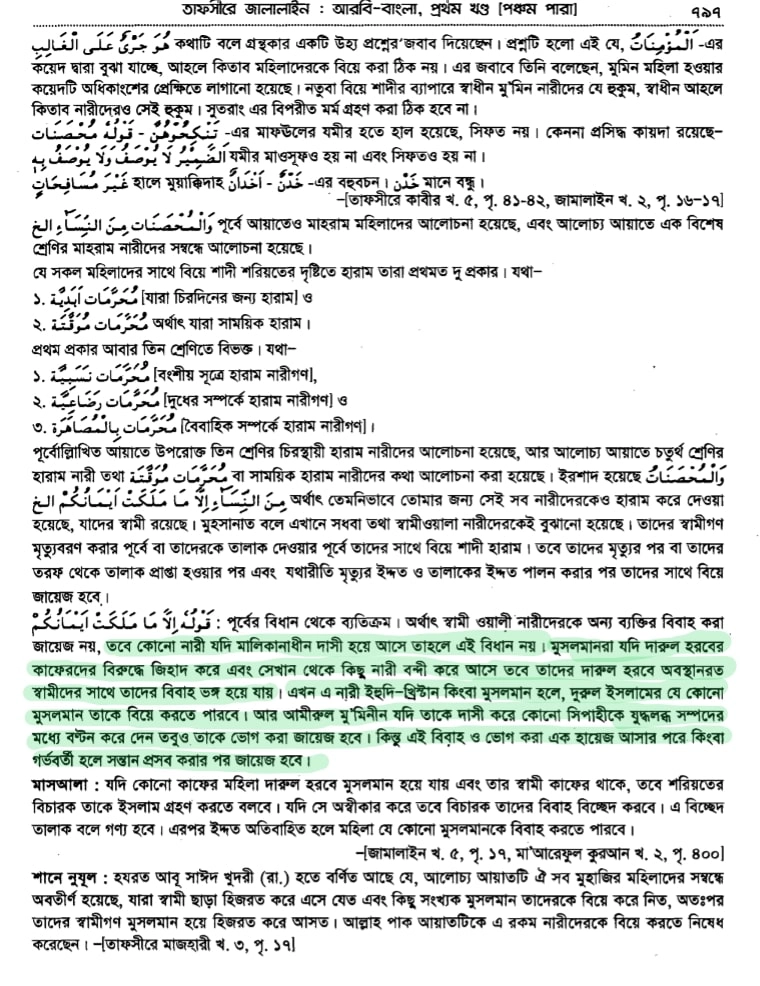
‘দক্ষিণহস্ত’ বা ‘মালিকানাভুক্ত’ শব্দবন্ধটির আড়ালে লুকিয়ে থাকা চরম নিষ্ঠুরতা উন্মোচিত হয় তাফসীরে জালালাইনে। জালালুদ্দীন সুয়ূতি এবং জালালুদ্দীন মহল্লী অত্যন্ত নির্লজ্জভাবে ব্যাখ্যা করেছেন যে, অমুসলিম দেশ বা ‘দারুল হরব’-এ কোনো নারীর স্বামী জীবিত থাকলেও, সেই নারী যদি যুদ্ধে ধরা পড়ে তবে তাকে ভোগ করা বৈধ। এটি একটি পদ্ধতিগত গণধর্ষণের আইনি কাঠামো ছাড়া আর কিছুই নয়।

মানবাধিকারেরদৃষ্টিভঙ্গিতে, এই আয়াত ও তাফসীরগুলো কোনো শাশ্বত মানবিক বাণী নয়। বরং এগুলো প্রমাণ করে যে কোরআন একটি নির্দিষ্ট সময়ের (সপ্তম শতাব্দী) এবং নির্দিষ্ট ভৌগোলিক অঞ্চলের যুদ্ধ-সংস্কৃতি দ্বারা গভীরভাবে প্রভাবিত। আধুনিক যুগে যখন এই আয়াতগুলোকে ‘অপরিবর্তনশীল’ বলে দাবি করা হয়, তখন তা সরাসরি বর্তমান বিশ্বের মানবাধিকার ও মানবিক মর্যাদার ভিত্তিকে হুমকির মুখে ফেলে দেয়। যদি কোরআন কেয়ামত পর্যন্ত অপরিবর্তনীয় হয়, তবে তাফসীরকারকদের এই ভয়ঙ্কর ব্যাখ্যাগুলো আধুনিক মুসলিম সমাজের জন্য এক চরম নৈতিক দেউলিয়াত্ব হিসেবেই বিবেচিত হবে।(( তাফসীরে জালালাইন, ইসলামিয়া কুতুবখানা প্রকাশনী, প্রথম খণ্ড, পৃষ্ঠা নম্বর ৭৯৫, ৭৯৭ )) -
তাফসীরে মাযহারীঃ লুণ্ঠনের ধর্মীয় বৈধতা

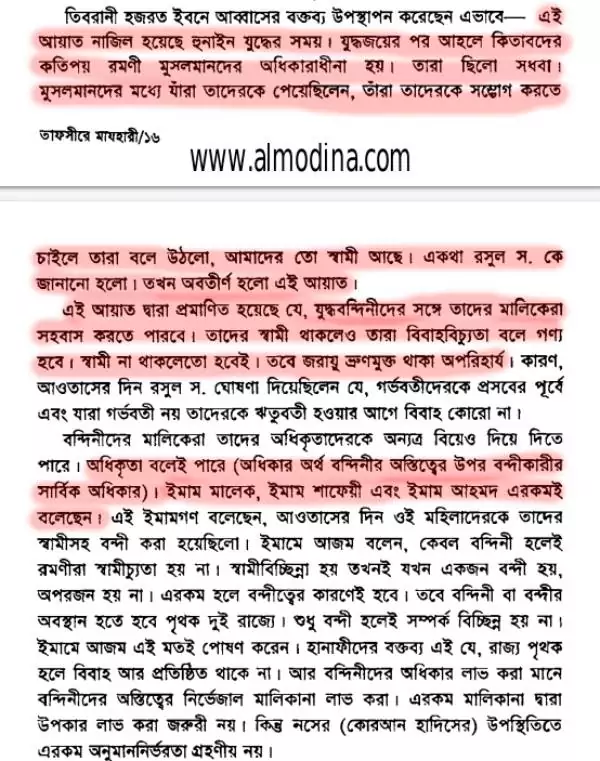
তাফসীরে মাযহারীতেও একই অসভ্য প্রথার পুনরাবৃত্তি করা হয়েছে। সেখানেও যুদ্ধবন্দী সধবা নারীদের ওপর যৌন আধিপত্যকে জায়েজ করা হয়েছে। এই ধরনের টেক্সটগুলো প্রমাণ করে যে, তৎকালীন ধর্মতাত্ত্বিকরা নারীর শরীরকে যুদ্ধের লুঠতরাজ বা 'গনিমতের মাল' হিসেবে বণ্টন করার বিষয়টিকে একটি ঐশ্বরিক মহিমা দান করেছিলেন। আধুনিক মনস্তত্ত্বের আলোকে, এই ধরনের বিধানগুলো বিজয়ী সৈন্যদের লালসা চরিতার্থ করার একটি নিষ্ঠুর হাতিয়ার ছাড়া আর কিছুই নয়। (( তাফসীরে মাযহারী, ৩য় খণ্ড, পৃষ্ঠা ১৬-১৭ )) -

উপসংহারঃ নৈতিক দেউলিয়াত্ব বনাম আধুনিক মানবিকতা

উপরের দালিলিক তথ্য ও ঐতিহাসিক বিবরণ বিশ্লেষণ করলে এটি দিবালোকের মতো স্পষ্ট হয়ে ওঠে যে, ইসলামী শাসন ব্যবস্থায় ‘দাসী’র শরীর ভোগ করা কেবল একটি সাধারণ প্রথা ছিল না, বরং এটি ছিল আইনিভাবে অনুমোদিত একটি পদ্ধতিগত যৌন দাসত্ব (Sexual Slavery)। নবী মুহাম্মদ এবং তার অনুসারীগণ যে কেবল এই প্রথা চালু রেখেছিলেন তা-ই নয়, বরং একে ‘হালাল’ এবং ‘সওয়াবের কাজ’ হিসেবে চিহ্নিত করে ধর্মীয়ভাবে প্রাতিষ্ঠানিক রূপ দিয়েছিলেন। শুধু যে যুদ্ধবন্দী নারীদের যৌন দাসত্বের শৃঙ্খলে আবদ্ধ করা এবং তাদের ধর্ষণ করাই ইসলামে বৈধতা দেয়া হয়েছে তাই নয়, তাদের বাজারে গরু ছাগলের মত উঠিয়ে বিক্রি করাকেও ইসলামি শরিয়ত বৈধতা দিয়েছে (( মানবিকতার কফিনে শেষ পেরেকঃ ইসলামের দাসীবাজার ও নারীর শরীরের উন্মুক্ত নিলাম ))। আধুনিক যুক্তিবাদ ও মানবাধিকারের দৃষ্টিভঙ্গিতে এই ব্যবস্থার অমানবিক দিকগুলো আধুনিক সভ্যতার ভিত্তিকে সরাসরি চ্যালেঞ্জ করে।

আধুনিক নৈতিকতায় ‘সম্মতি’ (Consent) হচ্ছে যেকোনো শারীরিক সম্পর্কের মূল ভিত্তি। অথচ ইসলামী শরিয়াহর অধীনে একজন দাসী তাঁর শরীরের ওপর কোনো অধিকার রাখে না; মালিকের অধিকার সেখানে ‘পণ্য’ বা ‘সম্পত্তি’র মতো নিরঙ্কুশ। ইচ্ছার বিরুদ্ধে কাউকে যৌনকর্মে বাধ্য করা আধুনিক সংজ্ঞানুযায়ী ধর্ষণ, যাকে ইসলামে ধর্মের মোড়কে আইনি বৈধতা দেওয়া হয়েছে (( ইসলামে দাসী-ধর্ষণঃ দাসী সহবাসে কি সম্মতি জরুরি? ))। যুদ্ধবন্দী নারীদের ‘গনিমতের মাল’ হিসেবে গণ্য করা এবং তাঁদের স্বামী জীবিত থাকা সত্ত্বেও তাঁদেরকে নতুন মালিকের শয্যাসঙ্গিনী করা মানুষের আত্মমর্যাদার ওপর এক চরম কুঠারাঘাত। এটি সরাসরি জাতিসংঘের মানবাধিকার সনদ এবং নারীর প্রতি সকল প্রকার বৈষম্য বিলোপ সনদের (CEDAW) সাথে সম্পূর্ণ সাংঘর্ষিক (( ইসলাম অনুসারে ক্রীতদাসীর সতর বা পর্দা নাভী থেকে হাঁটু পর্যন্ত ))।

ইসলামকে যখন একটি ‘অপরিবর্তনশীল’ এবং ‘শাশ্বত’ মতাদর্শ হিসেবে দাবি করা হয়, তখন এই মধ্যযুগীয় বর্বরতাগুলোও বর্তমান যুগের জন্য বৈধ বলে বিবেচিত হওয়ার ঝুঁকি তৈরি হয়। এই ধরনের টেক্সটগুলোকে ‘ঐশ্বরিক’ হিসেবে মেনে নেওয়া মানেই হলো আধুনিক সভ্যতার নৈতিক অগ্রগতিকে অস্বীকার করা। যুক্তিবাদী বিশ্লেষণে এটি স্পষ্ট যে, ইসলামী দাসী প্রথা ও তাঁদের সাথে যৌন সম্পর্কের বিধানগুলো কোনো ঐশ্বরিক ন্যায়বিচার নয়, বরং এগুলো সপ্তম শতাব্দীর অন্ধকার ও পুরুষতান্ত্রিক গোত্রীয় কালচারেরই চূড়ান্ত বহিঃপ্রকাশ। বিজ্ঞান, যুক্তি এবং আধুনিক মানবাধিকারের আলোকে এই প্রথাগুলো কেবল অসভ্য বা বর্বর নয়, বরং আধুনিক নৈতিকতার বিচারে এটি একটি বিশাল অন্ধকার অধ্যায়। মানবিক মর্যাদা সমুন্নত রাখার স্বার্থে এই ধরনের মধ্যযুগীয় ধ্যান-ধারণাগুলোকে সরাসরি প্রত্যাখ্যান করা ও বর্জন করাই উন্নত ও সভ্য সমাজের একমাত্র পথ।

Sex with Slave Girls in Islam: Dissecting 'Ma Malakat Aymanukum' and Sexual Slavery

In Islam's holy scripture the Quran and in the books of hadith, sexual relations with an owned or possessed slave girl have been clearly made halal. Buying and selling slaves, taking captive women of war as slave girls - all of this is completely halal in the eyes of Islam.

Introduction

The legal permission granted in the traditional framework of Islamic theology for establishing sexual relations with "owned" or "possessed" slave girls is, by the definition of modern human rights and bodily autonomy, directly and with total clarity counted as "sexual slavery" and "systematic rape". In the various verses of the Quran, the fundamental source of Islam, sexual relations with war captives or purchased women alongside free wives have not only been morally sanctioned, but have also been declared a right granted by Allah, a "halal" act, and a work and system of earning "sawab" or reward. (( Surah Al-Mu'minun verses 5-6 )) (( Surah Al-Ma'arij verses 29-30 )) (( Surah Al-Ahzab, verse 50 )) (( Surah An-Nisa, verse 24 )). These verses are founded upon an inhuman philosophy of ownership, in which one person's absolute dominion over another person's body is glorified within a "sacred" legal framework. Analysing the translations of quran.com (( quran.com )), the hadiths, the seerah, the fiqh and the classical books of tafsir makes it clear that these rulings were introduced precisely to give religious legitimacy to the tribal warfare and plunder of that era. From a rationalist viewpoint, no eternal morality can turn human dignity into a commodity; rather, these texts are plainly a reflection of the patriarchal and brutal slave culture of the seventh century.


The Statements of the Scholars About Intercourse with a Slave Girl

When modern Islamic da'is and scholars explain the matter of "enjoying" the captive women of seventh-century warfare, they often launch a strange attempt to justify it as the "reality" of that time or as "rescuing helpless women". But by the measure of reason and global human rights, these arguments are completely hollow and self-contradictory. To regard a captive woman as "ghanimah property" or the loot of war is not merely moral decay; it is a historical manifestation of institutionalising non-consensual sexual oppression. In no healthy, reason-based social framework can one person's body be defined as a "reward" for another. Let us learn from the sermons below what "arguments" the so-called scholars put forward behind this primitive ruling of "enjoying" kafir women. First, let us hear a sermon about how this systematic rape of kafir women is in fact their punishment for kufr,

0:00
–:––

Now let us analyse some statements of Ahmadullah and other scholars, in which, on the pretext of prohibiting free mixing of men and women, they declare human love and romantic relationships to be completely haram, while at the same time regarding the enjoyment of a sex slave as the supreme moral ruling granted by Allah. They try to justify such a slave system as a "system", which is in reality nothing but another name for erasing the human identity of woman:

https://youtu.be/_91dFHdPMbk

0:00
–:––

0:00
–:––

0:00
–:––

0:00
–:––

0:00
–:––

0:00
–:––

Transacting a human being as a "gift" is a punishable crime in modern morality. Yet in Islamic history we see that the Prophet Muhammad himself accepted women or slave girls as gifts, and sexual intercourse with them was considered lawful, which is equally applicable in Islamic Sharia even today. Listening to the account of Maria al-Qibtiyya in Mizanur Rahman Azhari's speech, one understands how a human life was transferred like a mere inanimate object:

0:00
–:––

How terrifying a form this mediaeval outlook can still take is understood when a modern Pakistani Muslim imagines "booking" foreign women as "ghanimah property" in the context of war. This proves that these religious teachings still sustain gendered violence and inhuman lust in the human subconscious:

0:00
–:––

What the Quran Says - Intercourse with a Slave Girl

In various verses of the Quran, two specific sources have been mentioned for satisfying men's sexual lust: first, the lawfully married wife; second, the "possessed slave girl" (ma malakat aymanukum) acquired through war or purchase. What modern morality calls "sexual slavery" (Sexual Slavery), the Quran has not only made lawful, but has presented as a completely normal social system. Analysing these verses shows that in the so-called divine ruling, the primary criterion of the sexual relationship was not woman's "consent" (Consent), but man's "ownership". From a rationalist viewpoint it is clear that these rulings are not part of any eternal morality, but merely a tool for perpetuating the seventh-century tribal war economy and patriarchal consumerism.


Surah Al-Mu'minun, Verses 5-6

In these verses, "guarding the private parts" has been mentioned as a condition of the believers' success. However, the amusing thing is that slave girls have been completely excluded from this obligation of guarding. That is, believing men can have sexual relations with as many slave girls as they wish besides their wives, and for this they will not be condemned in the slightest by society or God. This proves that slave girls or captive women were regarded not as complete human beings, but merely as "sexual property".

Who guard their private parts.
Tafsirul Quran
And those who restrain their private parts
Sheikh Mujibur Rahman
And those who guard their own private parts.
Rawai Al-bayan
And those who keep their private parts preserved (1),
Dr. Abu Bakr Muhammad Zakaria

Except from their wives and the slave girls whom they own, for in that case they are free from blame.
Tafsirul Quran
Except from their wives or the slave girls under their possession; in this they will not be blameworthy.
Sheikh Mujibur Rahman
Except their wives and those whom their right hands possess, for indeed in that they will not be blamed.
Rawai Al-bayan
Except their wives or the slave girls under their possession; in this they will not be blamed (1),
Dr. Abu Bakr Muhammad Zakaria

Surah Al-Ma'arij, Verses 29-30

In these verses too, "guarding the private parts" has been mentioned as a condition of the believers' success. However, the noteworthy point is that slave girls have been completely excluded from this obligation of guarding the private parts. That is, believing men can have sexual relations with as many slave girls as they wish besides their wives, and for this they will not be condemned in the slightest by society or God. This proves that slave girls or captive women were regarded not as complete human beings, but merely as "sexual property".

Who guard their private parts
Tafsirul Quran
And those who restrain their private parts.
Sheikh Mujibur Rahman
And those who guard their private parts.
Rawai Al-bayan
And those who guard their private parts (1),
Dr. Abu Bakr Muhammad Zakaria

Except their wives or the slave girls under their possession apart from, because in that they will not be reproached,
Tafsirul Quran
Except their wives or the slave girls under their possession – except in this case, they will not be blameworthy –
Sheikh Mujibur Rahman
Except their wives and the slave girls whom their right hands own apart from. Then in that case they will not be blameworthy.
Rawai Al-bayan
Except their wives or the slave girls under their possession apart from, in this they will not be blamed—
Dr. Abu Bakr Muhammad Zakaria

Surah Al-Ahzab, Verse 50

In this verse, a list of special sexual privileges has been given for the Prophet himself. Here, "fay'" or kafir women acquired without battle have been made "halal" for the Prophet. A captive woman, whose tribe and family may have been killed in war, whose home has been destroyed – instead of showing her compassion, allocating her body for the victor is the ultimate form of primitive barbarism. In the light of modern human rights, this is counted as a "war crime".

O Prophet (peace be upon him)! I have made lawful for you your wives to whom you have paid the dower; and made lawful for you those who have come under your ownership from what Allah has given you as fay' (acquired without battle), and the daughters of your paternal uncles and paternal aunts, the daughters of your maternal uncles and maternal aunts who migrated with you. And if any believing woman offers herself to the Prophet and the Prophet wishes to marry her, that too is lawful – this is especially for you, excluding the believers, so that you have no difficulty. I know what I have ordained for the believers concerning their wives and slave girls. Allah is Oft-Forgiving, Most Merciful.
Tafsirul Quran
O Prophet! I have made lawful for you your wives to whom you have paid the dower and made lawful for you those who have come under your ownership from what Allah has given you as 'fay'' and made lawful for marriage the daughters of your paternal uncles and paternal aunts, maternal uncles and maternal aunts who have left the country with you, and if any believing woman offers herself to the Prophet and the Prophet wishes to marry her, she too is lawful. This is especially for you, not for the other believers; so that you have no difficulty. I know what I have ordained for the believers concerning their wives and the slave girls under their ownership. Allah is Forgiving, Most Merciful.
Sheikh Mujibur Rahman
O Prophet, I have made lawful for you your wives to whom you have given the dower, and I have made lawful for you those among what Allah has given you as fay'* who have come under your ownership and (made lawful for marriage) the daughters of your paternal uncles, paternal aunts, maternal uncles, maternal aunts who migrated with you, and if any believing woman dedicates herself** to the Prophet and the Prophet wishes to marry her, she is also lawful for him. This is especially for you, not for the other believers; I certainly know what I have ordained for them concerning their wives and those whom their right hands own; so that you have no difficulty. Allah is Forgiving, Most Merciful. * 'Fay'' is the wealth of the kafirs acquired without battle.
Rawai Al-bayan
O Prophet! We have made lawful for you your wives, to whom you have given the dower, and made lawful for you those who have come under your ownership from among those whom Allah has given you as fay'. And made lawful for marriage the daughters of your paternal uncles and paternal aunts, maternal uncles and maternal aunts who migrated with you, and (made lawful) such a believing woman who dedicates herself to the Prophet, if the Prophet wishes to marry her--- this is especially for you, not for the other believers; so that you have no difficulty. We certainly know what We have ordained for the believers concerning their wives and the slave girls under their ownership (1). And Allah is Forgiving, Most Merciful.
Dr. Abu Bakr Muhammad Zakaria

Surah An-Nisa, Verse 24

Verse 24 of Surah An-Nisa exposes one of the most controversial and darkest aspects in the history of morality. Here, sexual relations with married women have been made haram, but one hideous concession has been granted – if that woman is acquired as a "possessed slave girl" on the battlefield. That is, the Quran is directly legalising snatching a married woman from her husband and, against her will, making her the bedfellow of a new master. This is not only an extreme violation of human rights, but also proves that the theologians of that era institutionalised wartime sexual violence under the cloak of religion.

Women already married are also forbidden to you, except the slave girls under your possession, Allah has made these ordinances obligatory upon you. It has been made lawful for you to enter into marriage bonds with all other women besides those forbidden to you, in exchange for dower money, not for illicit sexual relations. Then for those of them whom you have enjoyed, give them their prescribed dower. There is no sin upon you if, after the dower is fixed, you mutually agree to change the dower amount; surely Allah is All-Knowing, Most Wise.
Tafsirul Quran
And married women among the women have been forbidden to you; but those whom your right hands possess - Allah has prescribed them for you, apart from these, other women have been made lawful for you; you may seek them with your own wealth for the purpose of marriage, not of fornication; then, for the pleasure you have enjoyed from them, give them their prescribed due, and there will be no sin if, after the fixing, you mutually agree; surely Allah is All-Knowing, All-Wise.
Sheikh Mujibur Rahman
And (forbidden are) married women from among the women. However, those (slave girls) whom your right hands own are exempted. This is the ruling of Allah upon you, and all women besides these have been made halal for you so that you may seek them with your wealth in marriage, not in illicit sexual conduct. So give those of them whom you have enjoyed their prescribed dower. And there is no sin upon you concerning that in which you mutually agree after the determination. Surely Allah is All-Knowing, Most Wise.
Rawai Al-bayan
And among the women, all married women except the slave girls under your possession (1) are forbidden to you; these are the rulings of Allah upon you. It has been made lawful for you to marry, at the expense of wealth, women other than those mentioned, not for illicit sexual relations. Those of them whom you have enjoyed, you shall pay their prescribed mahr (2). There is no blame upon you if, after the mahr is fixed, you mutually agree on any matter (3). Surely Allah is All-Knowing, Most Wise.
Dr. Abu Bakr Muhammad Zakaria


The Hadiths - Intercourse with a Slave Girl Is Halal

An impartial analysis of the applied evidentiary foundation of Islamic theology, the science of hadith, shows that in that seventh-century tribal social system, sexual dominion over war captives or purchased women was an extremely regular and institutionalised matter. Where the modern concept of "bodily autonomy" rejects any kind of coercion or imbalance of power, the narrations of the hadiths define women merely as a "means of fulfilling men's sexual needs". Even the Prophet Muhammad himself kept slave girls or "umm walads" and had sexual relations with them, which in that era was not a moral deviation but had become a religious right. (( Sunan an-Nasa'i, Islamic Foundation, Hadith: 3961 )) (( Sunan an-Nasa'i (IF), Volume 4, Page 106 ))

Publisher: Islamic Foundation
Book: Sunan an-Nasa'i (IF)
Chapter: 37/ Treatment of the wife (كتاب عشرة النساء)
Hadith number: 3961
3961. Ibrahim ibn Yunus ibn Muhammad al-Harami (may Allah have mercy on him) ... narrated from Anas (RA). He said, the Messenger of Allah (peace be upon him) had a slave girl with whom the Messenger of Allah (peace be upon him) used to have intercourse. Aisha (RA) and Hafsa (RA) kept pressing the Messenger of Allah (peace be upon him) over this. Finally, the Messenger of Allah (peace be upon him) made that slave girl haram for himself. In this connection, Allah the Exalted revealed: (يَا أَيُّهَا النَّبِيُّ لِمَ تُحَرِّمُ مَا أَحَلَّ اللَّهُ لَكَ) "O Prophet! Why do you make haram for yourself what Allah has made halal for you (Surah At-Tahrim: 1).
Hadith status: Sahih (Authentic)
Tahqiq: Sahih.

From a logical and sceptical viewpoint, the above narration is highly significant. Here we see that even though the Prophet vowed to stop enjoying the slave girl due to the mental anguish or jealousy of his wives, he is again being commanded through the so-called "divine revelation" to engage in sexual intercourse with that slave girl (( The Story Behind the Threat of Divorce to the Prophet's Wives )). This indicates that in the theological system of that era, man's sexual "right" was so absolute that women's human emotions or consent had no place there. Even in a narration of Sahih Muslim concerning Maria al-Qibtiyya (who was the Prophet's gifted slave girl), one sees a person's life or death being determined merely on the basis of sexual jealousy or slander, which in a modern judicial system is counted as an ultimate violation of human rights and barbarism. (( Sahih Muslim, Islamic Foundation, Volume 6, Page 285 ))

Sahih Muslim (Islamic Foundation)
51/ Repentance (Tawbah)
Section: 11. The harem of the Messenger of Allah (ﷺ) being cleared of suspicion
6766. Zuhayr ibn Harb (may Allah have mercy on him) ... narrated from Anas (RA). He said, an accusation (slander) was raised against a man concerning the umm walad of the Messenger of Allah (peace be upon him). Then the Messenger of Allah (peace be upon him) said to Ali (RA), Go. Strike off his head. Ali (RA) went to him and found him cooling his body in a well. Ali (RA) said to him, Come out. He stretched out his hand to Ali (RA). He brought him out and found that his male organ had been cut off, he had no penis. Then Ali (RA) refrained from killing him. Then he came to the Prophet (peace be upon him) and said, O Messenger of Allah! He is one whose organ has been severed, he has no penis.
Hadith status: Sahih (Authentic)
Narrator: Anas ibn Malik (RA)

These historical sources prove that Maria al-Qibtiyya and her son Ibrahim were the product of a slave-based sexual relationship, in which Maria was not given the status of the Prophet's "wife", but lived her entire life as an "owned" woman. By the measure of modern science, this is a clear example of demeaning human biological dignity. (( Sahih al-Bukhari, Tawhid Publications, Hadith: 1382 ))

Sahih al-Bukhari (Tawhid)
23/ Funerals (Janazah)
Section: 23/91. What has been said concerning the (minor) children of the Muslims.
1382. Narrated from Bara' (RA). He said, when (the Prophet's son) Ibrahim (RA) died, the Messenger of Allah (peace be upon him) said: For him there is a wet nurse in Paradise. (2355, 6190) (Adhunik Prakashani: 1291, Islamic Foundation: 1299)
Hadith status: Sahih (Authentic)
Narrator: Bara' ibn Azib (RA)

When, in the light of reason, the matter of guarding the "private parts" or privacy is permitted to be left open only before one's wife and slave girl, it makes clear that the slave girl or female slave was not given the honour or right to privacy of a free human being. This is the manifestation of a deep social division and dehumanisation, in which a person's body has been defined merely as an object of the master's enjoyment. (( Sunan at-Tirmidhi (Tahqiq), Hadith: 2769 )) -

Sunan at-Tirmidhi (Tahqiq)
41/ Etiquette (Adab)
Section: 22. Guarding the private parts
2769. Narrated from Bahz ibn Hakim (may Allah have mercy on him) successively from his father and his grandfather. He said, I asked, O Messenger of Allah! How much of our private parts should we cover and how much may we keep open? He said: Guard your private parts from the sight of everyone except your wife and slave girl. He asked again, What if men are sitting together? He said: Do your utmost so that no one can see your covered parts. I asked again, But a man is sometimes alone as well. He said: Allah the Exalted has more right to be regarded with shyness (than people).
Hasan: Ibn Majah (1920)
Abu Isa says, this hadith is hasan. The name of Bahz's grandfather is Mu'awiyah ibn Haydah al-Qushayri. Al-Jurayri narrated the hadith on the authority of Hakim ibn Mu'awiyah. He is Bahz's father.
Hadith status: Hasan (Good)
Narrator: Bahz ibn Hakim (may Allah have mercy on him)

Even in the narrations of the Companions, although relations with married women have been declared haram, even there a hideous concession has been granted for "possessed slave girls". This means that after winning a war, snatching another's wife and making her one's bedfellow was not considered immoral in the least. This is in extreme contradiction to the modern Geneva Conventions or wartime human rights, and in the reasoning of modern civilised humanity it is nothing but another name for rape ((
The Fate of Civilian Women and Children in War: Ghanimah Property or Plunder in Islam )). (( Sahih al-Bukhari, Tawhid Publication, Hadith: 5105 )) -

Sahih al-Bukhari (Tawhid Publication)
67/ Marriage
Section: 67/25. Which women are halal to marry and which women are haram to marry.
وَقَوْلِهِ تَعَالَى: (حُرِّمَتْ عَلَيْكُمْ أُمَّهَاتُكُمْ وَبَنَاتُكُمْ وَأَخَوَاتُكُمْ وَعَمَّاتُكُمْ وَخَالاَتُكُمْ وَبَنَاتُ الأَخِ وَبَنَاتُ الأُخْتِ) إِلَى آخِرِ الآيَتَيْنِ إِلَى قَوْلِهِ: (إِنَّ اللَّهَ كَانَ عَلِيمًا حَكِيمًا).
Allah the Exalted says: "Forbidden to you are your mothers and daughters, sisters, paternal aunts, maternal aunts, brothers' daughters and sisters' daughters, foster mothers, foster sisters, mothers-in-law, and the daughters of the wives with whom you have consummated marriage who are under your guardianship - surely Allah is All-Knowing and Most Wise."(Surah An-Nisa 4/23-24)
وَقَالَ أَنَسٌ: (وَالْمُحْصَنَاتُ مِنَ النِّسَاءِ) ذَوَاتُ الأَزْوَاجِ الْحَرَائِرُ حَرَامٌ إِلاَّ مَا مَلَكَتْ أَيْمَانُكُمْ لاَ يَرَى بَأْسًا أَنْ يَنْزِعَ الرَّجُلُ جَارِيَتَهُ مِنْ عَبْدِهِ.
وَقَالَ: (وَلاَ تَنْكِحُوا الْمُشْرِكَاتِ حَتَّى يُؤْمِنَّ).
وَقَالَ ابْنُ عَبَّاسٍ مَا زَادَ عَلَى أَرْبَعٍ فَهْوَ حَرَامٌ، كَأُمِّهِ وَابْنَتِهِ وَأُخْتِهِ.
Anas (RA) said, by the words (وَالْمُحْصَنَاتُ مِنَ النِّسَاءِ) it is meant that marrying free married women is haram; but using a purchased slave girl is not haram. If a person takes a slave girl divorced from her husband and then uses her, there is no harm. In this connection the word of Allah: "Do not marry polytheist women until they believe."(Al-Baqarah: 221) Ibn 'Abbas (RA) said, marrying more than four is as haram or unlawful as marrying one's own mother, daughter and sister.
Ibn 'Abbas (RA) said, marrying seven women by blood relation and seven by marital relation is haram. Then he recited this verse: "Forbidden to you are your mothers." (Surah An-Nisa: 24)
'Abdullah ibn Ja'far (may Allah have mercy on him) bound in marriage simultaneously the wife[1] and daughter of 'Ali (RA) (they were both stepmother and stepdaughter). Ibn Sirin said, there is no harm in this. But Hasan al-Basri (may Allah have mercy on him) did not initially like this opinion; but later he said, there is no harm in this. Hasan ibn Hasan ibn 'Ali married two cousins at the same time in one night. Jabir ibn Zayd regarded it as makruh out of fear of severing ties; but it is not haram. As Allah the Exalted says, "And all other women besides these are made halal for you." (An-Nisa: 24) Ibn 'Abbas (RA) said, if someone has illicit sexual intercourse with his sister-in-law, his wife does not become haram for him.
Sha'bi and Abu Ja'far said, if someone commits sodomy with a boy, then his mother will become haram for him to marry. Narrated from Ikrimah (RA)... Ibn 'Abbas (RA). He said, if someone has sexual intercourse with his mother-in-law, his wife does not become haram. Abu Nasr narrated from Ibn 'Abbas (RA) that it will become haram. 'Imran ibn Husayn (RA), Jabir ibn Zayd (RA), Al-Hasan (may Allah have mercy on him) and some Iraqis narrated that the marital bond with his wife will become haram. In the above matter, Abu Hurayrah (RA) said that the marital bond with the wife does not become haram until one has illicit sexual intercourse with his mother-in-law. Ibn Musayyib, 'Urwah (RA) and Zuhri said that keeping relations with the wife in this state is lawful. Zuhri said, 'Ali (RA) said, it does not become haram. There Zuhri's statement is mursal, i.e., Zuhri did not hear this from 'Ali (RA). (Adhunik Prakashani - section, Islamic Foundation - section)
[1] During the lifetime of Fatimah (RA), 'Ali (RA) did not marry anyone. Later he married.
Hadith status: Sahih (Authentic)
Narrator: Abdullah ibn Abbas (RA)

The most terrifying human degradation is observed when sexual relations with a slave girl are glorified not as a mere physical urge, but as a "sadaqah" or act of reward. When an exploiter sees enjoying the body of the exploited (the slave girl) as a means of Allah's pleasure, the moral foundation of that theological framework collapses. This bestows a religious sanctity on coercive sexuality, which from the viewpoint of modern psychology is the master's one-sided mental and physical oppression over the slave, and by the yardstick of twenty-first-century morality it is ultimate savagery. (( Mishkat al-Masabih (Mishkat), Hadith: 1898 )) (( Mishkat al-Masabih (Mishkat), Adhunik Prakashani, Third Volume, Page 183 )) -

Mishkat al-Masabih (Mishkat)
Part-6: Zakat
Section: 6. First paragraph - The dignity of sadaqah
1898-[11] Narrated from Abu Dharr (RA). He said, the Messenger of Allah (peace be upon him) said: Every 'tasbih', i.e., saying SubhanAllah, is a sadaqah (charity), every 'takbir', i.e., saying Allahu Akbar, is a sadaqah (charity), every 'tahmid', i.e., saying Alhamdulillah, is a sadaqah (charity). Every 'tahlil', i.e., saying 'La ilaha illallah', is a sadaqah (charity). Commanding good deeds and restraining from evil deeds is a sadaqah (charity). Intercourse with one's own wife or with one's slave girl is also a sadaqah (charity). The Companions submitted: O Messenger of Allah! Will one of us get a reward even for satisfying his lust? In reply the Messenger of Allah (peace be upon him) said: Tell me, if a person satisfied his lust through haram means, would he not be a sinner? In the same way, the one who satisfies his lust through halal means (with his wife or slave girl) will get a reward. (Muslim)[1]
[1] Sahih: Muslim 1006, Ahmad 21482, Sunan al-Kubra lil-Bayhaqi 7823, Silsilah as-Sahihah 454, Sahih at-Targhib 1556, Sahih al-Jami' as-Saghir 2588.
Hadith status: Sahih (Authentic)


Slave Concubinage in the Books of Tafsir: The Institutional Form of Sexual Slavery

The books of tafsir are extremely important for understanding the application and interpretation of Islamic law. From the way these commentators have interpreted the ambiguous verses of the Quran, it becomes clear that in mediaeval Islamic thought, the woman's body was regarded as merely a political and military commodity. Where the modern 'Geneva Convention' guarantees the humane dignity of prisoners of war and protection from sexual violence, the classical tafsirs have established the rape of captive women (which they define as 'intercourse') as a lawful right.


Tafsir Ibn Kathir: Ownership Versus Rights

What the renowned exegete Ibn Kathir said in his explanation of verses 5-6 of Surah Al-Mu'minun is, by the yardstick of modern morality, extremely inhumane. According to his explanation, for believing men there is no difference between a wife and a slave girl in satisfying their lust. In rational analysis it is clear that here "ownership" or "the right of the right hand" denotes a structure of power in which a person's consent or dissent has no value. Becoming the sole owner of a person's private parts merely through buying or conquering that person cannot be any "divine justice"; rather, it is a reflection of a primitive plunder culture. (( Tafsir Ibn Kathir, Islamic Foundation, Seventh Volume, Pages 514, 519, 520 )) -

Similarly, what Ibn Kathir has described in his tafsir of verse 24 of Surah An-Nisa is even more horrifying. There it is clearly stated that even if captive women are married, they remain "halal" or consumable for their new Muslim masters. This ruling is an extreme axe-blow on the sanctity of marital relations and the consent of woman. In modern law this is counted as a "war crime" (War Crime), but in the tafsir it has been presented as an act of reward. (( Tafsir Ibn Kathir, Tafsir Publications Committee, Volumes 4,5,6,7, Page number: 343 )) -


Tafsir al-Jalalayn: The Ultimate Document of Inhumanity

The extreme cruelty hidden behind the term "right hand" or "owned" is exposed in Tafsir al-Jalalayn. Jalaluddin Suyuti and Jalaluddin Mahalli have explained most shamelessly that even if the husband of a woman is alive in a non-Muslim country or "Dar al-Harb", if the woman is captured in war, consuming her is lawful. This is nothing other than a legal framework of systematic mass rape.

From the viewpoint of human rights, these verses and tafsirs are not any eternal humane message. Rather, they prove that the Quran was deeply influenced by the war culture of a specific time (the seventh century) and a specific geographical region. When, in the modern era, these verses are claimed to be "unchanging". Then that directly threatens the foundations of human rights and human dignity in the present world. If the Quran is unchangeable until the Day of Judgement, then these horrifying interpretations of the exegetes will be considered an extreme moral bankruptcy for modern Muslim societies.(( Tafsir al-Jalalayn, Islamia Kutubkhana Publication, First Volume, Page number 795, 797 )) -


Tafsir-e-Mazhari: The Religious Legitimacy of Plunder

The same barbaric custom has been repeated in Tafsir-e-Mazhari as well. There too, sexual dominion over married war captives has been made permissible. Such texts prove that the theologians of that era bestowed a divine glory upon the matter of distributing the woman's body as the plunder of war or 'ghanimah property'. In the light of modern psychology, such rulings are nothing but a cruel instrument for gratifying the lust of victorious soldiers. (( Tafsir-e-Mazhari, 3rd Volume, Pages 16-17 )) -


Conclusion: Moral Bankruptcy Versus Modern Humanity

Analysing the evidentiary facts and historical narratives above, it becomes as clear as daylight that in the Islamic ruling system, enjoying the body of a 'slave girl' was not merely a common custom; it was a systematic sexual slavery (Sexual Slavery) legally sanctioned. The Prophet Muhammad and his followers not only kept this custom in force, but institutionalised it religiously by marking it as "halal" and "an act of reward". Islam has not only made lawful the chaining of captive women into the chains of sexual slavery and their rape, it has also made lawful by Sharia selling them off in the market like cows and goats (( The Last Nail in the Coffin of Humanity: The Slave-Girl Market in Islam and the Open Auction of Women's Bodies )). In the view of modern rationalism and human rights, these inhumane aspects of this system directly challenge the foundations of modern civilisation.

In modern morality, 'consent' (Consent) is the fundamental basis of any physical relationship. Yet under the Islamic Sharia, a slave girl has no right over her own body; the owner's right there is as absolute as over 'commodity' or 'property'. Forcing someone into a sexual act against her will is, by the modern definition, rape, which in Islam has been given legal sanction wrapped in the garb of religion (( Rape of Slave Girls in Islam: Is Consent Required in Intercourse with a Slave Girl? )). Regarding the war captives as 'ghanimah property' and, even while their husbands are alive, turning them into the bedfellows of new owners is an extreme axe-blow on human self-respect. This is directly and completely contradictory to the UN Universal Declaration of Human Rights and the Convention on the Elimination of All Forms of Discrimination against Women (CEDAW) (( According to Islam, the Satr or Veil of a Slave Girl Is from the Navel to the Knees )).

When Islam is claimed to be an 'unchanging' and 'eternal' ideology, a risk is created that these mediaeval barbarities may also be considered lawful for the present age. Accepting such texts as 'divine' is itself denying the moral progress of modern civilisation. In rationalist analysis it is clear that these rulings of the Islamic slave system and sexual relations are not any divine justice; rather, they are the ultimate expression of the dark and patriarchal tribal culture of the seventh century. In the light of science, reason and modern human rights, these institutions are not merely uncivilised or barbaric; by the verdict of modern morality this is a great dark chapter. For the sake of upholding human dignity, directly rejecting and discarding such mediaeval beliefs is the only path for developed and civilised societies.

← তালিকায় ফিরে যান