SHONGSHOY翻訳 · আর্টিকেল ← INDEX
POST 3640322 April 2024

ইসলামের বিধান অনুসারে নারী নেতৃত্ব দিতে পারবে না

ভূমিকা

ইসলামে নারী নেতৃত্বকে নিষিদ্ধ করার যে হাদিসগুলো রয়েছে, তা আধুনিক যুগে নারী অধিকার এবং আন্তর্জাতিক মানবাধিকারের নীতির সাথে সম্পূর্ণরূপে সাংঘর্ষিক। ধর্মের নামে নারীর অধিকার সীমাবদ্ধ করা এবং তাদের নেতৃত্ব প্রদানের সুযোগ থেকে বঞ্চিত করা শুধু সামাজিক উন্নয়নকে বাধাগ্রস্ত করে না, এটি নারীর প্রতি এক প্রকার অবমাননা। মেধা যোগ্যতা এবং ইচ্ছে থাকা সত্ত্বেও ইসলামের দৃষ্টিতে একজন নারী কখনো নেতৃত্ব দেয়ার জন্য উপযুক্ত নয়, শুধুমাত্র লিঙ্গের ভিত্তিতে এই বৈষম্য নারীর জন্য অত্যন্ত অবমাননাকর। ইসলামে বিভিন্ন ফতোয়া ও হাদিসের ভিত্তিতে ইসলামে নারী নেতৃত্বকে নিষিদ্ধ করা হয়েছে। এই প্রবন্ধে আমরা ইসলামের নারী নেতৃত্ব নিষিদ্ধ করার প্রেক্ষাপট, এর বৈষম্যমূলক দিক এবং কেন এই ধরনের নিষেধাজ্ঞা আধুনিক সমাজের নারী অধিকার ও আন্তর্জাতিক মানবাধিকারের পরিপন্থী, তা আলোচনা করবো।


ইসলামের বর্ণনাঃ নারী নেতৃত্ব হারাম?

ইসলামের অনেকগুলো সহিহ হাদিসে বর্ণিত হয়েছে, “যে জাতি নারীদের তাদের নেতা হিসেবে নিযুক্ত করে, তারা কখনও সফল হবে না।” (সহিহ আল-বুখারি)। এই হাদিসটি প্রায়শই ইসলামী সমাজে নারী নেতৃত্বকে নিষিদ্ধ করার ভিত্তি হিসেবে ব্যবহৃত হয়। এই বিষয়ে অসংখ্য ফতোয়া রয়েছে, যার মধ্যে ফতোয়া নম্বর ৯৬৪৩২-এও বলা হয়েছে যে, মহিলাদের নেতৃত্ব প্রদানের অনুমতি নেই, কারণ তাদের পদমর্যাদা অনুযায়ী তারা পুরুষের সাথে নেতৃত্ব প্রদানের উপযুক্ত নয়। ইসলামিক আইনশাস্ত্রের দৃষ্টিতে, নারীরা কেবলমাত্র ছোট পদ যেমন স্কুল বা হাসপাতালের দায়িত্ব নিতে পারে, কিন্তু দেশের শাসন, বিচারব্যবস্থা বা গুরুত্বপূর্ণ রাজনৈতিক পদে অংশগ্রহণ করতে পারে না। তাদের মতে, এই ধরনের দায়িত্ব নারীর স্বাভাবিক ক্ষমতা এবং সীমাবদ্ধতার পরিপন্থী। নারীদের এইসমস্ত পদে যাওয়ার মত যথেষ্ট মেধা বা যোগ্যতা নেই!

সহীহ বুখারী (ইফাঃ)
অধ্যায়ঃ ৮১/ ফিতনা
পরিচ্ছদঃ ২৯৯৪. পরিচ্ছেদ নাই
৬৬১৮। উসমান ইবনু হায়সাম (রহঃ) … আবূ বাকরা (রাঃ) থেকে বর্ণিত। তিনি বলেন, একটি কথা দ্বারা আল্লাহ তা’আলা জঙ্গে জামাল (উষ্ট্রের যুদ্ধ) এর সময় আমাকে বড়ই উপকৃত করেছেন। (সে কথাটি হল) নাবী সাল্লাল্লাহু আলাইহি ওয়াসাল্লাম এর নিকট যখন এ সংবাদ পৌছলে যে, পারস্যের লোকেরা কিসরার কন্যাকে তাদের শাসক নিযুক্ত করেছে তখন তিনি বললেনঃ সে জাতি কখনই সফলকাম হবে না যারা তাদের শাসনভার কোন রমনীর হাতে অর্পণ করে।
হাদিসের মানঃ সহিহ (Sahih)

সহীহ বুখারী (তাওহীদ)
অধ্যায়ঃ ৯২/ ফিতনা
পরিচ্ছদঃ ৯২/১৮. পরিচ্ছেদ নাই।
৭০৯৯. আবূ বকরাহ্ (রাঃ) হতে বর্ণিত। তিনি বলেন, একটি কথা দিয়ে আল্লাহ্ জঙ্গে জামাল (উষ্ট্রের যুদ্ধ) এর সময় আমাকে বড়ই উপকৃত করেছেন। (তা হল) নাবী সাল্লাল্লাহু আলাইহি ওয়াসাল্লাম-এর নিকট যখন এ খবর পৌঁছল যে, পারস্যের লোকেরা কিসরার মেয়েকে তাদের শাসক নিযুক্ত করেছে, তখন তিনি বললেনঃ সে জাতি কক্ষনো সফলকাম হবে না, যারা তাদের শাসনভার কোন স্ত্রীলোকের হাতে অর্পণ করে।(1) (৪৪২৫) (আধুনিক প্রকাশনী- ৬৬০৪, ইসলামিক ফাউন্ডেশন- ৬৬১৮)
(1) মুসলমানরা যদি সফলতা পেতে চায় তবে তাদেরকে অবশ্যই নারী নেতৃত্ব পরিহার করতে হবে।
হাদিসের মানঃ সহিহ (Sahih)

সহীহ বুখারী (তাওহীদ)
অধ্যায়ঃ ৬৪/ মাগাযী (যুদ্ধ)
পরিচ্ছদঃ ৬৪/৮৩. পারস্যের কিসরা ও রোমের অধিপতি কায়সারের কাছে নাবী সাল্লাল্লাহু ‘আলাইহি ওয়াসাল্লাম-এর পত্র প্রেরণ।
৪৪২৫. আবূ বাকরাহ (রাঃ) হতে বর্ণিত। তিনি বলেন, রাসূলুল্লাহ সাল্লাল্লাহু ‘আলাইহি ওয়াসাল্লাম থেকে শ্রুত একটি বাণীর দ্বারা আল্লাহ জঙ্গে জামালের (উষ্ট্রের যুদ্ধ) দিন আমার মহা উপকার করেছেন, যে সময় আমি সাহাবায়ে কিরামের সঙ্গে মিলিত হয়ে জামাল যুদ্ধে শারীক হতে প্রায় প্রস্তুত হয়েছিলাম। আবূ বাকরাহ (রাঃ) বলেন, সে বাণীটি হল, যখন নাবী সাল্লাল্লাহু ‘আলাইহি ওয়াসাল্লাম-এর কাছে এ খবর পৌঁছল যে, পারস্যবাসী কিসরা কন্যাকে তাদের বাদশাহ মনোনীত করেছেন, তখনতিনি বললেন,সে জাতি কক্ষণো সফল হবে না স্ত্রীলোক যাদের প্রশাসক হয়। (৭০৯৯) (আধুনিক প্রকাশনীঃ ৪০৭৭, ইসলামিক ফাউন্ডেশনঃ ৪০৮০)
হাদিসের মানঃ সহিহ (Sahih)

কোরআন, হাদিস এবং ফতোয়ার ভিত্তিতে বলা যে, নারীরা বড় পদে নেতৃত্ব দিতে সক্ষম নয়, তা শুধু নারীদের সক্ষমতাকে ছোট করে দেখানো নয়, এটি একটি সামাজিক এবং নৈতিক বৈষম্যও। নারীর ক্ষমতায়ন এবং অধিকার প্রতিষ্ঠার ক্ষেত্রে এটি একটি মারাত্মক অন্তরায় এবং তাদের মেধা ও দক্ষতাকে স্বীকৃতি দেওয়ার পথে বড় বাধা। এই প্রসঙ্গে মুক্তমনাদের সমালোচনার জবাবে অনেক ইসলামিক এপোলোজিস্টগণ একটি দাবী করেন যে, জঙ্গে জামাল বা উটের যুদ্ধে হযরত আয়িশা হযরত আলীর বিরুদ্ধে যুদ্ধ করেছিলেন। তারা এই বর্ণনার মাধ্যমে অনেক সময় বোঝাতে চান যে, ইসলামে নারীরাও যোদ্ধা হতে পারে এবং নেতৃত্ব দিতে পারে! অথচ, ইসলামের বিধান হচ্ছে, নারী কখনই নেতৃত্ব দিতে পারবে না। আসুন দেখি, এই বিষয়ে ইসলামের অবস্থান কী (( সূনান আত তিরমিজী (তাহকীককৃত), হাদিসঃ ২২৬২ ))

সূনান আত তিরমিজী (তাহকীককৃত)
৩১/ কলহ ও বিপর্যয়
পরিচ্ছেদঃ ৭৫. যে জাতি নিজেদের শাসক হিসাবে নারীকে নিয়োগ করে
২২৬২। আবূ বাকরা (রাঃ) হতে বর্ণিত আছে, তিনি বলেন, রাসূলুল্লাহ সাল্লাল্লাহু আলাইহি ওয়াসাল্লামের নিকট হতে শুনা একটি উক্তি দ্বারা আল্লাহ তা'আলা আমাকে (উষ্ট্রের যুদ্ধে অংশগ্রহণ হতে) রক্ষা করেছেন। পারস্য সম্রাট কিসরা নিহত হওয়ার পর তিনি প্রশ্ন করেনঃ তারা কাকে শাসক হিসাবে নিয়োগ করেছে? সাহাবীগণ বলেন, তার কন্যাকে। রাসূলুল্লাহ সাল্লাল্লাহু আলাইহি ওয়াসাল্লাম বললেনঃযে জাতি নিজেদের শাসক হিসাবে নারীকে নিয়োগ করে সে জাতির কখনো কল্যাণ হতে পারে না। বর্ণনাকারী বলেন, তারপর আইশা (রাঃ) বসরায় আসার পর রাসূলুল্লাহ সাল্লাল্লাহু আলাইহি ওয়াসাল্লামের ঐ বাণী আমার মনে পড়ে গেল। অতএব, এর মাধ্যমেই আল্লাহ তা'আলা আমাকে (আলীর বিরুদ্ধে অস্ত্ৰধারণ হতে) রক্ষা করেন।
সহীহ, ইরওয়া (২৪৫), বুখারী।
আবূ ঈসা বলেন, এ হাদীসটি হাসান সহীহ।‏
হাদিসের মানঃ সহিহ (Sahih)
বর্ণনাকারীঃ আবূ বাকরা (রাঃ)

এবারে আসুন নসরুল বারী থেকে বোখারী শরীফের হাদিসটির ব্যাখ্যা পড়ে নিই, (( সহজ নসরুল বারী শরহে বুখারী, খণ্ড ১২, পৃষ্ঠা ৩৭৮ ))
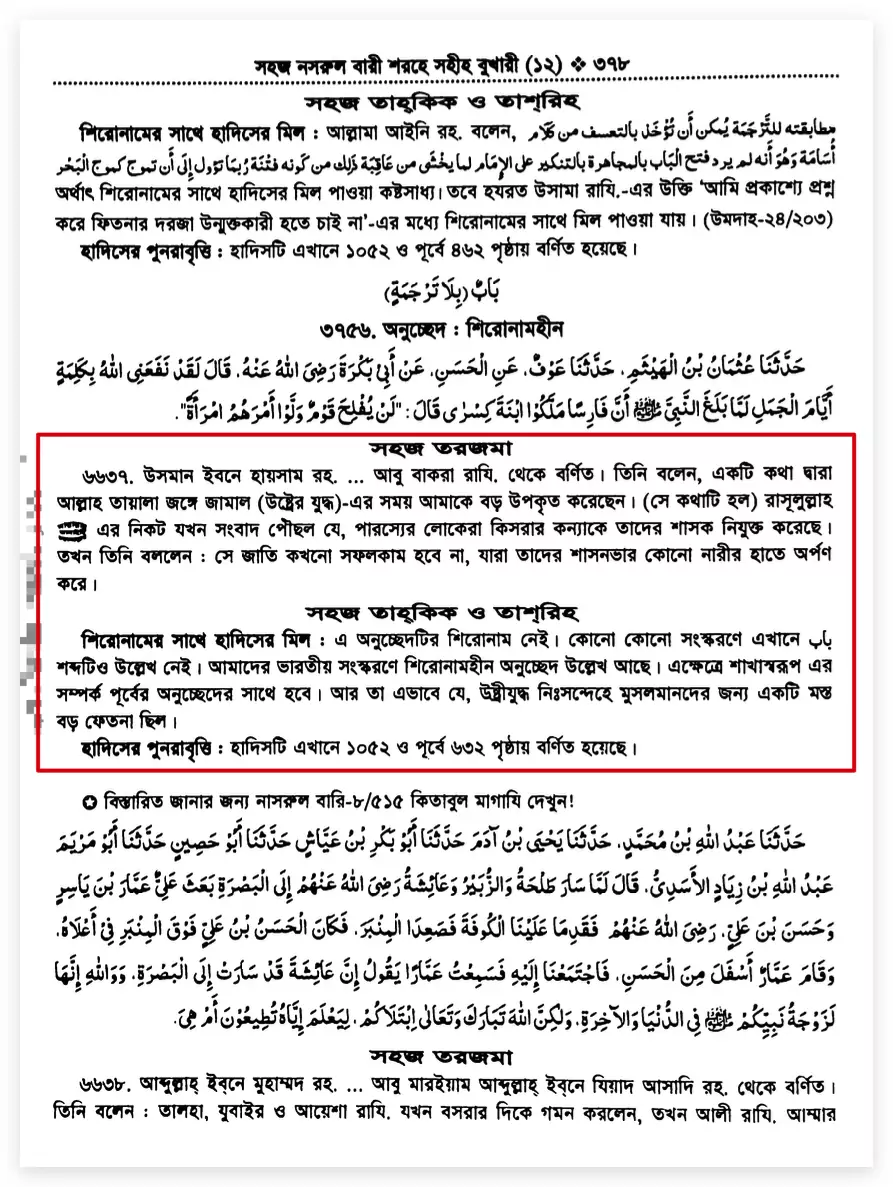
উপরের হাদিস থেকে বোঝা যায়, আয়িশা আলীর বিরুদ্ধে যুদ্ধ করলেও, সেটি আসলে ইসলামের বিধান অনুসারে সঠিক কাজ ছিল না। কারণ ইসলামের সুস্পষ্ট বিধান হচ্ছে, নারী নেতৃত্ব দিতে পারবে না। এবারে আসুন আলেমদের মুখ থেকে শুনে নিই,

0:00
–:––

ইসলাম অনুসারে নারীরা স্বল্পবুদ্ধির?

নারীর প্রতি বৈষম্যমূলক ধারণা এবং তাদের বুদ্ধিমত্তা, জ্ঞান ও মেধা নিয়ে সংশয় প্রকাশ করা কেবল সামাজিক ও রাজনৈতিক অগ্রগতির অন্তরায় নয়, এটি নারীদের সম্মানের উপরও আঘাত হানে। তাই নারীদের অবমাননাকর ও স্বল্পবুদ্ধিসম্পন্ন প্রাণী হিসেবে বিবেচনা করার যে ধারণাটি ইসলামী রেফারেন্সগুলোতে পাওয়া যায়, তা সম্পূর্ণভাবে অগ্রহণযোগ্য এবং এটি শুধুমাত্র নারীদের মানসিক এবং শারীরিক বিকাশের জন্যই ক্ষতিকর নয়, বরং সমাজের সামগ্রিক উন্নয়নের জন্যও বড় বাধা। কোরআন- হাদিস এবং প্রায় সকল ইসলামিক রেফারেন্সে কোন রাখঢাক না রেখেই পরিষ্কারভাবে নারীদের স্বল্প বুদ্ধি সম্পন্ন প্রাণী হিসেবে বিবেচনা করার শিক্ষা দেয়া হয়। পাঠক বিবেচনা করবেন, বিষয়টি নারীর জন্য অবমাননাকর কিনা (( সহীহ মুসলিম, ইসলামিক ফাউন্ডেশন, হাদিসঃ ১৪৫ )) (( সহীহ বুখারী, তাওহীদ পাবলিকেশন্স, হাদিসঃ ১৪৬২ )) -

সহীহ মুসলিম (ইফাঃ)
অধ্যায়ঃ ১/ কিতাবুল ঈমান
পরিচ্ছদঃ ৩৪. ইবাদতের ত্রুটিতে ঈমান হ্রাস পাওয়া এবং কুফর শব্দটি আল্লাহর সাথে কুফুরী ছাড়া নিয়ামত ও হুকুম অস্বীকার করার বেলায়ও প্রযোজ্য
১৪৫। মুহাম্মাদ ইবনু রুম্হ ইবনু মুহাজির আল মিসরি (রহঃ) … আবদুল্লাহ ইবনু উমর (রাঃ) থেকে বর্ণিত যে, রাসুলুল্লাহ সাল্লাল্লাহু আলাইহি ওয়াসাল্লাম ইরশাদ করেনঃ হে রমনীগন! তোমরা দান-খয়রাত করতে থাক এবং বেশি করে ইস্তিগফার কর। কেননা আমি দেখেছি যে, জাহান্নামের অধিবাসীদের অধিকাংশই নারী। জনৈকা বুদ্ধিমতী মহিলা প্রশ্ন করল, হে আল্লাহর রাসুল! জাহান্নামে আমাদের সংখ্যাগরিষ্ঠতার কারণ কি? বললেন, তোমরা বেশি বেশি অভিসম্পাত করে থাকো এবং স্বামীর প্রতি (অকৃতজ্ঞতা) প্রকাশ করে থাকো। আর দ্বীন ও জ্ঞান-বুদ্ধিতে ক্রটিপূর্ণ কোন সম্প্রদায়, জ্ঞানীদের উপর তোমাদের চেয়ে প্রভাব বিস্তারকারী আর কাউকে আমি দেখিনি।
প্রশ্নকারিনী জিজ্ঞেস করল, হে আল্লাহর রাসুল! জ্ঞান-বুদ্ধি ও দ্বীনে আমাদের কমতি কিসে? তিনি বললেনঃ তোমাদের জ্ঞান-বুদ্ধির ক্রটি হলো দু-জন স্ত্রীলোকের সাক্ষ্য একজন পুরুষের সাক্ষ্যের সমান; এটাই তোমাদের বুদ্ধির ক্রটির প্রমাণ। স্ত্রীলোক (প্রতিমাসে) কয়েকদিন সালাত (নামায/নামাজ) থেকে বিরত থাকে আর রমযান মাসে রোযা ভঙ্গ করে; (ঋতুমতী হওয়ার কারণে) এটাই দ্বীনের ক্রটি।
হাদিসের মানঃ সহিহ (Sahih)

সহীহ বুখারী (তাওহীদ)
অধ্যায়ঃ ২৪/ যাকাত
পরিচ্ছদঃ ২৪/৪৪. নিকটাত্মীয়দেরকে যাকাত দেয়া।
১৪৬২. আবূ সা‘ঈদ খুদরী (রাঃ) হতে বর্ণিত। তিনি বলেন, এক ঈদুল আযহা বা ঈদুল ফিত্রের দিনে আল্লাহর রাসূল সাল্লাল্লাহু আলাইহি ওয়াসাল্লাম ঈদগাহে গেলেন এবং সালাত শেষ করলেন। পরে লোকদের উপদেশ দিলেন এবং তাদের সদাকাহ দেয়ার নির্দেশ দিলেন আর বললেনঃ লোক সকল! তোমরা সদাকাহ দিবে। অতঃপর মহিলাগণের নিকট গিয়ে বললেনঃ মহিলাগণ! তোমরা সদাকাহ দাও। আমাকে জাহান্নামে তোমাদেরকে অধিক সংখ্যক দেখানো হয়েছে। তারা বললেন, হে আল্লাহর রাসূল! এর কারণ কী? তিনি বললেনঃ তোমরা বেশি অভিশাপ দিয়ে থাক এবং স্বামীর অকৃতজ্ঞ হয়ে থাক।হে মহিলাগণ! জ্ঞান ও দ্বীনে অপরিপূর্ণ হওয়া সত্ত্বেও দৃঢ়চেতা পুরুষের বুদ্ধি হরণকারিণী তোমাদের মত কাউকে দেখিনি। যখন তিনি ফিরে এসে ঘরে পৌঁছলেন, তখন ইবনু মাস‘ঊদ (রাঃ)-এর স্ত্রী যায়নাব (রাযি.) তাঁর কাছে প্রবেশের অনুমতি চাইলেন। বলা হলো, হে আল্লাহর রাসূল! যায়নাব এসেছেন। তিনি বললেন, কোন্ যায়নাব? বলা হলো, ইবনু মাস‘ঊদের স্ত্রী। তিনি বললেনঃ হাঁ, তাকে আসতে দাও। তাকে অনুমতি দেয়া হলো। তিনি বললেন, হে আল্লাহর নাবী সাল্লাল্লাহু আলাইহি ওয়াসাল্লাম আজ আপনি সদাকাহ করার নির্দেশ দিয়েছেন। আমার অলংকার আছে। আমি তা সদাকাহ করার ইচ্ছা করেছি। ইবনু মাস‘ঊদ (রাঃ) মনে করেন, আমার এ সদাকায় তাঁর এবং তাঁর সন্তানদেরই হক বেশি। তখন আল্লাহর রাসূল সাল্লাল্লাহু আলাইহি ওয়াসাল্লাম বললেন, ইবনু মাস‘ঊদ (রাঃ) ঠিক বলেছে। তোমার স্বামী ও সন্তানই তোমার এ সদাকাহর অধিক হাক্দার। (৩০৪, মুসলিম ১২/২, হাঃ ৯৮২, আহমাদ ৭২৯৯) (আধুনিক প্রকাশনীঃ ১৩৬৮, ইসলামিক ফাউন্ডেশনঃ ১৩৭৪)
হাদিসের মানঃ সহিহ (Sahih)


মানবাধিকারের দৃষ্টিতে নারী নেতৃত্ব

আন্তর্জাতিক মানবাধিকার সনদ অনুযায়ী, প্রতিটি ব্যক্তি, নারী বা পুরুষ, সমানভাবে নেতৃত্ব প্রদানের অধিকার রাখে, যদি তার মেধা এবং যোগ্যতা থাকে। লিঙ্গের কারণে কারো প্রতি বৈষম্য করা যাবে না, কোন বিশেষ লিঙ্গের মানুষকে অধিকার বঞ্চিত করা যাবে না, এটিই আধুনিক সভ্য মানুষের দৃষ্টিভঙ্গি। জাতিসংঘের মানবাধিকার ঘোষণা ১৯৪৮-এর ২১তম অনুচ্ছেদে বলা হয়েছে, "প্রতিটি ব্যক্তির তার দেশের সরকারে সরাসরি বা প্রতিনিধি হিসেবে অংশগ্রহণ করার অধিকার রয়েছে।" এছাড়াও, জাতিসংঘের "নারীর প্রতি সকল প্রকার বৈষম্য বিলোপ সনদ" (Convention on the Elimination of All Forms of Discrimination Against Women - CEDAW)-এ স্পষ্টভাবে বলা হয়েছে যে, নারীর প্রতি সব ধরনের বৈষম্য দূর করতে হবে এবং তাদের সামাজিক, অর্থনৈতিক, রাজনৈতিক, ও সাংস্কৃতিক ক্ষেত্রে পূর্ণাঙ্গ অধিকার দিতে হবে।

ইসলামে নারীদের নেতৃত্ব নিষিদ্ধ করার জন্য যে কোরআনের আয়াত, হাদিস বা ফতোয়ার উপর ভিত্তি করে যুক্তি দেওয়া হয়, তা নারীর এই অধিকারকে পুরোপুরি লঙ্ঘন করে। নারীর নেতৃত্ব নিষিদ্ধ করা মূলত একটি প্রাগৌতিহাসিক সামাজিক ধারণা, যা পুরুষতান্ত্রিক সমাজের প্রচলিত মানসিকতার প্রতিফলন। এই ধরনের নিষেধাজ্ঞা নারীদের শারীরিক এবং মানসিক ক্ষমতার ওপর একটি অযৌক্তিক সীমা আরোপ করে, যা তাদের প্রতি একধরনের বৈষম্য সৃষ্টি করে এবং তাদের স্বাধীনতাকে খর্ব করে।


ধর্মীয় নিষেধাজ্ঞার বাস্তবতা এবং নারী নেতৃত্বের ক্ষমতা

ইসলামের নারী নেতৃত্ব নিষিদ্ধ করার মূল যুক্তি হলো, নারীরা শারীরিকভাবে দুর্বল এবং মানসিকভাবে বড় দায়িত্ব পালন করতে অক্ষম। তারা এটি বলে থাকেন যে, নারীদের যেহেতু মাসের একটি বিশেষ সময় কিছুটা শারীরিক অসুবিধার সম্মুখীন হতে হয়, যেটাকে মাসিকের সমস্যা বলে, তাই নারীদের বড় কোন পদে দেয়া ঠিক নয়! অথচ, ইতিহাস প্রমাণ করে, নারীরা নেতৃত্বের ক্ষেত্রে সমানভাবে সক্ষম। উনিশ শতকে এবং বিংশ শতাব্দীতে বিশ্বের বিভিন্ন দেশে নারী নেতৃত্ব প্রতিষ্ঠিত হয়েছে। ব্রিটেনের প্রধানমন্ত্রী মার্গারেট থ্যাচার, ভারতের প্রধানমন্ত্রী ইন্দিরা গান্ধী, পাকিস্তানের প্রধানমন্ত্রী বেনজির ভুট্টো, এবং বাংলাদেশে শেখ হাসিনা ও খালেদা জিয়া—এরা প্রত্যেকেই প্রমাণ করেছেন যে, নারীরা নেতৃত্ব দিতে অক্ষম নয় বরং বড় বড় রাজনৈতিক, অর্থনৈতিক, এবং সামাজিক পরিবর্তন আনতে সক্ষম। শুধু যে দেশের নেতৃত্ব তাই নয়, অনেক বড় বড় আন্দোলন সংগ্রামেও নারীরা পুরুষের সমকক্ষ হয়ে লড়াই করেছেন, যার উদাহরণ ইতিহাসে অসংখ্য। এরকম বলার কোন যুক্তিই নেই যে, নারীরা এসব কাজে সফল হবেন না!

এই প্রেক্ষাপটে, ইসলামের নারী নেতৃত্বের ওপর নিষেধাজ্ঞা অযৌক্তিক এবং বাস্তবতার সাথে অসামঞ্জস্যপূর্ণ। নারীদের ক্ষমতায়ন এবং নেতৃত্ব প্রদানকে বাধা দেওয়া শুধুমাত্র তাদের প্রতিভা এবং মেধার অপচয় নয়, এটি গোটা সমাজের উন্নয়নকেও বাধাগ্রস্ত করে। নারী নেতৃত্বের প্রতি এই ধরনের বৈষম্য শুধু পুরুষতান্ত্রিক মনোভাবকে সমর্থন করে এবং সমাজে নারীর অবস্থানকে পিছিয়ে দেয়।


ইসলামিক ফতোয়া এবং সামাজিক প্রতিক্রিয়া

ইসলামে নারীর নেতৃত্ব নিষিদ্ধ করার ফতোয়া নারীদের সামাজিকভাবে প্রান্তিক করে তোলে। ইসলামী সমাজে এমন ফতোয়ার কারণে নারীরা নিজেদের অধিকার প্রতিষ্ঠা করতে হিমশিম খায়। পুরুষদের সাথে সমান মর্যাদায় নেতৃত্ব প্রদানের অধিকার থেকে বঞ্চিত হওয়া শুধু নারীদের নয়, সমাজের সামগ্রিক অগ্রগতিরও অন্তরায়। নারীদের গুরুত্বপূর্ণ রাজনৈতিক ও সামাজিক পদে নিষিদ্ধ করা তাদের মেধা ও নেতৃত্বের সক্ষমতাকে অস্বীকার করা।

ইসলামের প্রাথমিক যুগে কিছু নারী সামাজিক দায়িত্ব পালন করতেন, যেমন—আয়িশা বিভিন্ন বিষয়ে ফতোয়া দিতেন এবং পুরুষ সাহাবীগণ তাঁর মতামতকে গুরুত্ব দিতেন। তাছাড়া, 'উমর ইবন আল-খাত্তাব মদিনার বাজারে একজন নারীকে নিয়ন্ত্রণকারী হিসেবে নিযুক্ত করেছিলেন। যদিও এই বিষয়টি উমরের নারীকে অধিকার দেয়াড় মানসিকতা থেকে আসেনি, এসেছিল কারণ শিফা বিনতে আবদুল্লাহ ছিলেন উমর এর চাচাত বোন। আসুন এই বিষয়ে একটি বিখ্যাত ফতোয়া দেখে নিই, যেখানে নারীকে এমন কোন পদে দেয়া নিষিদ্ধ করা হয়েছে, যা হচ্ছে কোথাও শীর্ষ অবস্থান, কিংবা যার বহুবিধ দায়িত্ব থাকে, যেমন মন্ত্রী, বিচারক কিংবা প্রশাসক (( People who appoint a woman as their leader will never succeed ))

People who appoint a woman as their leader will never succeed
Fatwa No: 96432
Fatwa Date:29-5-2007 - Jumaadaa Al-Oula 13, 1428
Question
What does the Messenger of God (saas) mean when he says, "Any community ruled by a woman will never succeed?" Jazaakum Allahu Khairan.
Answer
All perfect praise be to Allaah, The Lord of the Worlds. I testify that there is none worthy of worship except Allaah, and that Muhammad sallallaahu `alayhi wa sallam ( may Allaah exalt his mention ) is His slave and Messenger.
The Prophet sallallaahu `alayhi wa sallam ( may Allaah exalt his mention ) said: "A people who appoint a woman as their leader will never succeed." (Al-Bukhari). This narration means that it is not permissible for a woman to lead positions of great responsibility, like being a Muslim ruler, a minister, or a judge and the like, as this leads her to mix and be in seclusion with men, and bear great responsibilities which does not befit the nature of a woman.
As regards the small positions which a woman can efficiently run and bear, and in which her responsibility is limited, then it is permissible for her to hold these positions, like running a hospital or a school. For instance 'Umar may Allaah be pleased with him appointed Ash-Shifaa' bint 'Abdullaah Al-'Adawiyyah may Allaah be pleased with her as an accountant for Al-Madeenah market. Ibn Hajar may Allaah have mercy upon him reported this in a biography about Ash-Shifaa' may Allaah be pleased with her and 'Aa'ishah may Allaah be pleased with her was appointed to take care of orphans.
Allaah Knows best.


এপোলোজিস্টদের যুক্তি ও ঐতিহাসিক বিভ্রান্তি

ইসলামিক এপোলোজিস্টরা প্রায়ই ইসলামে নারী নেতৃত্বের বৈধতা প্রমাণ করতে কয়েকটি ঐতিহাসিক উদাহরণ উপস্থাপন করেন। কিন্তু এই উদাহরণগুলোর গভীর বিশ্লেষণে দেখা যায় যে, সেগুলো হয় প্রাক-ইসলামিক যুগের অর্জনের ফল, অথবা পরবর্তীকালে ইসলামি শরিয়তের মূল ধারায় সেগুলোকে 'ভুল' বা বিচ্যুতি হিসেবে চিহ্নিত করা হয়েছে। এই ধরনের উদাহরণগুলো প্রায়ই সংক্ষিপ্তভাবে উল্লেখ করা হয়, কিন্তু তাদের প্রসঙ্গ, ঐতিহাসিক সত্যতা এবং ইসলামি গ্রন্থসমূহের ব্যাখ্যা বিবেচনা না করে। নিচে তিনটি বহুল আলোচিত উদাহরণের বিস্তারিত বিশ্লেষণ করা হলো, যা ইসলামি ইতিহাস ভিত্তিক প্রমাণ এবং যুক্তির উপর নির্ভর করে। এই বিশ্লেষণে দেখা যাবে যে, এই উদাহরণগুলো ইসলামে নারী নেতৃত্বের পক্ষে প্রমাণ হিসেবে ব্যবহার করা যায় না, বরং সেগুলো ইসলামের পরবর্তী বিধিবিধানের সাথে সাংঘর্ষিক।

খাদিজার ব্যবসায়িক সাফল্য: ইসলামের নয়, জাহেলিয়াতের অবদান

ইসলামিক এপোলোজিস্টরা খাদিজা বিনতে খুয়ায়লিদের আত্মনির্ভরশীল সফল ব্যবসায়ী হওয়ার উদাহরণকে ইসলামে নারীর অধিকারের প্রমাণ হিসেবে তুলে ধরেন। কিন্তু ঐতিহাসিক তথ্য বিশ্লেষণ করলে দেখা যায় যে, খাদিজা তাঁর ব্যবসায়িক প্রতিষ্ঠা লাভ করেছিলেন ইসলামের আবির্ভাবের পূর্বে, যা 'জাহেলিয়াতের যুগ' হিসেবে পরিচিত। প্রাক-ইসলামিক আরবে নারীরা, বিশেষ করে বিধবা নারীরা, সম্পদ রক্ষা করা, বাণিজ্য কাফেলা পরিচালনা করা এবং স্বাবলম্বী হওয়ার অধিকার উপভোগ করতেন। উদাহরণস্বরূপ, খাদিজা মক্কায় একজন ধনী বণিক ছিলেন, যাঁর কাফেলা সমস্ত কুরাইশ বণিকদের কাফেলার সমান ছিল। তিনি পুরুষদের নিয়োগ দিয়ে সিরিয়া এবং ইয়েমেনে ব্যবসা চালাতেন, এবং তাঁর সাফল্যের জন্য 'আমিরাত-কুরাইশ' (কুরাইশের রাজকুমারী) উপাধি লাভ করেন। এটি প্রাক-ইসলামিক সমাজের বৈশিষ্ট্য ছিল, যেখানে নারীরা সম্পত্তির মালিক হতে পারতেন, উত্তরাধিকার লাভ করতেন এবং ব্যবসায়িক স্বাধীনতা উপভোগ করতেন। একইসাথে জাঁদরেল নেত্রী হিন্দ বিনতে উতবা, কবি আসমা বিনতে মারওয়ান প্রমুখ নারীরা ছিলেন সেই আমলের নিজ নিজ ক্ষেত্রে অত্যন্ত সফল নারী।

ইসলামের পূর্ণাঙ্গ বিধিবিধান প্রচলিত হওয়ার পর, বিশেষ করে পর্দার কঠোরতা এবং নারী-পুরুষের অবাধ মেলামেশার নিষেধাজ্ঞা (যেমন সুরা আন-নুর ২৪:৩১), খাদিজার মতো স্বাধীন ব্যবসা পরিচালনা নারীর পক্ষে কঠিন হয়ে পড়ে। খুলাফায়ে রাশেদীনের যুগে (যেমন আবু বকর, উমরের শাসনকালে) কোনো বিখ্যাত সফল ব্যবসায়ী নারী, কবি বা নেত্রীর প্রমাণ মেলে না। সহিহ বুখারীতে (হাদিস ৭০৯৯) বর্ণিত হাদিসে বলা হয়েছে যে, নারীর নেতৃত্বে জাতি সফল হয় না, যা পরোক্ষভাবে নারীর পাবলিক লিডারশিপকে নিরুৎসাহিত করে। সুতরাং, খাদিজার সাফল্য ইসলামের কৃতিত্ব নয়, বরং প্রাক-ইসলামিক আরবে নারীর অধিকারের প্রতিফলন। এটি দেখায় যে, ইসলামের প্রচলনের পর নারীর অর্থনৈতিক স্বাধীনতা সীমিত হয়েছে, যা এপোলোজিস্টদের যুক্তিকে ভুল প্রমাণ করে।


আয়িশার উষ্ট্রের যুদ্ধ: একটি বিচ্যুতি ও অনুশোচনার ইতিহাস

আয়িশা বিনতে আবু বকরের উষ্ট্রের যুদ্ধে (ব্যাটেল অফ দ্য ক্যামেল, ৬৫৬ খ্রিষ্টাব্দ) নেতৃত্বকে কিছু এপোলোজিস্ট নারী লিডারশিপের উদাহরণ হিসেবে ব্যবহার করেন। কিন্তু ইসলামি মূল ধারায় এই ঘটনাকে 'ভুল' বা বিচ্যুতি হিসেবে দেখা হয়। যুদ্ধের সময় সাহাবী আবু বকরা রাসূল-এর সেই বিখ্যাত হাদিস স্মরণ করেন: "যে জাতি নারীর হাতে নেতৃত্ব দেয়, তারা কখনো সফল হবে না" (সহিহ আল-বুখারী ৭০৯৯, ৪৪২৫; সুনান আত-তিরমিজি ২২৬২)। এই হাদিসটি পার্সিয়ান এম্পায়ারে খসরোর কন্যাকে রানী নিয়োগের প্রসঙ্গে বলা হয়েছে, যা নারী লিডারশিপকে স্পষ্টভাবে নিষিদ্ধ করে। এর কারণে অনেক সাহাবী আয়িশার পক্ষে যুদ্ধে অংশ নেননি।

যুদ্ধে আয়িশা আলী -এর বিরুদ্ধে লড়াই করেছিলেন, কিন্তু পরবর্তীকালে তিনি গভীর অনুশোচনা প্রকাশ করেন। তিনি বলেছিলেন, "আমি চাই যেন আমি এই যাত্রায় না যেতাম এবং ঘরে বসে থাকতাম, যেমন অন্যরা (উম্মাহাতুল মুমিনীন) থেকেছিলেন। এটি আমার জন্য হারিস ইবনে হিশামের মতো দশ ছেলে হারানোর চেয়ে ভালো হতো।" আয়িশা (রা.) সুরা আল-আহজাব ৩৩:৩৩-এর নির্দেশ মেনে আমৃত্যু ঘরে অবস্থান করেন, যেখানে বলা হয়েছে: "আর তোমরা তোমাদের ঘরে অবস্থান করো এবং জাহেলিয়াতের যুগের মতো সাজসজ্জা প্রদর্শন করো না।" এই আয়াতটি প্রধানত রাসূলের স্ত্রীদের জন্য হলেও, বিশুদ্ধতাবাদী ধ্রুপদী ইসলামিক ধারায় সব নারীর জন্য প্রযোজ্য বলে মনে করা হয়, যা নারীকে ঘরকেন্দ্রিক করে। সুতরাং, আয়িশার এই নেতৃত্বকে ইসলামি শরিয়ত কোনোভাবেই আদর্শ হিসেবে গ্রহণ করেনি; বরং এটি একটি বিচ্যুতি যা পরবর্তীকালে সংশোধিত হয়েছে। এটি এপোলোজিস্টদের যুক্তিকে অসমর্থিত করে, কারণ এই ঘটনা নারী লিডারশিপের বিরুদ্ধে প্রমাণ হিসেবে ব্যবহৃত হয়।


শিফা বিনতে আবদুল্লাহর বাজার তদারকি: খণ্ডিত সত্য

খলিফা উমর মদিনার বাজারে শিফা বিনতে আবদুল্লাহকে তদারককারী হিসেবে নিয়োগের দাবিটিকে এপোলোজিস্টরা নারী নেতৃত্বের প্রমাণ হিসেবে ব্যবহার করেন। কিন্তু এটি কোনো রাজনৈতিক বা শাসনতান্ত্রিক নেতৃত্ব ছিল না। প্রথমত, শিফার দায়িত্ব ছিল মূলত হিসাবরক্ষণ, বাজারের শৃঙ্খলা রক্ষা এবং ব্যবসায়িক নিয়ম পালন নিশ্চিত করা—এটি একটি ছোট প্রশাসনিক পদ, যা রাষ্ট্রপতি বা নীতিনির্ধারণী পদের সমতুল্য নয়। দ্বিতীয়ত, ঐতিহাসিক সোর্স অনুসারে শিফা হযরত উমরের নিকটাত্মীয়া ছিলেন (বানু আদি ক্ল্যান থেকে), যা এই নিয়োগের কারণ বলে বহু সোর্স থেকে জানা যায়। কিন্তু কিছু স্কলার (যেমন আল-ফুরকান এবং রিলায়েবল ফতওয়া) এই নিয়োগকে মিথ বলে দাবি করেন, কারণ এটি প্রামাণ্য সোর্সে (যেমন সহিহ হাদিস সংগ্রহ) স্পষ্টভাবে উল্লেখিত নয়, এবং শিফার ছেলে এই দাবি অস্বীকার করেছিলেন।

যদি এই নিয়োগ সত্য হয়ও, তাহলে এটি নারীকে ঘরকেন্দ্রিক রাখার ইসলামি নির্দেশের সাথে সাংঘর্ষিক নয়, কারণ এটি সীমিত প্রশাসনিক দায়িত্ব। কিন্তু এটিকে রাজনৈতিক লিডারশিপের প্রমাণ হিসেবে ব্যবহার করা খণ্ডিত সত্য, কারণ ইসলামি ফতওয়ায় (যেমন ফতওয়া ৯৬৪৩২) নারীকে শীর্ষ পদ (শাসক, বিচারক) থেকে বিরত রাখা হয়েছে। এটি দেখায় যে, এপোলোজিস্টদের যুক্তি প্রসঙ্গহীন এবং ইসলামক বিধানের সামগ্রিক ব্যাখ্যা সম্পর্কে বিকৃত তথ্যের উপস্থাপন।

এই উদাহরণগুলোর যুক্তি-ভিত্তিক বিশ্লেষণে দেখা যায় যে, ইসলামি শরিয়তে নারী নেতৃত্বের জন্য কোনো স্পষ্ট সমর্থন নেই; বরং হাদিস এবং ফতওয়া এটিকে নিরুৎসাহিত করে। এই বিভ্রান্তিগুলো ইসলামিক দলিল প্রমাণ যাচাই করে করে যুক্তির ভিত্তিতে খণ্ডন করা দরকার, যাতে ধর্মীয় অন্ধবিশ্বাসের প্রভাব না পড়ে।


আধুনিক বিশ্বে নারীর ভূমিকা এবং বৈষম্য

আধুনিক বিশ্বে নারীরা বিভিন্ন ক্ষেত্রে গুরুত্বপূর্ণ ভূমিকা পালন করছেন। ব্যবসা, প্রযুক্তি, রাজনীতি, এবং সংস্কৃতির মতো ক্ষেত্রে নারীরা নেতৃত্ব দিচ্ছেন এবং নিজেদের মেধার যোগ্যতা প্রমাণ করছেন। জাতিসংঘের "Gender Inequality Index"-এর ২০২০ সালের প্রতিবেদন অনুযায়ী, যে সকল দেশে নারীদের অংশগ্রহণ বেশি, সেসব দেশের অর্থনৈতিক উন্নয়ন এবং সামাজিক অগ্রগতি তুলনামূলকভাবে বেশি।

তাহলে প্রশ্ন ওঠে, কেন ইসলামিক সমাজে নারীর নেতৃত্বকে নিষিদ্ধ করা হয়? এর মূল কারণ হলো পুরুষতান্ত্রিক মানসিকতা, যা নারীর ক্ষমতায়নকে ভয় পায় এবং তাদের সীমাবদ্ধ রাখতে চায়। নারীকে শুধুমাত্র পুরুষের উপভোগের বস্তু এবং ক্ষমতাহীন অসহায় করে রাখার মাধ্যমে পুরুষ নিজেকে নারীর ত্রাণকর্তা হিসেবে পরিচয় দিতে চায়, এবং এই পরিচয় দেয়ার মাধ্যমে নারীকে নিজের নিয়ত্রণে রাখতে চায়। নারীর প্রতি এই ধরনের বৈষম্যমূলক দৃষ্টিভঙ্গি তাদের সমাজে হেয় প্রতিপন্ন করে এবং তাদের স্বাভাবিক অধিকার থেকে বঞ্চিত করে।


উপসংহার

ইসলামে নারী নেতৃত্ব নিষিদ্ধ করার ফতোয়া এবং হাদিসের ভিত্তিতে নারীর প্রতি যে বৈষম্য তৈরি হয়েছে, তা আধুনিক সমাজের নারী অধিকার এবং আন্তর্জাতিক মানবাধিকারের পরিপন্থী। নারী নেতৃত্ব নিষিদ্ধ করা তাদের ক্ষমতাকে সীমাবদ্ধ করা এবং তাদের মেধা ও যোগ্যতার প্রতি অসম্মান প্রদর্শন। ইতিহাস সাক্ষ্য দেয়, নারীরা নেতৃত্ব প্রদানের ক্ষেত্রে পুরুষের সমানভাবে দক্ষ এবং যোগ্য। নারীর প্রতি এই ধরনের বৈষম্য দূর করতে হলে, ইসলামিক সমাজে নারীদের অধিকার সম্পর্কে সচেতনতা বৃদ্ধি করতে হবে এবং নতুন ও আধুনিক ফতোয়ার মাধ্যমে তাদের ওপর আরোপিত নিষেধাজ্ঞা ও সীমাবদ্ধতাকে অস্বীকার করতে হবে। নারীর অধিকার ও নেতৃত্ব প্রতিষ্ঠা না করলে সমাজের উন্নয়ন ও অগ্রগতি কখনোই সম্ভব নয়। সুতরাং, নারীদের ক্ষমতায়ন এবং তাদের পূর্ণ অধিকার প্রতিষ্ঠা সমাজের প্রগতির জন্য অপরিহার্য।

According to Islamic Law, Women Cannot Lead

Introduction

The hadiths in Islam that prohibit women's leadership are completely at odds with women's rights and the principles of international human rights in the modern era. Restricting women's rights in the name of religion and depriving them of the opportunity to lead not only hinders social development, it is a kind of humiliation of women. Despite merit, qualification and willingness, in the eyes of Islam a woman is never fit to lead — this discrimination based solely on gender is extremely degrading for women. In Islam, women's leadership has been prohibited on the basis of various fatwas and hadiths. In this article we will discuss the context of Islam's prohibition of women's leadership, its discriminatory aspects, and why such a ban is contrary to women's rights and international human rights in modern society.


Islam's Narration: Is Women's Leadership Haram?

It is narrated in many authentic hadiths of Islam, "A nation that appoints women as their leader will never succeed." (Sahih al-Bukhari). This hadith is frequently used as the basis for prohibiting women's leadership in Islamic society. There are numerous fatwas on this matter, among which fatwa number 96432 also states that women are not permitted to lead, because according to their rank they are not fit to lead alongside men. From the viewpoint of Islamic jurisprudence, women can only take charge of small posts such as schools or hospitals, but cannot participate in governing the country, the judiciary, or important political positions. According to them, such responsibilities are contrary to women's natural capacity and limitations. Women do not have enough merit or qualification for such positions!

Sahih al-Bukhari (IF)
Chapter: 81/ Fitan (Trials)
Section: 2994. No section
6618. Uthman ibn Haytham (may Allah have mercy on him) ... narrated from Abu Bakrah (RA). He said: A statement benefited me greatly during the Battle of Jamal (the Battle of the Camel). (The statement was) When the news reached the Prophet (peace be upon him) that the people of Persia had appointed the daughter of Kisra as their ruler, he said: A nation that entrusts its rule to a woman will never succeed.
Hadith status: Sahih (Authentic)

Sahih al-Bukhari (Tawheed)
Chapter: 92/ Fitan (Trials)
Section: 92/18. No section.
7099. Narrated from Abu Bakrah (RA). He said: A statement benefited me greatly during the Battle of Jamal (the Battle of the Camel). (It was) when the news reached the Prophet (peace be upon him) that the people of Persia had appointed the daughter of Kisra as their ruler, he said: A nation that entrusts its rule to a woman will never succeed.(1) (4425) (Adhunik Prokashani- 6604, Islamic Foundation- 6618)
(1) If Muslims want success, they must certainly avoid women's leadership.
Hadith status: Sahih (Authentic)

Sahih al-Bukhari (Tawheed)
Chapter: 64/ Al-Maghazi (Military Expeditions)
Section: 64/83. The sending of letters by the Prophet (peace be upon him) to Kisra of Persia and Qaysar, ruler of Rome.
4425. Narrated from Abu Bakrah (RA). He said: A saying heard from the Messenger of Allah (peace be upon him) benefited me greatly on the day of the Battle of Jamal (the Battle of the Camel), when I had almost joined the companions and taken part in the Battle of the Camel. Abu Bakrah (RA) said: The saying was — when the news reached the Prophet (peace be upon him) that the Persians had chosen the daughter of Kisra as their king, he said: A nation whose administrator is a woman will never succeed. (7099) (Adhunik Prokashani: 4077, Islamic Foundation: 4080)
Hadith status: Sahih (Authentic)

On the basis of the Quran, hadith and fatwas, saying that women are incapable of leading in high positions is not only belittling women's capability, it is also a social and moral discrimination. It is a severe obstacle to women's empowerment and the establishment of their rights, and a major barrier to recognizing their merit and skills. In this context, in reply to the criticism of freethinkers, many Islamic apologists make a claim that in the Battle of Jamal (the Battle of the Camel) Hazrat Aisha fought against Hazrat Ali. Through this narration they often try to suggest that in Islam women can also be warriors and can lead! Yet the ruling of Islam is that a woman can never lead. Let us see what Islam's position on this matter is (( Sunan at-Tirmidhi (verified), Hadith: 2262 ))

Sunan at-Tirmidhi (verified)
31/ Strife and Calamity
Section: 75. A nation that appoints a woman as its ruler
2262. Narrated from Abu Bakrah (RA), he said, A statement heard from the Messenger of Allah (peace be upon him) saved me (from participating in the Battle of the Camel). After the Persian emperor Kisra was killed, he asked: Whom have they appointed as ruler? The companions said: His daughter. The Messenger of Allah (peace be upon him) said: A nation that appoints a woman as its ruler can never attain good. The narrator said: Then after Aisha (RA) came to Basra, that saying of the Messenger of Allah (peace be upon him) came back to my mind. Therefore, through it Allah saved me (from taking up arms against Ali).
Sahih, Irwa (245), Bukhari.
Abu Isa said: This hadith is hasan sahih.
Hadith status: Sahih (Authentic)
Narrator: Abu Bakrah (RA)

Now let us read the explanation of the hadith of Sahih Bukhari from Nasrul Bari, (( Sahaj Nasrul Bari Sharh Bukhari, Volume 12, Page 378 ))

From the hadith above it is understood that although Aisha fought against Ali, that was actually not the right thing to do according to Islamic law. Because the clear ruling of Islam is that a woman cannot lead. Now let us hear it from the mouths of the scholars,

0:00
–:––

According to Islam, Are Women Deficient in Intellect?

The discriminatory ideas about women and the casting of doubt on their intelligence, knowledge and merit is not only an obstacle to social and political progress, it also strikes at women's honor. Therefore, the idea found in Islamic references of regarding women as degraded and feeble-minded creatures is completely unacceptable, and it is harmful not only for women's mental and physical development, but is also a major barrier to the overall development of society. The Quran, hadith and almost all Islamic references teach, without any hesitation, that women should be regarded as creatures of deficient intellect. Let the reader consider whether the matter is humiliating for women or not (( Sahih Muslim, Islamic Foundation, Hadith: 145 )) (( Sahih al-Bukhari, Tawheed Publications, Hadith: 1462 )) -

Sahih Muslim (IF)
Chapter: 1/ Kitab al-Iman
Section: 34. Faith decreases with defects in worship, and the word kufr applies to denying blessings and commandments as well as disbelieving in Allah
145. Muhammad ibn Rumh ibn Muhajir al-Misri (may Allah have mercy on him) ... narrated from Abdullah ibn Umar (RA) that the Messenger of Allah (peace be upon him) said: O women! Keep giving charity and seek forgiveness much, for I have seen that most of the inhabitants of Hell are women. An intelligent woman asked: O Messenger of Allah! What is the reason for our majority in Hell? He said, You curse a great deal and show (ingratitude) to your husbands. And I have not seen any community more deficient in religion and intellect that is more influential over the minds of the wise than you.
The questioner asked: O Messenger of Allah! What is the deficiency in our intellect and religion? He said: The deficiency of your intellect is that the testimony of two women equals the testimony of one man; this is the proof of your intellectual deficiency. And women abstain from prayer (salat) for a few days (every month) and break the fast in Ramadan (because of menstruation); this is the deficiency of religion.
Hadith status: Sahih (Authentic)

Sahih al-Bukhari (Tawheed)
Chapter: 24/ Zakat
Section: 24/44. Giving zakat to relatives.
1462. Narrated from Abu Sa'id al-Khudri (RA). He said: On the day of Eid al-Adha or Eid al-Fitr, the Messenger of Allah (peace be upon him) went to the musalla (prayer ground) and completed the prayer. Then he advised the people and ordered them to give sadaqah, saying: O people! You shall give sadaqah. Then he went to the women and said: O women! Give sadaqah, for I have been shown that you are the majority of the inhabitants of Hell. They said: O Messenger of Allah! What is the reason? He said: You curse a great deal and are ungrateful to your husbands. O women! Despite being deficient in intellect and religion, I have not seen anyone like you who can rob the intellect of a resolute man. When he returned and reached home, Zaynab (RA), the wife of Ibn Mas'ud (RA), sought permission to enter. It was said: O Messenger of Allah! Zaynab has come. He said: Which Zaynab? It was said: The wife of Ibn Mas'ud. He said: Yes, let her come in. She was given permission. She said: O Prophet of Allah (peace be upon him)! Today you have ordered sadaqah. I have ornaments, and I intend to give them as sadaqah. Ibn Mas'ud (RA) thinks that he and his children have more right to my sadaqah. Then the Messenger of Allah (peace be upon him) said: Ibn Mas'ud (RA) is right. Your husband and children have the most right to this sadaqah of yours. (304, Muslim 12/2, Hadith 982, Ahmad 7299) (Adhunik Prokashani: 1368, Islamic Foundation: 1374)
Hadith status: Sahih (Authentic)


Women's Leadership in the Eyes of Human Rights

According to the international human rights charter, every individual, woman or man, equally holds the right to lead, if they have the merit and qualification. No one may be discriminated against on the basis of gender, and no person of any particular sex may be deprived of rights — this is the outlook of modern civilized people. Article 21 of the United Nations Declaration of Human Rights 1948 states, "Everyone has the right to take part in the government of his country, directly or through freely chosen representatives." In addition, the United Nations' "Convention on the Elimination of All Forms of Discrimination Against Women" (CEDAW) clearly states that all forms of discrimination against women must be eliminated and they must be given full rights in the social, economic, political, and cultural spheres.

The arguments based on the Quranic verses, hadiths or fatwas for prohibiting women's leadership in Islam completely violate this right of women. Prohibiting women's leadership is essentially a prehistoric social idea, a reflection of the prevailing mentality of patriarchal society. This kind of ban imposes an unreasonable limit on women's physical and mental capacities, creating a kind of discrimination against them and curtailing their freedom.


The Reality of the Religious Ban and the Capability of Women's Leadership

Islam's main argument for prohibiting women's leadership is that women are physically weak and mentally incapable of carrying out great responsibilities. They say that since women face some physical discomfort during a particular time of the month, which is called the menstruation problem, it is not right to give women any big position! Yet history proves that women are equally capable of leadership. In the nineteenth century and the twentieth century, women's leadership has been established in many countries of the world. British Prime Minister Margaret Thatcher, Indian Prime Minister Indira Gandhi, Pakistani Prime Minister Benazir Bhutto, and in Bangladesh Sheikh Hasina and Khaleda Zia — each of them has proved that women are not incapable of leading, but rather capable of bringing about great political, economic, and social changes. It is not only leadership of the country; in many great movements and struggles women have fought as equals of men, of which history has countless examples. There is no logic whatsoever in saying that women will not succeed in these tasks!

In this context, Islam's ban on women's leadership is illogical and inconsistent with reality. Preventing women's empowerment and leadership is not only a waste of their talent and merit, it also hinders the development of the whole society. This kind of discrimination against women's leadership only supports the patriarchal mentality and pushes back women's position in society.


Islamic Fatwas and Social Reaction

The fatwas prohibiting women's leadership in Islam marginalize women socially. In Islamic society, because of such fatwas, women struggle to establish their rights. Being deprived of the right to lead on equal footing with men is an obstacle not only for women but for the overall progress of society. Prohibiting women from important political and social positions is a denial of their merit and leadership capability.

In the early period of Islam some women carried out social responsibilities, such as — Aisha gave fatwas on various matters and the male companions gave weight to her opinions. Besides, 'Umar ibn al-Khattab appointed a woman as market supervisor in Medina. Although this matter did not stem from Umar's mentality of granting women rights, it happened because Shifa bint Abdullah was Umar's cousin. Let us now look at a famous fatwa on this matter, in which a woman is forbidden from any such post which is a top position anywhere, or which carries multiple responsibilities, such as minister, judge or administrator (( People who appoint a woman as their leader will never succeed ))

People who appoint a woman as their leader will never succeed
Fatwa No: 96432
Fatwa Date:29-5-2007 - Jumaadaa Al-Oula 13, 1428
Question
What does the Messenger of God (saas) mean when he says, "Any community ruled by a woman will never succeed?" Jazaakum Allahu Khairan.
Answer
All perfect praise be to Allaah, The Lord of the Worlds. I testify that there is none worthy of worship except Allaah, and that Muhammad sallallaahu `alayhi wa sallam ( may Allaah exalt his mention ) is His slave and Messenger.
The Prophet sallallaahu `alayhi wa sallam ( may Allaah exalt his mention ) said: "A people who appoint a woman as their leader will never succeed." (Al-Bukhari). This narration means that it is not permissible for a woman to lead positions of great responsibility, like being a Muslim ruler, a minister, or a judge and the like, as this leads her to mix and be in seclusion with men, and bear great responsibilities which does not befit the nature of a woman.
As regards the small positions which a woman can efficiently run and bear, and in which her responsibility is limited, then it is permissible for her to hold these positions, like running a hospital or a school. For instance 'Umar may Allaah be pleased with him appointed Ash-Shifaa' bint 'Abdullaah Al-'Adawiyyah may Allaah be pleased with her as an accountant for Al-Madeenah market. Ibn Hajar may Allaah have mercy upon him reported this in a biography about Ash-Shifaa' may Allaah be pleased with her and 'Aa'ishah may Allaah be pleased with her was appointed to take care of orphans.
Allaah Knows best.


The Apologists' Arguments and Historical Confusion

Islamic apologists often present a few historical examples to prove the legitimacy of women's leadership in Islam. But deep analysis of these examples shows that they are either the achievements of the pre-Islamic era, or were later marked as 'wrong' or a deviation in the mainstream of Islamic Sharia. Such examples are often mentioned in brief, without considering their context, historical authenticity, and the interpretation of Islamic texts. Below is a detailed analysis of three widely discussed examples, based on evidence from Islamic history and logic. This analysis will show that these examples cannot be used as proof in favor of women's leadership in Islam, but rather conflict with Islam's later rulings.

Khadijah's Business Success: Not Islam's Contribution, but That of Jahiliyyah

Islamic apologists present the example of Khadijah bint Khuwaylid being a self-reliant, successful businesswoman as proof of women's rights in Islam. But analysis of historical facts shows that Khadijah built her business before the advent of Islam, which is known as the 'Age of Jahiliyyah'. In pre-Islamic Arabia, women — especially widows — enjoyed the right to protect wealth, manage trade caravans, and be self-sufficient. For example, Khadijah was a wealthy merchant in Mecca, whose caravan equalled the caravans of all the Quraysh merchants. She hired men and ran business in Syria and Yemen, and for her success she earned the title of 'Ameerat Quraysh' (the Princess of Quraysh). This was a feature of pre-Islamic society, where women could own property, inherit, and enjoy commercial freedom. At the same time, the great female leader Hind bint Utbah, the poet Asma bint Marwan and other women were highly successful women in their respective fields of that era.

After the full implementation of Islam's rules, especially the strictness of hijab and the prohibition of free mixing of men and women (such as Surah an-Nur 24:31), running an independent business like Khadijah became difficult for women. In the era of the rightly guided caliphs (such as the reigns of Abu Bakr and Umar), no evidence of any famous successful businesswoman, poet or female leader is found. The hadith narrated in Sahih al-Bukhari (Hadith 7099) says that a nation led by a woman does not succeed, which indirectly discourages women's public leadership. Therefore, Khadijah's success is not Islam's achievement, but a reflection of women's rights in pre-Islamic Arabia. This shows that after the advent of Islam, women's economic freedom was restricted, which proves the apologists' argument wrong.


Aisha's Battle of the Camel: A History of Deviation and Remorse

Some apologists use the leadership of Aisha bint Abu Bakr in the Battle of the Camel (656 CE) as an example of women's leadership. But in the Islamic mainstream this event is seen as a 'mistake' or deviation. During the battle, the companion Abu Bakrah recalled that famous hadith of the Messenger: "A nation that entrusts leadership to a woman will never succeed" (Sahih al-Bukhari 7099, 4425; Sunan at-Tirmidhi 2262). This hadith was said in the context of appointing the daughter of Khosrow as queen of the Persian Empire, which clearly prohibits women's leadership. Because of this, many companions did not take part in the battle on Aisha's side.

In the battle, Aisha fought against Ali, but later she expressed deep remorse. She said, "I wish I had not gone on this journey and had stayed at home, as the others (the Mothers of the Believers) did. That would have been better for me than losing ten sons like Harith ibn Hisham." Aisha (RA) followed the instruction of Surah al-Ahzab 33:33 and remained at home until her death, in which it is said: "And remain in your houses, and do not display yourselves as in the days of Jahiliyyah." Although this verse was primarily for the wives of the Messenger, in the puritanical classical Islamic tradition it is considered applicable to all women, which confines women to the home. Therefore, Islamic Sharia has in no way accepted this leadership of Aisha as an ideal; rather, it was a deviation that was later corrected. This refutes the apologists' argument, because this incident is used as evidence against women's leadership.


Shifa bint Abdullah's Market Supervision: A Fragmented Truth

Apologists use the claim that Caliph Umar appointed Shifa bint Abdullah as supervisor of the Medina market as proof of women's leadership. But this was not any political or governmental leadership. First, Shifa's duty was mainly bookkeeping, maintaining market order and ensuring compliance with business rules — this was a small administrative post, not equivalent to the presidency or a policy-making position. Second, according to historical sources, Shifa was a close relative of Hazrat Umar (from the Banu Adi clan), which is known from many sources to be the reason for this appointment. But some scholars (such as al-Furqan and Reliable Fatwa) claim this appointment is false, because it is not clearly mentioned in authoritative sources (such as the authentic hadith collections), and Shifa's son denied this claim.

Even if this appointment is true, it does not conflict with the Islamic instruction of keeping women home-centered, because it was limited administrative duty. But using it as proof of political leadership is a fragmented truth, because in Islamic fatwas (such as fatwa 96432) women are barred from top positions (ruler, judge). This shows that the apologists' argument is out of context and presents distorted information about the overall interpretation of Islamic rulings.

The logic-based analysis of these examples shows that there is no clear support for women's leadership in Islamic Sharia; rather, the hadiths and fatwas discourage it. These confusions need to be refuted on the basis of logic by verifying Islamic documentary evidence, so that the influence of religious superstition does not take hold.


Women's Role in the Modern World and Discrimination

In the modern world, women are playing important roles in various fields. In fields such as business, technology, politics, and culture, women are leading and proving the worth of their merit. According to the 2020 report of the United Nations' "Gender Inequality Index", the countries where women's participation is higher have comparatively higher economic development and social progress.

So the question arises: why is women's leadership prohibited in Islamic society? The main reason is the patriarchal mentality, which fears women's empowerment and wants to keep them confined. By keeping women merely as objects of men's enjoyment and powerless and helpless, men want to present themselves as women's savior, and through this identity they want to keep women under their control. This kind of discriminatory attitude toward women makes them despised in society and deprives them of their natural rights.


Conclusion

The discrimination against women created on the basis of the fatwas and hadiths prohibiting women's leadership in Islam is contrary to women's rights and international human rights in modern society. Prohibiting women's leadership is restricting their power and showing disrespect for their merit and qualification. History bears witness that women are equally skilled and qualified as men in leadership. To eliminate this kind of discrimination against women, awareness about women's rights must be increased in Islamic society, and through new and modern fatwas the bans and restrictions imposed on them must be rejected. Without establishing women's rights and leadership, the development and progress of society is never possible. Therefore, women's empowerment and the establishment of their full rights are essential for the progress of society.

← তালিকায় ফিরে যান