SHONGSHOY翻訳 · আর্টিকেল ← INDEX
POST 3643722 April 2024

ইসলামে সমকামীদের সম্পর্কে অমানবিক বিধান

ইসলামি শরীয়তে সমকামিতা কঠোরভাবে নিষিদ্ধ এবং শাস্তিযোগ্য অপরাধ হিসেবে বিবেচিত হয়, যার শাস্তি হিসেবে মৃত্যুদণ্ডও প্রদান করা হয়েছে। হাদিসগ্রন্থগুলোতে নবী মুহাম্মদ-এর কিছু বর্ণনা পাওয়া যায়, যেখানে তিনি সমকামীদের হত্যা করার নির্দেশ দিয়েছেন

ভূমিকা

ইসলামী শরীয়ত অনুযায়ী সমকামিতা একটি গুরুতর অপরাধ, যার শাস্তি হিসেবে অনেক ফিকাহ ব্যাখ্যাকার মৃত্যুদণ্ড নির্ধারণ করেছেন। ইসলামী বিশ্বাস, বিশেষ করে কুরআন, হাদিস ও প্রাথমিক আমলের ফিকাহ গ্রন্থে এই বিষয়টি ‘লওয়াত’ বা ‘কওমে লূতের কর্ম’ নামে পরিচিত। কুরআনে “কওমে লূত”-এর কাহিনি বারবার উল্লেখিত হয়েছে (( সূরা আল-আ‘রাফ ৭:৮০-৮৪ )) (( সূরা আন-নামল ২৭:৫৪-৫৮ )) (( সূরা আল-আনকাবূত ২৯:২৮-৩৫ )), যেখানে লূত জাতির পুরুষরা নারীদের পরিবর্তে পুরুষদের প্রতি যৌন আকর্ষণ প্রদর্শন করেছিল বলে বর্ণিত আছে, এবং ফলস্বরূপ তারা ‘আল্লাহর আযাবে’ ধ্বংসপ্রাপ্ত হয়। ইসলামী ব্যাখ্যা মতে, এই কাহিনি থেকেই ইসলামী শরীয়তের ‘লওয়াত’ সংক্রান্ত আইনগত ভিত্তি গড়ে ওঠে।

তবে ধর্মীয় গ্রন্থে উল্লিখিত এই গল্পটি ঐতিহাসিক বা বৈজ্ঞানিক নয়; বরং এটি একটি ধর্মীয় বর্ণনা, যার ভিত্তিতে পরবর্তী যুগের ফিকাহবিদরা নৈতিক ও আইনি বিধান রচনা করেন। ইসলামী সভ্যতার প্রাথমিক যুগে যখন সামাজিক কাঠামো ছিল গোত্রনির্ভর, তখন যৌন আচরণ নিয়ন্ত্রণকে সামাজিক শৃঙ্খলা রক্ষার অংশ হিসেবে দেখা হতো। সেখান থেকেই সমকামিতাকে কেবল পাপ নয়, বরং রাষ্ট্রীয় অপরাধ হিসেবে গণ্য করা হয়। কিন্তু আধুনিক সভ্যতায় ব্যক্তিগত যৌন পরিচয়কে ব্যক্তিগত অধিকার হিসেবে বিবেচনা করা হয়, ফলে এই শরীয়তীয় বিধান বর্তমান মানবাধিকার ও নৈতিক দর্শনের সঙ্গে সরাসরি সংঘাতে পড়ে। যদিও এই আধুনিক যুগেও যেসব দেশে ইসলামী শরীয়া শাসন চালু আছে, সেসব দেশে সমকামীদের প্রকাশ্যে উঁচু স্থান থেকে ছুড়ে হত্যা করা হয়, নতুবা প্রকাশ্যে পাথর ছুড়ে হত্যা বা শিরঃচ্ছেদ করা হয় (( Persecution of homosexuals in the Palestinian autonomous areas )) (( Iran defends execution of gay people )) । যা শুধুমাত্র মানুষের মানবাধিকার হরণই নয়, মানুষের যৌন স্বাধীনতারও লঙ্ঘন। একইসাথে পছন্দ করে নিজ যৌন সঙ্গী নির্বাচন এবং জীবন যাপনের পথে প্রতিবন্ধকতা সৃষ্টি করা। আজকে আমরা ইসলামিক শরীয়া দেশগুলোতে এই সমস্যা, বর্বর ও মধ্যযুগীয় এইসব বিচারের নামে প্রহসনের ভিত্তি কোথায় তা খুঁজে দেখবো এবং পর্যালোচনা করবো।


কোরআনে সমকামীদের হত্যার বিধান

ইসয়াম ধর্মের পবিত্র গ্রন্থ কোরআনে বেশ কয়েক জায়গাতে সমকামীদের শাস্তির কথা বলা আছে।

সূরা আল-আ‘রাফ ৭:৮০-৮৪

আর আমি লূতকে পাঠিয়েছিলাম। যখন সে তার জাতিকে বলেছিল, ‘তোমরা এমন নির্লজ্জতার কাজ করছ যা বিশ্বজগতে তোমাদের পূর্বে কোন একজনও করেনি।’
— Taisirul Quran
আর আমি লূতকে পাঠিয়েছিলাম। সে তার কাওমকে বলেছিলঃ তোমরা এমন অশ্লীল ও কু-কর্ম করছো যা তোমাদের পূর্বে বিশ্বে আর কেহই করেনি।
— Sheikh Mujibur Rahman
আর (প্রেরণ করেছি) লূতকে। যখন সে তার কওমকে বলল, ‘তোমরা কি এমন অশ্লীল কাজ করছ, যা তোমাদের পূর্বে সৃষ্টিকুলের কেউ করেনি’?
— Rawai Al-bayan
আর আমি লূতকেও [১] পাঠিয়েছিলাম [২]। তিনি তার সম্প্রদায়কে বলেছিলেন, ‘তোমরা কি এমন খারাপ কাজ করে যাচ্ছ যা তোমাদের আগে সৃষ্টিকুলের কেউ করেনি ?
— Dr. Abu Bakr Muhammad Zakaria

তোমরা যৌন তাড়নায় স্ত্রীদের বাদ দিয়ে পুরুষদের নিকট গমন করছ, তোমরা হচ্ছ এক সীমালঙ্ঘনকারী সম্প্রদায়।
— Taisirul Quran
তোমরা স্ত্রীলোকদের বাদ দিয়ে পুরুষদের দ্বারা নিজেদের যৌন ইচ্ছা নিবারণ করে নিচ্ছ। প্রকৃত পক্ষে, তোমরা হচ্ছ সীমালংঘনকারী সম্প্রদায়।
— Sheikh Mujibur Rahman
‘তোমরা তো নারীদের ছাড়া পুরুষদের সাথে কামনা পূর্ণ করছ, বরং তোমরা সীমালঙ্ঘনকারী কওম’।
— Rawai Al-bayan
‘তোমরা তো কাম-তৃপ্তির জন্য নারীদের ছেড়ে পুরুষের কাছে যাও, বরং তোমরা সীমালংঘনকারী সম্প্রদায়।’
— Dr. Abu Bakr Muhammad Zakaria

তার জাতির এ ছাড়া আর কোন জবাব ছিল না যে, ‘তোমাদের জনপদ থেকে এদেরকে বের করে দাও, এরা এমন লোক যারা খুব পবিত্র হতে চায়।’
— Taisirul Quran
তার জাতির লোকদের এটা ছাড়া আর কোন জবাবই ছিলনা যে, এদের তোমাদের জনপদ থেকে বের করে দাও, এরা নিজেদেরকে বড় পবিত্র রাখতে চায়।
— Sheikh Mujibur Rahman
আর তার কওমের উত্তর কেবল এই ছিল যে, তারা বলল, ‘তাদেরকে তোমরা তোমাদের জনপদ থেকে বের করে দাও। নিশ্চয় তারা এমন লোক, যারা অতি পবিত্র হতে চায়’।
— Rawai Al-bayan
উত্তরে তার সম্প্রদায় শুধু বলল, ‘এদেরকে তোমাদের জনপদ থেকে বহিস্কার কর, এরা তো এমন লোক যারা অতি পবিত্র হতে চায়।’
— Dr. Abu Bakr Muhammad Zakaria

অতঃপর আমি তাকে আর তার পরিবার-পরিজনকে রক্ষা করলাম কিন্তু তার স্ত্রী ছাড়া, কেননা সে ছিল পেছনে অবস্থানকারীদের অন্তর্ভুক্ত।
— Taisirul Quran
পরিশেষে, আমি তাকে এবং তার পরিবারের লোকদেরকে, তার স্ত্রী ছাড়া, শাস্তি হতে রক্ষা করেছিলাম, তার স্ত্রী তাদের সাথে পিছনেই রয়ে গিয়েছিল।
— Sheikh Mujibur Rahman
তাই আমি তাকে ও তার পরিবারকে রক্ষা করলাম তার স্ত্রী ছাড়া। সে ছিল পেছনে থেকে যাওয়া লোকদের অন্তর্ভুক্ত।
— Rawai Al-bayan
অতঃপর আমরা তাকে ও তার পরিজনদের সবাইকে উদ্ধার করেছিলাম, তার স্ত্রী ছাড়া, সে ছিল পিছনে অবস্থানকারীদের অন্তর্ভুক্ত।
— Dr. Abu Bakr Muhammad Zakaria

তাদের উপর এক পাথরের বৃষ্টি বর্ষিয়ে দিলাম। তারপর দেখ, অপরাধীদের পরিণতি কী হয়েছিল!
— Taisirul Quran
অতঃপর আমি তাদের উপর মুষলধারে বারিপাত ঘটালাম, অতঃপর লক্ষ্য কর, অপরাধী লোকদের পরিণাম কি হয়েছিল।
— Sheikh Mujibur Rahman
আর আমি তাদের উপর বর্ষণ করেছিলাম বৃষ্টি। সুতরাং দেখ, অপরাধীদের পরিণতি কিরূপ ছিল।
— Rawai Al-bayan
আর আমরা তাদের উপর ভীষণভাবে বৃষ্টি বর্ষণ করেছিলাম। কাজেই দেখুন, অপরাধীদের পরিণাম কিরূপ হয়েছিল [১]।
— Dr. Abu Bakr Muhammad Zakaria


সূরা আন-নামল ২৭:৫৪-৫৮

স্মরণ কর লূতের কথা, সে তার সম্প্রদায়কে বলেছিল- তোমরা দেখে-শুনে কেন অশ্লীল কাজ করছ,
— Taisirul Quran
স্মরণ কর লূতের কথা, সে তার সম্প্রদায়কে বলেছিলঃ তোমরা জেনে শুনে কেন অশ্লীল কাজ করছ?
— Sheikh Mujibur Rahman
আর স্মরণ কর লূতের কথা, যখন সে তার কওমকে বলেছিল, ‘তোমরা কেন অশ্লীল কাজ করছ, অথচ তা তোমরা ভালভাবে প্রত্যক্ষ করছ’?
— Rawai Al-bayan
আর স্মরণ করুন লূতের কথা [১], তিনি তার সম্প্রদায়কে বলেছিলেন, ‘তোমরা জেনে-দেখে [২] কেন অশ্লীল কাজ করছ?
— Dr. Abu Bakr Muhammad Zakaria

তোমরা কি কাম আসক্তি মিটানোর জন্য নারীদের বাদ দিয়ে পুরুষদের নিকট গমন কর? তোমরা এমন এক জাতি যারা মূর্খের আচরণ করছ।
— Taisirul Quran
তোমরা কি কাম-তৃপ্তির জন্য নারীকে ছেড়ে পুরুষে উপগত হবে? তোমরাতো এক অজ্ঞ সম্প্রদায়।
— Sheikh Mujibur Rahman
‘তোমরা কি নারীদের বাদ দিয়ে পুরুষদের উপর কামতৃপ্তির জন্য উপগত হবে? বরং তোমরা এমন এক কওম যারা জানে না’।
— Rawai Al-bayan
‘তোমরা কি কামতৃপ্তির জন্য নারীকে ছেড়ে পুরুষে উপগত হবে? তোমরা তো এক অজ্ঞ [১] সম্প্রদায়।’
— Dr. Abu Bakr Muhammad Zakaria

তখন তার সম্প্রদায়ের এ কথা বলা ছাড়া আর কোন জওয়াব ছিল না যে, তোমাদের জনপদ থেকে লূতের পরিবারবর্গকে বের করে দাও, এরা এমন লোক যারা পবিত্র সাজতে চায়।
— Taisirul Quran
উত্তরে তার সম্প্রদায় শুধু বললঃ লূত পরিবারকে তোমাদের জনপদ হতে বহিস্কার কর, এরাতো এমন লোক যারা অতি পবিত্র সাজতে চায়।
— Sheikh Mujibur Rahman
ফলে তার কওমের জবাব একমাত্র এই ছিল যে, ‘লূতের পরিবারকে তোমাদের জনপদ থেকে বের করে দাও। নিশ্চয় এরা এমন লোক যারা পবিত্র থাকতে চায়’।
— Rawai Al-bayan
উত্তরে তার সম্প্রদায় শুধু বলল, ‘লূত-পরিবারকে তোমরা জনপদ থেকে বহিস্কার কর, এরা তো এমন লোক যারা পবিত্র থাকতে চায়।’
— Dr. Abu Bakr Muhammad Zakaria

অতঃপর আমি তাকে ও তার পরিবারবর্গকে রক্ষা করলাম, তার স্ত্রী ব্যতীত। আমি তার ভাগ্য ধ্বংসপ্রাপ্তদের মধ্যে নির্ধারণ করেছিলাম।
— Taisirul Quran
অতঃপর তাকে ও তার পরিজনবর্গকে আমি উদ্ধার করলাম, তার স্ত্রী ব্যতীত, তাকে করেছিলাম ধ্বংসপ্রাপ্তদের অন্তর্ভুক্ত।
— Sheikh Mujibur Rahman
অতএব আমি মুক্তি দিলাম তাকে ও তার পরিবারকে, তবে তার স্ত্রীকে ছাড়া। আমি তাকে ধ্বংসপ্রাপ্তদের মধ্যে সাব্যস্ত করে রেখেছিলাম।
— Rawai Al-bayan
অতঃপর আমরা তাকে ও তার পরিজনবর্গকে উদ্ধার করলাম, তার স্ত্রী ছাড়া, আমরা তাকে অবশিষ্টদের অন্তর্ভুক্ত করেছিলাম।
— Dr. Abu Bakr Muhammad Zakaria

আর আমি তাদের উপর বর্ষিয়ে ছিলাম এক ভয়ংকর বৃষ্টি। ভীতি প্রদর্শিতদের উপর এ বৃষ্টি ছিল কতই না মন্দ!
— Taisirul Quran
তাদের উপর ভয়ঙ্কর বৃষ্টি বর্ষণ করেছিলাম; যাদেরকে ভীতি প্রদর্শন করা হয়েছিল তাদের জন্য এই বর্ষণ ছিল কত মারাত্মক।
— Sheikh Mujibur Rahman
আমি তাদের উপর মুষলধারে (পাথরের) বৃষ্টি বর্ষণ করেছিলাম। ভীতি প্রদর্শিতদের জন্য কতইনা নিকৃষ্ট ছিল এই বৃষ্টি!
— Rawai Al-bayan
আর আমরা তাদের উপর ভয়ংকর বৃষ্টি বর্ষণ করেছিলাম; সুতরাং ভীতি প্রদর্শিতদের জন্য এ বর্ষণ কতই না নিকৃষ্ট ছিল !
— Dr. Abu Bakr Muhammad Zakaria


সূরা আল-আনকাবূত ২৯:২৮-৩৫

স্মরণ কর লূতের কথা, যখন সে তার সম্প্রদায়কে বলেছিল- অবশ্যই তোমরা এমন এক অশ্লীল কাজ করছ যা তোমাদের পূর্বে বিশ্বজগতে কেউ করেনি।
— Taisirul Quran
স্মরণ কর লূতের কথা, সে তার সম্প্রদায়কে বলেছিলঃ তোমরা এমন অশ্লীল কাজ করছো যা তোমাদের পূর্বে বিশ্বে কেহ করেনি।
— Sheikh Mujibur Rahman
আর (স্মরণ কর) লূত এর কথা, যখন সে তার কওমের লোকদেরকে বলেছিল, ‘নিশ্চয় তোমরা এমন অশ্লীল কাজ কর, যা সৃষ্টিকুলের কেউ তোমাদের আগে করেনি’।
— Rawai Al-bayan
আর স্মরণ করুন লূতের কথা, যখন তিনি তাঁর সম্প্রদায়কে বলেছিলেন, ‘নিশ্চয় তোমরা এমন অশ্লীল কাজ করছ, যা তোমাদের আগে সৃষ্টিকুলের কেউ করেনি।’
— Dr. Abu Bakr Muhammad Zakaria

তোমরা (কাম-তাড়িত হয়ে) পুরুষদের কাছে যাও, রাহাজানি কর এবং নিজেদের মজলিসে ঘৃণ্য কর্ম কর। তার সম্প্রদায়ের এ কথা বলা ছাড়া কোন জওয়াব ছিল না যে, তুমি সত্যবাদী হলে আমাদের উপর আল্লাহর ‘আযাব নিয়ে এসো।
— Taisirul Quran
তোমরা পুরুষের উপর উপগত হচ্ছ এবং তোমরা রাহাজানি করে থাক এবং তোমরা নিজেদের মজলিশে প্রকাশ্য ঘৃণ্য কাজ করে থাক। উত্তরে তার সম্প্রদায় শুধু এই বললঃ আমাদের উপর আল্লাহর শাস্তি আনয়ন কর, যদি তুমি সত্যবাদী হও।
— Sheikh Mujibur Rahman
‘তোমরা তো পুরুষের উপর উপগত হও এবং রাস্তায় ডাকাতি কর; আর নিজদের বৈঠকে গর্হিত কাজ কর!’ তার কওমের জবাব ছিল কেবল এই যে, তারা বলল, ‘তুমি আল্লাহর আযাব নিয়ে আস যদি তুমি সত্যবাদীদের অন্তর্ভুক্ত হও’।
— Rawai Al-bayan
‘তোমরাই তো পুরুষে উপগত হচ্ছ, তোমরাই তো রাহাজানি করে থাক এবং তোমরাই তো নিজেদের মজলিশে প্রকাশ্যে ঘৃণ্য কাজ করে থাক [১] ।’ উত্তরে তার সম্প্রদায় শুধু এটাই বলল, ‘আমাদের উপর আল্লাহ্‌র শাস্তি আনয়ন কর---তুমি যদি সত্যবাদীদের অন্তর্ভুক্ত হয়ে থাক।’
— Dr. Abu Bakr Muhammad Zakaria

সে বলল- হে আমার প্রতিপালক! ফাসাদ সৃষ্টিকারী সম্প্রদায়ের বিরুদ্ধে আমাকে সাহায্য কর।
— Taisirul Quran
সে বললঃ হে আমার রাব্ব! বিপর্যয় সৃষ্টিকারী সম্প্রদায়ের বিরুদ্ধে আমাকে সাহায্য করুন।
— Sheikh Mujibur Rahman
সে বলল, ‘হে আমার রব, আমাকে সাহায্য করুন ফাসাদ সৃষ্টিকারী কওমের বিরুদ্ধে’।
— Rawai Al-bayan
তিনি বললেন, ‘হে আমার রব! বিপর্যয় সৃষ্টিকারী সম্প্রদায়ের বিরুদ্ধে আমাকে সাহায্য করুন।’
— Dr. Abu Bakr Muhammad Zakaria

যখন আমার দূতগণ (অর্থাৎ ফেরেশতারা) ইব্রাহীমের কাছে সুসংবাদ নিয়ে আসল, তারা বলল- আমরা এ জনপদের বাসিন্দাদের ধ্বংস করব, এর অধিবাসীরা তো যালিম।
— Taisirul Quran
যখন আমার প্রেরিত মালাইকা/ফেরেশতারা সুসংবাদসহ ইবরাহীমের নিকট এলো, তারা বলেছিলঃ আমরা এই জনপদবাসীকে ধ্বংস করব, এর অধিবাসীতো সীমা লংঘনকারী।
— Sheikh Mujibur Rahman
আর আমার ফেরেশতারা যখন ইবরাহীমের কাছে সুসংবাদ নিয়ে এসেছিল তখন তারা বলেছিল, ‘নিশ্চয় আমরা এ জনপদের অধিবাসীদেরকে ধ্বংস করব, নিশ্চয় এর অধিবাসীরা যালিম’।
— Rawai Al-bayan
আর যখন আমার প্রেরিত ফেরেশতাগণ সুসংবাদসহ ইবরাহিমের কাছে আসল, তারা বলেছিল, ‘নিশ্চয় আমরা এ জনপদবাসীকে ধ্বংস করব [১], এর অধিবাসীরা তো যালিম।’
— Dr. Abu Bakr Muhammad Zakaria

ইবরাহীম বলল- ওখানে তো লূত আছে। তারা বলল- ওখানে কারা আছে আমরা তা ভাল করেই জানি, আমরা তাকে আর তার পরিবারবর্গকে অবশ্য অবশ্যই রক্ষা করব তার স্ত্রীকে ছাড়া, সে ধ্বংসপ্রাপ্তদের অন্তর্ভুক্ত।
— Taisirul Quran
ইবরাহীম বললঃ এই জনপদে লূত রয়েছে। তারা বললঃ সেখানে কারা আছে তা আমরা ভাল জানি; আমরাতো লূতকে ও তাঁর পরিজনবর্গকে রক্ষা করবই, তাঁর স্ত্রীকে ব্যতীত; সে পশ্চাতে অবস্থানকারীদের অন্তর্ভুক্ত।
— Sheikh Mujibur Rahman
ইবরাহীম বলল, ‘নিশ্চয় সেখানে লূত আছে।’ তারা বলল, ‘আমরা ভালই জানি সেখানে কারা আছে, আমরা অবশ্যই তাকে ও তার পরিবারকে রক্ষা করব; তবে তার স্ত্রীকে নয়, সে হবে পিছনে পড়ে থাকা লোকদের একজন’।
— Rawai Al-bayan
ইবরাহীম বললেন, ‘এ জনপদে তো লূত রয়েছে।’ তারা বলল, ‘সেখানে কারা আছে, তা আমরা ভাল জানি, নিশ্চয় আমরা লূতকে ও তার পরিজনবর্গকে রক্ষা করব তার স্ত্রীকে ছাড়া [১]; সে তো পিছনে অবস্থানকারীদের অন্তর্ভুক্ত।’
— Dr. Abu Bakr Muhammad Zakaria

আমার দূতরা যখন লূতের কাছে আসল তখন সে তাদের জন্য বিষণ্ণ হয়ে পড়ল এবং (তাদের রক্ষার ব্যাপারে) নিজেকে অসহায় মনে করল। তখন তারা বলল- তোমরা ভয় কর না, দুঃখ কর না, আমরা তোমাকে আর তোমার পরিবারবর্গকে রক্ষা করব তোমার স্ত্রীকে ছাড়া, সে ধ্বংসপ্রাপ্তদের অন্তর্ভুক্ত।
— Taisirul Quran
এবং যখন আমার প্রেরিত মালাইকা/ফেরেশতারা লূতের নিকট এলো তখন তাদের জন্য সে বিষণ্ণ হয়ে পড়ল এবং নিজেকে তাদের রক্ষায় অসমর্থ মনে করল। তারা বললঃ ভয় করনা, দুঃখও করনা; আমরা তোমাকে ও তোমার পরিবারবর্গকে রক্ষা করব, তোমার স্ত্রী ব্যতীত; সে পশ্চাতে অবস্থানকারীদের অন্তর্ভুক্ত।
— Sheikh Mujibur Rahman
আর যখন আমার ফেরেশতারা লূতের কাছে আসল তখন তাদের জন্য সে চিন্তিত হয়ে পড়ল এবং তাদের রক্ষায় নিজেকে অক্ষম মনে করল; আর তারা বলল, ‘ভয় পাবেন না এবং চিন্তিত হবেন না; আপনাকে ও আপনার পরিবারকে আমরা রক্ষা করব; তবে আপনার স্ত্রীকে নয়, সে ধ্বংসপ্রাপ্তদের একজন হবে’।
— Rawai Al-bayan
আর যখন আমার প্রেরিত ফেরেশতাগণ লূতের কাছে আসল, তখন তাদের জন্য তিনি বিষণ্ণ হয়ে পড়লেন এবং নিজেকে তাদের রক্ষায় অসমর্থ মনে করলেন। আর তারা বলল, ‘ভয় করবেন না, দুঃখও করবেন না; আমরা আপনাকে ও আপনার পরিজনবৰ্গকে রক্ষা করব, আপনার স্ত্রী ছাড়া; সে তো পিছনে অবস্থানকারীদের অন্তর্ভুক্ত;
— Dr. Abu Bakr Muhammad Zakaria

আমরা এ জনপদের বাসিন্দাদের উপর আসমানী শাস্তি নাযিল করব, কারণ তারা ছিল পাপাচারে লিপ্ত।
— Taisirul Quran
আমরা এই জনপদবাসীর উপর আকাশ হতে শাস্তি নাযিল করব, কারণ তারা ছিল পাপাচারী।
— Sheikh Mujibur Rahman
নিশ্চয় আমরা এ জনপদবাসীর উপর আসমান থেকে শাস্তি নাযিল করব। কারণ তারা পাপাচার করত।
— Rawai Al-bayan
‘নিশ্চয় আমরা এ জনপদবাসীদের উপর আকাশ হতে শাস্তি নাযিল করব, কারণ তারা পাপাচার করছিল।’
— Dr. Abu Bakr Muhammad Zakaria

এতে আমি জ্ঞানী সম্প্রদায়ের জন্য এক সুস্পষ্ট নিদর্শন রেখে দিয়েছি।
— Taisirul Quran
আমি বোধশক্তি সম্পন্ন সম্প্রদায়ের জন্য এতে একটি স্পষ্ট নিদর্শন রেখেছি।
— Sheikh Mujibur Rahman
আর অবশ্যই আমি ঐ জনপদে সুস্পষ্ট নিদর্শন রেখে দিয়েছি সে কওমের জন্য যারা বুঝে।
— Rawai Al-bayan
আর অবশ্যই আমরা এতে বোধশক্তিসম্পন্ন সম্প্রদায়ের জন্য একটি স্পষ্ট নিদর্শন রেখেছি [১]।
— Dr. Abu Bakr Muhammad Zakaria


তাফসীর গ্রন্থে সমকামীদের হত্যার বিধান

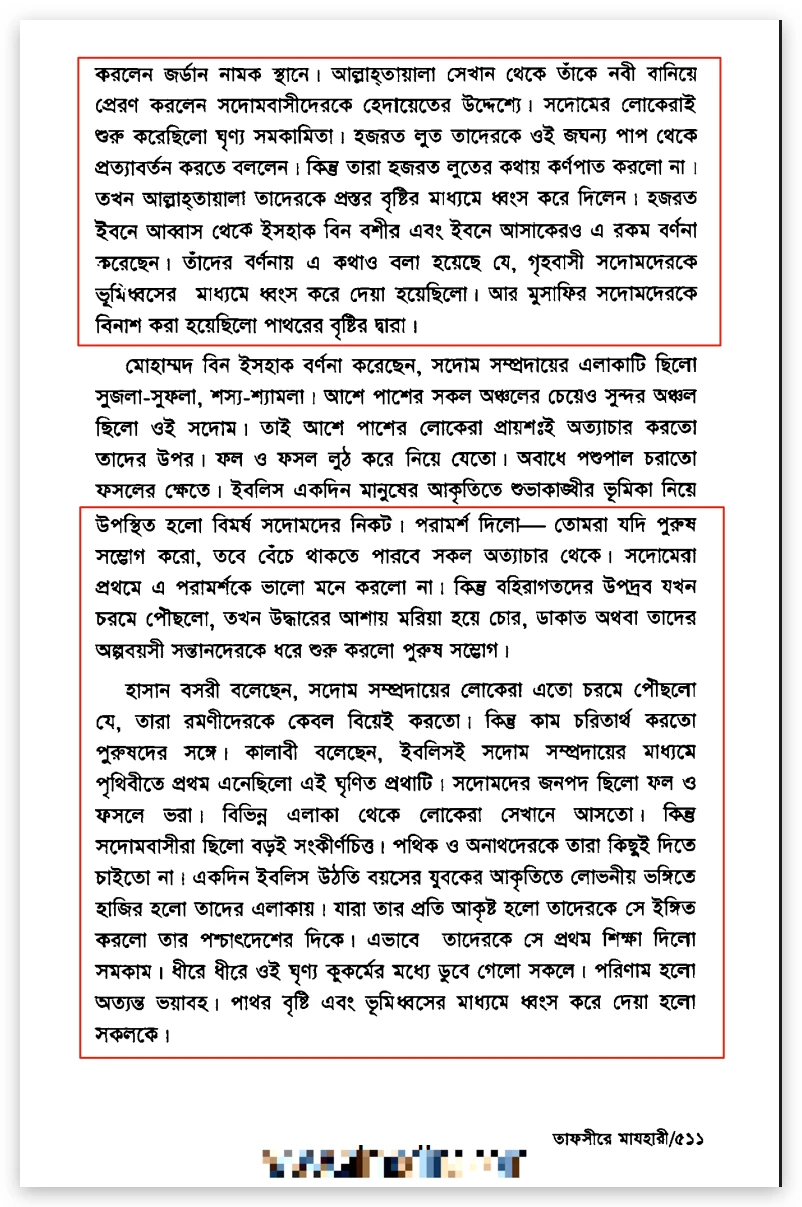
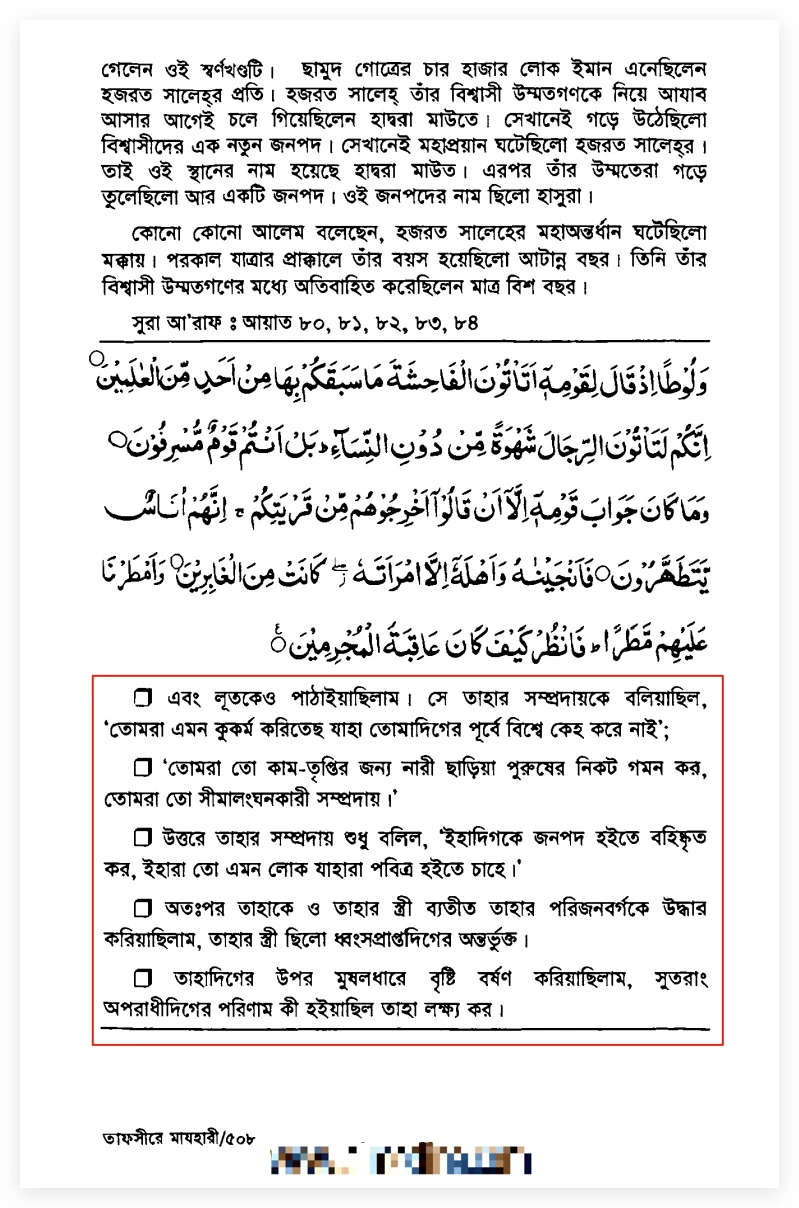
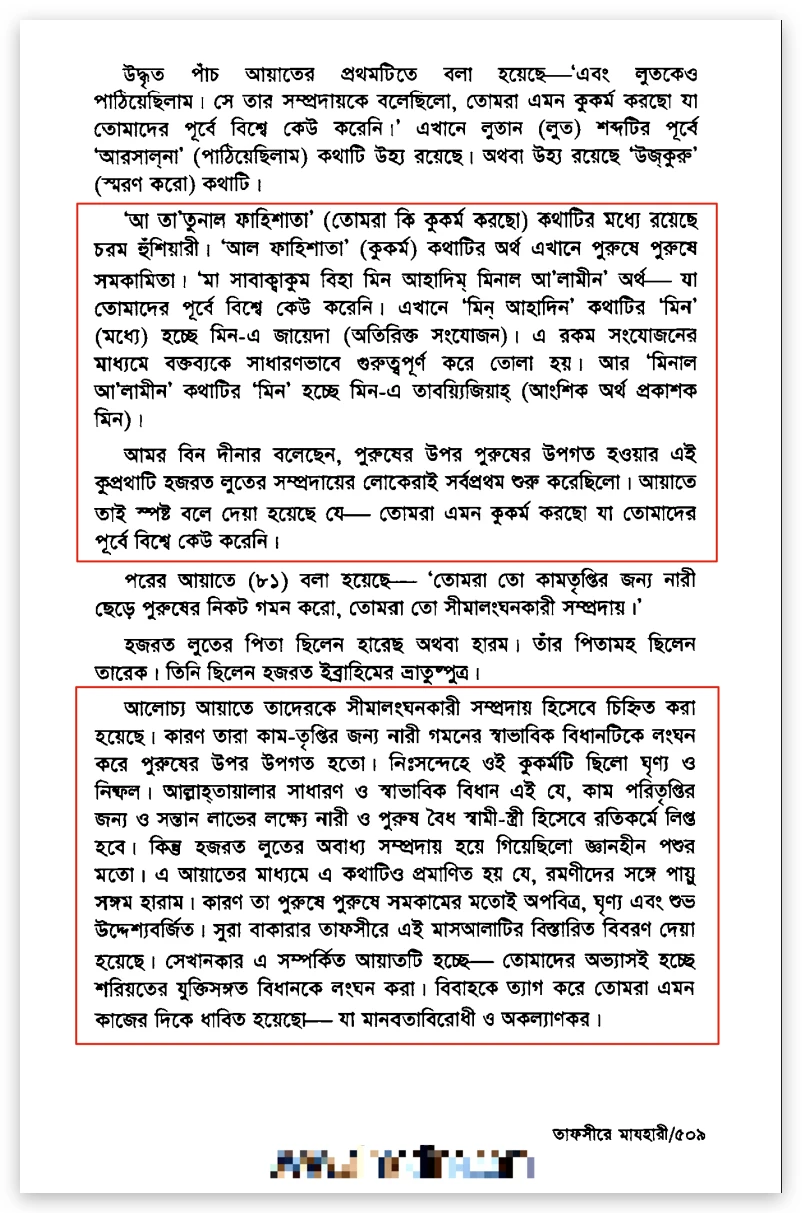
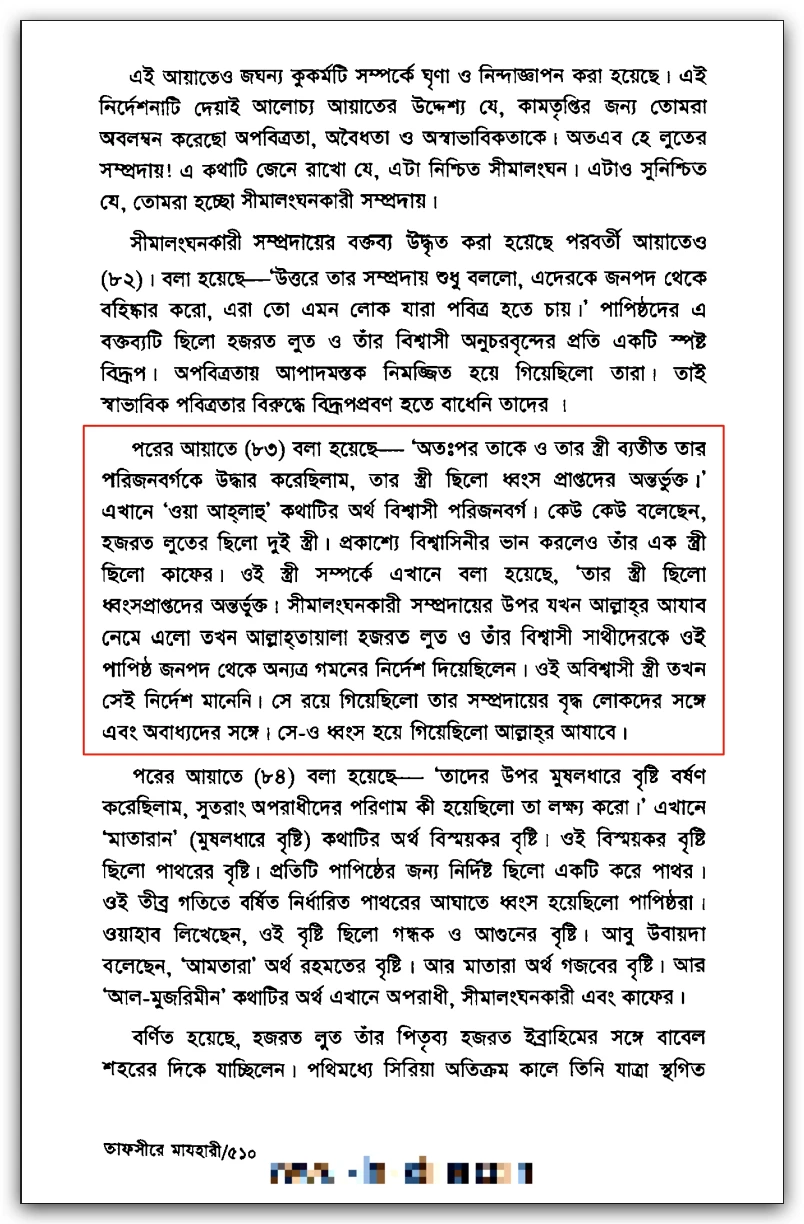
আসুন প্রখ্যাত তাফসীর গ্রন্থ তাফসীরে মাযহারী থেকে দেখে নেয়া যাক, এই আয়াতগুলো দ্বারা আসলে কী বোঝানো হচ্ছে, (( তাফসীরে মায়হারী, ৪র্থ খণ্ড, ইসলামিক ফাউন্ডেশন, পৃষ্ঠা ৫০৮-৫১১ ))

→ এবং লূতকেও পাঠাইয়াছিলাম। সে তাহার সম্প্রদায়কে বলিয়াছিল, 'তোমরা এমন কুকর্ম করিতেছ যাহা তোমাদিগের পূর্বে বিশ্বে কেহ করে নাই';
→ 'তোমরা তো কাম-তৃপ্তির জন্য নারী ছাড়িয়া পুরুষের নিকট গমন কর, তোমরা তো সীমালংঘনকারী সম্প্রদায়।'
→ উত্তরে তাহার সম্প্রদায় শুধু বলিল, “ইহাদিগকে জনপদ হইতে বহিষ্কৃত কর, ইহারা তো এমন লোক যাহারা পবিত্র হইতে চাহে।
→ অতঃপর তাহাকে ও তাহার স্ত্রী ব্যতীত তাহার পরিজনবর্গকে উদ্ধার করিয়াছিলাম, তাহার স্ত্রী ছিলো ধ্বংসপ্রাপ্তদিগের অন্তর্ভুক্ত।
→ তাহাদিগের উপর মুষলধারে বৃষ্টি বর্ষণ করিয়াছিলাম, সুতরাং অপরাধীদিগের পরিণাম কী হইয়াছিল তাহা লক্ষ্য কর।
উদ্ধৃত পাঁচ আয়াতের প্রথমটিতে বলা হয়েছে—‘এবং লুতকেও পাঠিয়েছিলাম। সে তার সম্প্রদায়কে বলেছিলো, তোমরা এমন কুকর্ম করছো যা তোমাদের পূর্বে বিশ্বে কেউ করেনি।' এখানে লুতান (লুত) শব্দটির পূর্বে 'আরসালনা' (পাঠিয়েছিলাম) কথাটি উহ্য রয়েছে। অথবা উহ্য রয়েছে … (স্মরণ করো) কথাটি।
‘আ তা’তুনাল ফাহিশাতা' (তোমরা কি কুকর্ম করছো) কথাটির মধ্যে রয়েছে চরম হুঁশিয়ারী। “আল ফাহিশাতা' (কুকর্ম) কথাটির অর্থ এখানে পুরুষে পুরুষে সমকামিতা। ‘মা সাবাক্বাকুম বিহা মিন আহাদিম্ মিনাল আ'লামীন' অর্থ— যা তোমাদের পূর্বে বিশ্বে কেউ করেনি। এখানে 'মিন্‌ আহাদিন' কথাটির 'মিন' (মধ্যে) হচ্ছে মিন-এ জায়েদা (অতিরিক্ত সংযোজন)। এ রকম সংযোজনের মাধ্যমে বক্তব্যকে সাধারণভাবে গুরুত্বপূর্ণ করে তোলা হয়। আর “মিনাল আ'লামীন' কথাটির ‘মিন' হচ্ছে মিন-এ তাবয়্যিজিয়াহ্ (আংশিক অর্থ প্রকাশক মিন) ৷
আমর বিন দীনার বলেছেন, পুরুষের উপর পুরুষের উপগত হওয়ার এই কুপ্রথাটি হজরত লুতের সম্প্রদায়ের লোকেরাই সর্বপ্রথম শুরু করেছিলো। আয়াতে তাই স্পষ্ট বলে দেয়া হয়েছে যে— তোমরা এমন কুকর্ম করছো যা তোমাদের পূর্বে বিশ্বে কেউ করেনি।
পরের আয়াতে (৮১) বলা হয়েছে— 'তোমরা তো কামতৃপ্তির জন্য নারী ছেড়ে পুরুষের নিকট গমন করো, তোমরা তো সীমালংঘনকারী সম্প্রদায়।' হজরত লুতের পিতা ছিলেন হারেছ অথবা হারম। তাঁর পিতামহ ছিলেন তারেক। তিনি ছিলেন হজরত ইব্রাহিমের ভ্রাতুষ্পুত্র।
আলোচ্য আয়াতে তাদেরকে সীমালংঘনকারী সম্প্রদায় হিসেবে চিহ্নিত করা হয়েছে। কারণ তারা কাম-তৃপ্তির জন্য নারী গমনের স্বাভাবিক বিধানটিকে লংঘন করে পুরুষের উপর উপগত হতো। নিঃসন্দেহে ওই কুকর্মটি ছিলো ঘৃণ্য ও নিষ্ফল। আল্লাহ্তায়ালার সাধারণ ও স্বাভাবিক বিধান এই যে, কাম পরিতৃপ্তির জন্য ও সন্তান লাভের লক্ষ্যে নারী ও পুরুষ বৈধ স্বামী-স্ত্রী হিসেবে রতিকর্মে লিপ্ত হবে। কিন্তু হজরত লুতের অবাধ্য সম্প্রদায় হয়ে গিয়েছিলো জ্ঞানহীন পশুর মতো। এ আয়াতের মাধ্যমে এ কথাটিও প্রমাণিত হয় যে, রমণীদের সঙ্গে পায়ু সঙ্গম হারাম। কারণ তা পুরুষে পুরুষে সমকামের মতোই অপবিত্র, ঘৃণ্য এবং শুভ উদ্দেশ্যবর্জিত। সুরা বাকারার তাফসীরে এই মাসআলাটির বিস্তারিত বিবরণ দেয়া হয়েছে। সেখানকার এ সম্পর্কিত আয়াতটি হচ্ছে— তোমাদের অভ্যাসই হচ্ছে শরিয়তের যুক্তিসঙ্গত বিধানকে লংঘন করা। বিবাহকে ত্যাগ করে তোমরা এমন কাজের দিকে ধাবিত হয়েছো— যা মানবতাবিরোধী ও অকল্যাণকর।
এই আয়াতেও জঘন্য কুকর্মটি সম্পর্কে ঘৃণা ও নিন্দাজ্ঞাপন করা হয়েছে। এই নির্দেশনাটি দেয়াই আলোচ্য আয়াতের উদ্দেশ্য যে, কামতৃপ্তির জন্য তোমরা অবলম্বন করেছো অপবিত্রতা, অবৈধতা ও অস্বাভাবিকতাকে। অতএব হে লুতের সম্প্রদায়! এ কথাটি জেনে রাখো যে, এটা নিশ্চিত সীমালংঘন। এটাও সুনিশ্চিত যে, তোমরা হচ্ছো সীমালংঘনকারী সম্প্রদায়। সীমালংঘনকারী সম্প্রদায়ের বক্তব্য উদ্ধৃত করা হয়েছে পরবর্তী আয়াতেও (৮২)। বলা হয়েছে———উত্তরে তার সম্প্রদায় শুধু বললো, এদেরকে জনপদ থেকে বহিষ্কার করো, এরা তো এমন লোক যারা পবিত্র হতে চায়।' পাপিষ্ঠদের এ বক্তব্যটি ছিলো হজরত লুত ও তাঁর বিশ্বাসী অনুচরবৃন্দের প্রতি একটি স্পষ্ট বিদ্রূপ। অপবিত্রতায় আপাদমস্তক নিমজ্জিত হয়ে গিয়েছিলো তারা। তাই স্বাভাবিক পবিত্রতার বিরুদ্ধে বিদ্রূপপ্রবণ হতে বাধেনি তাদের। পরের আয়াতে (৮৩) বলা হয়েছে—~— 'অতঃপর তাকে ও তার স্ত্রী ব্যতীত তার পরিজনবর্গকে উদ্ধার করেছিলাম, তার স্ত্রী ছিলো ধ্বংস প্রাপ্তদের অন্তর্ভুক্ত।' এখানে ‘ওয়া আলাহু' কথাটির অর্থ বিশ্বাসী পরিজনবর্গ। কেউ কেউ বলেছেন, হজরত লুতের ছিলো দুই স্ত্রী। প্রকাশ্যে বিশ্বাসিনীর ভান করলেও তাঁর এক স্ত্রী ছিলো কাফের। ওই স্ত্রী সম্পর্কে এখানে বলা হয়েছে, 'তার স্ত্রী ছিলো ধ্বংসপ্রাপ্তদের অন্তর্ভুক্ত।
সীমালংঘনকারী সম্প্রদায়ের উপর যখন আল্লাহ্ আযাব নেমে এলো তখন আল্লাহ্তায়ালা হজরত লুত ও তাঁর বিশ্বাসী সাথীদেরকে ওই পাপিষ্ঠ জনপদ থেকে অন্যত্র গমনের নির্দেশ দিয়েছিলেন। ওই অবিশ্বাসী স্ত্রী তখন সেই নির্দেশ মানেনি। সে রয়ে গিয়েছিলো তার সম্প্রদায়ের বৃদ্ধ লোকদের সঙ্গে এবং অবাধ্যদের সঙ্গে। সে-ও ধ্বংস হয়ে গিয়েছিলো আল্লাহ্ আযাবে।
পরের আয়াতে (৮৪) বলা হয়েছে— 'তাদের উপর মুষলধারে বৃষ্টি বর্ষণ করেছিলাম, সুতরাং অপরাধীদের পরিণাম কী হয়েছিলো তা লক্ষ্য করো।' এখানে 'মাতারান' (মুষলধারে বৃষ্টি) কথাটির অর্থ বিস্ময়কর বৃষ্টি। ওই বিস্ময়কর বৃষ্টি ছিলো পাথরের বৃষ্টি। প্রতিটি পাপিষ্ঠের জন্য নির্দিষ্ট ছিলো একটি করে পাথর। ওই তীব্র গতিতে বর্ষিত নির্ধারিত পাথরের আঘাতে ধ্বংস হয়েছিলো পাপিষ্ঠরা। ওয়াহাব লিখেছেন, ওই বৃষ্টি ছিলো গন্ধক ও আগুনের বৃষ্টি। আবু উবায়দা বলেছেন, 'আমতারা' অর্থ রহমতের বৃষ্টি। আর মাতারা অর্থ গজবের বৃষ্টি। আর ‘আল-মুজরিমীন' কথাটির অর্থ এখানে অপরাধী, সীমালংঘনকারী এবং কাফের।
বর্ণিত হয়েছে, হজরত লুত তাঁর পিতৃব্য হজরত ইব্রাহিমের সঙ্গে বাবেল শহরের দিকে যাচ্ছিলেন। পথিমধ্যে সিরিয়া অতিক্রম কালে তিনি যাত্রা স্থগিত করলেন জর্ডান নামক স্থানে। আল্লাহ্তায়ালা সেখান থেকে তাঁকে নবী বানিয়ে প্রেরণ করলেন সদোমবাসীদেরকে হেদায়েতের উদ্দেশ্যে। সদোমের লোকেরাই শুরু করেছিলো ঘৃণ্য সমকামিতা। হজরত লুত তাদেরকে ওই জঘন্য পাপ থেকে প্রত্যাবর্তন করতে বললেন। কিন্তু তারা হজরত লুতের কথায় কর্ণপাত করলো না। তখন আল্লাহ্তায়ালা তাদেরকে প্রস্তর বৃষ্টির মাধ্যমে ধ্বংস করে দিলেন। হজরত ইবনে আব্বাস থেকে ইসহাক বিন বশীর এবং ইবনে আসাকেরও এ রকম বর্ণনা করেছেন। তাঁদের বর্ণনায় এ কথাও বলা হয়েছে যে, গৃহবাসী সদোমদেরকে ভূমিধ্বসের মাধ্যমে ধ্বংস করে দেয়া হয়েছিলো। আর মুসাফির সদোমদেরকে বিনাশ করা হয়েছিলো পাথরের বৃষ্টির দ্বারা।
মোহাম্মদ বিন ইসহাক বর্ণনা করেছেন, সদোম সম্প্রদায়ের এলাকাটি ছিলো সুজলা-সুফলা, শস্য-শ্যামলা। আশে পাশের সকল অঞ্চলের চেয়েও সুন্দর অঞ্চল ছিলো ওই সদোম। তাই আশে পাশের লোকেরা প্রায়শঃই অত্যাচার করতো তাদের উপর। ফল ও ফসল লুঠ করে নিয়ে যেতো। অবাধে পশুপাল চরাতো ফসলের ক্ষেতে। ইবলিস একদিন মানুষের আকৃতিতে শুভাকাঙ্খীর ভূমিকা নিয়ে উপস্থিত হলো বিমর্ষ সদোমদের নিকট। পরামর্শ দিলো— তোমরা যদি পুরুষ সম্ভোগ করো, তবে বেঁচে থাকতে পারবে সকল অত্যাচার থেকে। সদোমেরা প্রথমে এ পরামর্শকে ভালো মনে করলো না। কিন্তু বহিরাগতদের উপদ্রব যখন চরমে পৌঁছলো, তখন উদ্ধারের আশায় মরিয়া হয়ে চোর, ডাকাত অথবা তাদের অল্পবয়সী সন্তানদেরকে ধরে শুরু করলো পুরুষ সম্ভোগ।
হাসান বসরী বলেছেন, সদোম সম্প্রদায়ের লোকেরা এতো চরমে পৌঁছলো যে, তারা রমণীদেরকে কেবল বিয়েই করতো। কিন্তু কাম চরিতার্থ করতো পুরুষদের সঙ্গে। কালাবী বলেছেন, ইবলিসই সদোম সম্প্রদায়ের মাধ্যমে পৃথিবীতে প্রথম এনেছিলো এই ঘৃণিত প্রথাটি। সদোমদের জনপদ ছিলো ফল ও ফসলে ভরা। বিভিন্ন এলাকা থেকে লোকেরা সেখানে আসতো। কিন্তু সদোমবাসীরা ছিলো বড়ই সংকীর্ণচিত্ত। পথিক ও অনাথদেরকে তারা কিছুই দিতে চাইতো না। একদিন ইবলিস উঠতি বয়সের যুবকের আকৃতিতে লোভনীয় ভঙ্গিতে হাজির হলো তাদের এলাকায়। যারা তার প্রতি আকৃষ্ট হলো তাদেরকে সে ইঙ্গিত করলো তার পশ্চাৎদেশের দিকে। এভাবে তাদেরকে সে প্রথম শিক্ষা দিলো সমকাম। ধীরে ধীরে ওই ঘৃণ্য কুকর্মের মধ্যে ডুবে গেলো সকলে। পরিণাম হলো অত্যন্ত ভয়াবহ। পাথর বৃষ্টি এবং ভূমিধ্বসের মাধ্যমে ধ্বংস করে দেয়া হলো সকলকে।
হাদিসে সমকামীদের হত্যার বিধান

হাদিস সমূহে সমকামিতার বিষয়ে ইসলামী আইন গঠনে মুখ্য ভূমিকা রেখেছে। নবী মুহাম্মদ-এর বর্ণিত একাধিক হাদিসে সমকামীদের শাস্তি হিসেবে মৃত্যুদণ্ডের উল্লেখ পাওয়া যায়। এই হাদিসগুলোকে বিভিন্ন আলেম ও মুফাসসির তাদের নিজ নিজ ফিকাহ মতবাদের আলোকে ব্যাখ্যা করেছেন। যেমন—সুনান আত-তিরমিযী (হাদীস ১৪৫৬), সুনান আবূ দাউদ (৪৪৬২), সুনান ইবন মাজাহ (২৫৬১), ও আল-বায়হাকী (৮/২৩২)-এ বর্ণিত হয়েছে যে, “যে ব্যক্তি কওমে লূতের কাজ করে, তাকে এবং তার সঙ্গীকে হত্যা করো।” ইমাম নাসাঈ, ইমাম তিরমিজী ও পরবর্তীতে ইমাম আল-আলবানী এই হাদিসকে সহীহ বলেছেন (( ইরওয়া আল-গালীল, হাদীস ২৩৫০ ))।

সুনানে ইবনে মাজাহ
অধ্যায়ঃ ১৪/ হদ্দ (দন্ড)
১৪/১২. যে ব্যক্তি লূত জাতির অনুরূপ অপকর্মে লিপ্ত হয়
১/২৫৬১। ইবনে আববাস (রাঃ) থেকে বর্ণিত। রাসূলুল্লাহ সাল্লাল্লাহু আলাইহি ওয়াসাল্লাম বলেনঃ তোমরা কাউকে লূত জাতির অনুরূপ অপকর্মে লিপ্ত পেলে তাকে এবং যার সাথে তা করা হয় তাকে হত্যা করো।
তিরমিযী ১৪৫৬, আবূ দাউদ ৪৪৬২, বায়হাকী ফিস সুনান ৮/২৩২, ইরওয়া ২৩৫০, মিশকাত ৩৫৭৫। তাহকীক আলবানীঃ সহীহ। উক্ত হাদিসের রাবী আবদুল আযীয বিন মুহাম্মাদ সম্পর্কে মুহাম্মাদ বিন সা’দ বলেন, তিনি হাদিস বর্ণনায় সংমিশ্রণ করেন। ইবনু হিব্বান বলেন, তিনি হাদিস বর্ণনায় ভুল করেন। মালিক বিন আনাস তাকে সিকাহ বলেছেন। আহমাদ বিন শু’আয়ব আন নাসায়ী বলেন, তিনি নির্ভরযোগ্য নয়। ইবনু হাজার আল-আসকালানী বলেন, তিনি সত্যবাদী তবে নিজ কিতাব ছাড়া অন্যত্র থেকে হাদিস বর্ণনায় ভুল করেন। (তাহযীবুল কামালঃ রাবী নং ৩৪৭০, ১৮/১৮৭ নং পৃষ্ঠা)
হাদিসের মানঃ সহিহ (Sahih)

সুনান আবূ দাউদ (তাহকিককৃত)
অধ্যায়ঃ ৩৩/ অপরাধ ও তার শাস্তি
২৯. কেউ কওমে লূতের অনুরূপ অপকর্ম করলে
৪৪৬৩। ইবনু আব্বাস (রাঃ) সূত্রে বর্ণিত। তিনি বলেন, অবিবাহিতদের লাওয়াতাতে (পায়ুকামে) লিপ্ত পাওয়া গেলে রজম করা হবে। ইমাম আবূ দাঊদ (রহঃ) বলেন, ‘আসিম (রহঃ) সূত্রে বর্ণিত হাদীস আমর ইবনু আবূ আমরের হাদীসকে দুর্বল প্রমাণিত করে।(1)
সনদ সহীহ মাওকুফ।
(1). বায়হাক্বী।
হাদিসের মানঃ সহিহ (Sahih)

এই হাদীসগুলো ইসলামী ফিকাহের প্রধান ভিত্তি হিসেবে গৃহীত হয়েছে। ইমাম মালিক, শাফেয়ী ও হাম্বলিরা একে সরাসরি হদ্দ অপরাধের আওতায় ফেলেছেন, আর ইমাম আবু হানিফা একে তাযীর হিসেবে দেখেছেন। অর্থাৎ, বিচারকের বিবেচনায় শাস্তি নির্ধারিত হতে পারে — কিন্তু সর্বাধিক প্রচলিত মত হলো মৃত্যু। মধ্যযুগীয় ফিকাহ গ্রন্থ যেমন আল-মুয়াত্তা, আল-হিদায়া, আল-মুগনী, বদায়েউস-সানায়ি প্রভৃতিতে এই শাস্তি বিস্তারিতভাবে উল্লেখ করা হয়েছে।


ইসলামী ফিকহে সমকামীদের হত্যার ঐতিহাসিক প্রেক্ষাপট

ইসলামী ইতিহাসে সমকামিতা বা লওয়াত অপরাধে মৃত্যুদণ্ড কার্যকরের একাধিক দলিল পাওয়া যায়। খলিফা উমর ইবনুল খাত্তাব (রা.)-এর সময় থেকে শুরু করে উমাইয়া ও আব্বাসীয় শাসনামলে লওয়াত অপরাধের দায়ে শিরচ্ছেদ, রজম, এমনকি জীবন্ত পুড়িয়ে মারার নজির পাওয়া যায়। ইবন কুদামা (আল-মুগনী) উল্লেখ করেন যে, উমর (রা.) একদল ব্যক্তিকে লওয়াতের অভিযোগে হত্যা করেন এবং বলেন, “তোমরা তাদের উপর আল্লাহর শাস্তি প্রয়োগ করো।” আল-জাসাস তাঁর আহকামুল কুরআন-এ বলেন, “লওয়াত এমন অপরাধ যা আল্লাহর ক্রোধ ডেকে আনে, তাই এর শাস্তি মৃত্যুদণ্ড।"

আধুনিক ইসলামিক গবেষকরা উল্লেখ করেছেন যে, এই আইনি প্রক্রিয়া মূলত ধর্মীয় শাস্তির চেয়ে বেশি ছিল সামাজিক নিয়ন্ত্রণের হাতিয়ার। মধ্যযুগীয় মুসলিম সমাজে রাষ্ট্র, ধর্ম ও নৈতিকতা ছিল একে অপরের সঙ্গে গভীরভাবে জড়িত। ফলে যৌনতার যে কোনো ভিন্নতা রাষ্ট্রবিরোধী বা ধর্মবিরোধী অপরাধ হিসেবে বিবেচিত হতো। কিছু গবেষক যেমন খালেদ এল-রুয়াইহেব (( Harvard University, Before Homosexuality in the Arab-Islamic World, 1500–1800 )) দেখিয়েছেন, ইসলামি সমাজে প্রকৃত সমকামী আচরণের চেয়ে বেশি গুরুত্ব পেতো সামাজিক লজ্জা ও সম্মানরক্ষা। অর্থাৎ, সমকামিতা নিয়ে ভয় ও নিষেধাজ্ঞা মূলত সামাজিক রক্ষণশীলতা ও ধর্মীয় কর্তৃত্ববাদের অংশ।


খিলাফত আমলে খলিফাদের প্রকাশ্য সমকামিতা

যদিও ইসলামী শরীয়তে সমকামিতার শাস্তি কঠোর ও মৃত্যুদণ্ডযোগ্য বলা হয়েছে, ইতিহাসে দেখা যায় — খিলাফতের রাজদরবারে ঠিক বিপরীত প্রবণতা বিদ্যমান ছিল। বহু খলিফা, আমির ও রাজপুরুষ নিজের প্রাসাদে প্রকাশ্যে পুরুষপ্রেমে লিপ্ত ছিলেন এবং তরুণ দাস বা "গেলমান" বা “আমরদ” (beardless youths)-এর প্রতি অস্বাভাবিক আকর্ষণ দেখাতেন। ইসলামী ইতিহাসবিদ আল-মাসউদী, আল-তাবারী, ইবন খাল্লিকান ও ইবন আল-জাওযী সহ বহু প্রাচীন লেখক তাঁদের গ্রন্থে এই ঘটনাগুলো নথিভুক্ত করেছেন।

আব্বাসীয় খলিফা আল-আমিন (শাসনকাল ৮০৯–৮১৩ খ্রিস্টাব্দ) ছিলেন ইসলামী ইতিহাসের অন্যতম বিতর্কিত শাসক। আল-মাসউদী তাঁর Muruj al-Dhahab-এ লিখেছেন, “আল-আমিন নারীদের প্রতি অনাগ্রহী ছিলেন এবং সুদর্শন তরুণ দাসদের সঙ্গেই সময় কাটাতেন; তাদের তিনি ‘প্রিয়জন’ বলে ডাকতেন” (( Muruj al-Dhahab, vol. 4, p. 61 )). ইবন আল-জাওযী তাঁর Al-Muntazam fi Tarikh al-Umam wal-Muluk-এ উল্লেখ করেছেন যে, আল-আমিনের প্রাসাদে শতাধিক তরুণ গায়ক ও দাস ছিল, যাদের মধ্যে কয়েকজনের সঙ্গে তাঁর ঘনিষ্ঠ সম্পর্কের গুজব ছড়িয়ে পড়ে (( Al-Muntazam, vol. 9, p. 28 )). আল-তাবারীর Tarikh al-Rusul wa al-Muluk-এও একই তথ্য পাওয়া যায়, যেখানে তিনি বলেন, “খলিফা তাঁর সভায় তরুণ দাসদের সঙ্গে কবিতা পাঠ করতেন এবং তাদের সৌন্দর্যের প্রশংসা করতেন” ((Tarikh al-Tabari, vol. 31, p. 28–29)).

আরেক আব্বাসীয় খলিফা আল-মুতাসিম বিল্লাহ (শাসনকাল ৮৩৩–৮৪২) সম্পর্কে ইবন খাল্লিকান লিখেছেন যে, তিনি তুর্কি সৈন্যদের সৌন্দর্যে মুগ্ধ ছিলেন এবং তাঁদের মধ্য থেকেই রাজপ্রাসাদের রক্ষীবাহিনী গঠন করেন (( Ibn Khallikan, Wafayat al-A’yan, vol. 5, p. 241 ))। আল-মাসউদীর বিবরণে দেখা যায়, তাঁর প্রিয় সৈন্য আফশিনের সঙ্গে অস্বাভাবিক ঘনিষ্ঠতা ছিল, যা প্রাসাদীয় রাজনীতির মূল বিষয় হয়ে ওঠে (( Muruj al-Dhahab, vol. 4, p. 102 )). আধুনিক ইতিহাসবিদ Hugh Kennedy এই সম্পর্ককে “personal intimacy and political favoritism intertwined with homoerotic overtones” বলে বর্ণনা করেছেন (( Kennedy, The Prophet and the Age of the Caliphates, 2004, p. 165 )).

ফাতেমীয় খলিফা আল-আমির ফি আহকমিল্লাহ (শাসনকাল ১১০১–১১৩০ খ্রিস্টাব্দ) সম্পর্কেও একই ধরনের অভিযোগ পাওয়া যায়। মিশরের ইতিহাসবিদ আল-মাকরিজী তাঁর al-Khitat গ্রন্থে লিখেছেন যে, “খলিফা যুবকদের প্রতি প্রবল আকৃষ্ট ছিলেন; তাঁর প্রাসাদে প্রায়শই নগ্ন নর্তক ও দাসদের নৃত্য আয়োজন হতো” (( al-Maqrizi, al-Khitat, vol. 2, p. 148 ))। এই সমকামী আচরণের কারণে প্রাসাদের নৈতিক অবক্ষয় ঘটে এবং পরবর্তীতে তিনি আততায়ী হামলায় নিহত হন।

আন্দালুসে উমাইয়া রাজবংশের খলিফাদের মধ্যেও সমকামিতার প্রবণতা স্পষ্ট দেখা যায়। কর্ডোভার খলিফা আল-হাকাম দ্বিতীয় (শাসনকাল ৯৬১–৯৭৬ খ্রিস্টাব্দ) তাঁর প্রাসাদে এক তরুণ গায়ক “সান্দাল”-এর প্রতি অতিরিক্ত অনুরাগ দেখাতেন, যাকে তিনি প্রায় স্ত্রীর মর্যাদা দিতেন (( Ibn Hayyan, al-Muqtabis fi Tarikh al-Andalus, vol. 5, p. 312 ))। আধুনিক ইতিহাসবিদ Reinhart Dozy লিখেছেন, “আল-হাকামের রাজসভায় পুরুষপ্রেম ছিল এক ধরণের রোমান্টিক ফ্যাশন, যা কবিতা, সংগীত ও রাজকীয় সংস্কৃতির সঙ্গে জড়িয়ে যায়” (( Dozy, Spanish Islam: A History of the Moslems in Spain, 1913, p. 458 ))।

এ সময়ের প্রখ্যাত কবি আবু নুয়াস (৭৫৬–৮১৪ খ্রিস্টাব্দ) ছিলেন আল-আমিনের রাজদরবারের ঘনিষ্ঠ। তাঁর কবিতায় পুরুষপ্রেম ও তরুণদের প্রতি যৌন আকর্ষণ প্রকাশ্যে বর্ণিত হয়েছে, যেমন—“হে তরুণ, তোর গালের গোলাপ আর ঠোঁটের মদে মত্ত আমি” (( Abu Nuwas: The Libertine Poet of Baghdad, Philip Kennedy, 2005, p. 72 ))। আবু নুয়াসের এই সাহসী কবিতা ও আল-আমিনের সমর্থন মধ্যযুগীয় ইসলামী সভ্যতার অন্তর্গত বৈপরীত্যকে স্পষ্টভাবে প্রকাশ করে—যেখানে শরীয়ত সমকামিতার জন্য মৃত্যুদণ্ডের নির্দেশ দেয়, অথচ রাজদরবারে সেটিই ছিল একধরনের বিলাসিতা ও সংস্কৃতি।

উল্লেখ্য, এই তথ্যগুলো শুধু গুজব নয়; বরং সমকালীন আরবি ঐতিহাসিক গ্রন্থগুলোতে বিস্তৃতভাবে নথিবদ্ধ। যদিও কিছু বিবরণ পরবর্তীতে রাজনৈতিক উদ্দেশ্যে বিকৃত হতে পারে, তবুও বহুসূত্রে মিলে যায় এমন দলিলগুলো ইঙ্গিত দেয় যে খিলাফতের সময় প্রকাশ্য সমকামিতা কেবল ব্যক্তিগত নয়, রাজকীয় সংস্কৃতিরই অংশে পরিণত হয়েছিল। এটি প্রমাণ করে, ইসলামী খিলাফতের রাজনৈতিক ক্ষমতা ও ধর্মীয় বিধানের মধ্যে গভীর দ্বিচারিতা এবং নৈতিক বিচ্ছিন্নতা বিদ্যমান ছিল।


আধুনিক ইসলামি রাষ্ট্রে সমকামিতার শাস্তি

২১ শতকেও বহু ইসলামি দেশ এই প্রাচীন শরীয়ত বিধান অনুসারে আইন প্রণয়ন করেছে। ইরান, সৌদি আরব, আফগানিস্তান, ইয়েমেন, মাওরিতানিয়া, সুদান এবং নাইজেরিয়ার উত্তরাঞ্চলে সমকামিতাকে মৃত্যুদণ্ডযোগ্য অপরাধ হিসেবে ঘোষণা করা হয়েছে। ইরানের ইসলামী দণ্ডবিধির ২৩৪ ধারায় (Islamic Penal Code, 2013) বলা আছে—"দুই পুরুষের মধ্যে যৌন সম্পর্ক প্রমাণিত হলে উভয়ের মৃত্যুদণ্ড কার্যকর করা হবে।" সৌদি আরবের শরীয়ত আদালতে বিচারক ফিকাহের ব্যাখ্যা অনুসারে সমকামিতাকে "ফাহিশা" (অশ্লীলতা) হিসেবে গণ্য করে মৃত্যুদণ্ড, রজম বা চাবুকের শাস্তি নির্ধারণ করেন। আফগানিস্তানের তালেবান সরকারের ২০২১ সালের নির্দেশিকাতেও সমকামীদের মৃত্যুদণ্ডের আদেশ পুনর্ব্যক্ত হয়েছে (( Afghanistan: Taliban Target LGBT Afghans ))।

এই দেশগুলোর আইনি কাঠামো মূলত শরীয়তভিত্তিক, যেখানে আধুনিক সংবিধান ও আন্তর্জাতিক মানবাধিকার চুক্তির কোনো বাস্তব প্রতিফলন নেই। Human Rights Watch, Amnesty International এবং United Nations Human Rights Council বারবার এই শাস্তির নিন্দা জানিয়েছে। তাদের প্রতিবেদনে বলা হয়েছে, ইসলামি দেশগুলোর এই আইনগুলো “religiously justified violence” বা ধর্মীয়ভাবে বৈধ ঘোষিত সহিংসতার উদাহরণ। ২০২৩ সালে জাতিসংঘের মহাসচিবের প্রতিবেদনে (A/HRC/52/45) উল্লেখ করা হয়, “ধর্মীয় নীতির নামে মানুষের যৌন পরিচয়ের জন্য মৃত্যুদণ্ড প্রদান আন্তর্জাতিক মানবাধিকারের সবচেয়ে জঘন্য লঙ্ঘন।”


মানবাধিকার, বিজ্ঞান ও নৈতিকতার আলোকে সমালোচনা

সমকামিতা সম্পর্কে ইসলামী শরীয়তের ধারণা প্রাচীনকালীন সামাজিক মনোভাবের প্রতিফলন, যা আধুনিক বিজ্ঞানের সঙ্গে সম্পূর্ণ অসঙ্গত। মনোবিজ্ঞান, জীববিজ্ঞান এবং সমাজবিজ্ঞানের গবেষণা আজ স্পষ্টভাবে দেখিয়েছে যে, যৌন অভিরুচি মানুষের জিনগত ও মানসিক গঠনের সঙ্গে সম্পর্কিত, এটি পছন্দনির্ভর নয়। ১৯৭৩ সালে American Psychiatric Association সমকামিতাকে মানসিক রোগের তালিকা থেকে বাদ দেয় এবং ২০১৯ সালে WHO ICD-11 সমকামিতাকে “অস্বাভাবিকতা” নয়, বরং “মানব বৈচিত্র্য”-এর অংশ হিসেবে স্বীকৃতি দেয়।

অন্যদিকে, আন্তর্জাতিক মানবাধিকার সনদ—বিশেষত Universal Declaration of Human Rights (UDHR, অনুচ্ছেদ ৩, ৫, ৭ ও ১২) এবং International Covenant on Civil and Political Rights (ICCPR, Article 6)—জীবন, স্বাধীনতা, এবং বৈষম্যহীনতার অধিকার নিশ্চিত করেছে। সুতরাং কোনো ব্যক্তির যৌন পরিচয় বা আচরণের কারণে মৃত্যুদণ্ড দেওয়া মানবাধিকারের মৌলিক লঙ্ঘন। ধর্মীয় যুক্তির নামে এই শাস্তি কেবল একটি সামাজিক সহিংসতা বৈধ করার প্রক্রিয়া।

এখানে একটি গুরুত্বপূর্ণ দিক হলো: ইসলামী শরীয়ত সমকামিতাকে ‘নৈতিক অপরাধ’ হিসেবে সংজ্ঞায়িত করলেও, কোনো ভুক্তভোগী বা ক্ষতির প্রমাণ ছাড়াই শাস্তি নির্ধারণ করে। এটি ‘retributive justice’-এর মৌলিক ধারণারও পরিপন্থী। কোনো অপরাধে যদি সরাসরি অন্যের ক্ষতি না হয়, তাহলে মৃত্যুদণ্ডের মতো চরম শাস্তি যুক্তিসঙ্গত নয়। এই কারণেই অধিকাংশ আধুনিক আইনব্যবস্থায় সমকামিতা অপরাধের তালিকা থেকে বাদ পড়েছে। আজকের দিনে ১৩০টিরও বেশি দেশে সমকামী সম্পর্ক আইনত বৈধ।


উপসংহার

ইসলামী শরীয়তের সমকামী হত্যার বিধান মূলত একটি ধর্মীয় কর্তৃত্ববাদী ব্যবস্থার অংশ, যা মানুষের ব্যক্তিগত পরিচয় ও স্বাধীনতার বিরুদ্ধে দাঁড়ায়। এই বিধান যে যুগে গঠিত হয়েছিল, তখনকার সমাজে বৈজ্ঞানিক ব্যাখ্যা অনুপস্থিত ছিল; নৈতিকতা নির্ধারিত হতো পৌরাণিক গল্প আর ধর্মীয় ধারণার দ্বারা। কিন্তু আধুনিক সভ্যতায় আইন ও ন্যায়বিচারকে প্রমাণ, যুক্তি ও মানবাধিকারের আলোকে পর্যালোচনা করতে হয়। ফলে হাজার বছর আগের এই শাস্তি আজ ন্যায়ের বদলে অন্যায়ের প্রতীক হয়ে দাঁড়িয়েছে।

এই আইন শুধু সমকামীদের নয়, বরং পুরো মানব সমাজের বিবেকের ওপর আঘাত। ধর্মীয় গ্রন্থের পুরনো ব্যাখ্যা আধুনিক রাষ্ট্রে মানবাধিকারের ভিত্তি হতে পারে না। মানবসভ্যতা যদি যুক্তি, করুণা ও সহানুভূতির ওপর দাঁড়িয়ে এগোতে চায়, তবে এমন শরীয়তীয় শাস্তিগুলোকে ঐতিহাসিক দলিল হিসেবে রেখে দিতে হবে—চিরন্তন বিধান হিসেবে নয়। যে ধর্মব্যবস্থা কেবল ভয়, শাস্তি ও হত্যার মাধ্যমে সমাজ নিয়ন্ত্রণ করে, তা সভ্যতার নয়; বরং বর্বরতার প্রতীক। ইসলামী শরীয়তের এই সমকামী হত্যার বিধান তাই শুধু একটি ধর্মীয় আইন নয়—এটি মানবতার বিরুদ্ধে প্রণীত এক নির্মম রায়, যা সময়ের প্রেক্ষাপটে পুনর্মূল্যায়ন অপরিহার্য।


The Inhumane Ruling on Homosexuals in Islam

In Islamic Sharia, homosexuality is regarded as a strictly forbidden and punishable crime, for which the death penalty has also been prescribed. In the hadith collections there are some narrations of the Prophet Muhammad in which he ordered that homosexuals be killed

Introduction

According to Islamic Sharia, homosexuality is a serious crime, for which many fiqh interpreters have prescribed the death penalty as punishment. In Islamic belief, especially in the Quran, hadith and the fiqh books of the early period, this matter is known as 'liwat' or 'the deed of the people of Lut'. The story of the "people of Lut" is mentioned repeatedly in the Quran (( Surah al-A'raf 7:80-84 )) (( Surah an-Naml 27:54-58 )) (( Surah al-Ankabut 29:28-35 )), where it is narrated that the men of Lut's nation displayed sexual attraction to men instead of women, and as a result they were destroyed by 'Allah's punishment'. According to Islamic interpretation, from this story the legal basis of the 'liwat'-related law of Islamic Sharia developed.

However, this story mentioned in religious texts is not historical or scientific; rather, it is a religious narrative, on the basis of which the jurists of later eras composed moral and legal rulings. In the early period of Islamic civilization, when the social structure was tribe-dependent, controlling sexual behavior was seen as part of maintaining social order. From there, homosexuality came to be regarded not merely as a sin, but as a state crime. But in modern civilization, personal sexual identity is considered a personal right, as a result of which this Sharia ruling directly clashes with current human rights and moral philosophy. Even in this modern age, in the countries where Islamic Sharia is in force, homosexuals are thrown to death from high places in public, or killed by public stoning or beheading (( Persecution of homosexuals in the Palestinian autonomous areas )) (( Iran defends execution of gay people )). This is not only the deprivation of human rights, but also a violation of human sexual freedom. At the same time, it creates obstacles in the way of freely choosing one's own sexual partner and living one's life. Today we will find out and examine where the basis of these problems in Islamic Sharia countries — of these barbaric and medieval travesties of justice — lies.


The Ruling on Killing Homosexuals in the Quran

In the Quran, the holy book of the Islamic religion, the punishment of homosexuals is mentioned in several places.

Surah al-A'raf 7:80-84

And (We sent) Lut. When he said to his nation: 'You commit such an indecent act which no one before you in the worlds has ever committed.'
— Taisirul Quran
And We sent Lut. He said to his people: You are committing such obscene and evil deeds which no one in the world before you has committed.
— Sheikh Mujibur Rahman
And (We sent) Lut. When he said to his people, 'Do you commit such an indecent act which no one among the creation before you has committed'?
— Rawai Al-bayan
And We also sent Lut [1] [2]. He said to his community, 'Do you keep doing such an evil act which no one among the creation before you has done?
— Dr. Abu Bakr Muhammad Zakaria

You approach men out of sexual urge, forsaking your wives; you are a transgressing nation.
— Taisirul Quran
You satisfy your sexual desires through men, leaving women aside. In fact, you are a transgressing nation.
— Sheikh Mujibur Rahman
'You satisfy your desires with men instead of women; indeed you are a transgressing people'.
— Rawai Al-bayan
'You go to men instead of women for sexual gratification; rather, you are a transgressing nation.'
— Dr. Abu Bakr Muhammad Zakaria

And the only answer of his nation was: 'Drive them out of your town; these are people who want to remain very pure.'
— Taisirul Quran
His people had no other answer except that: drive them out of your town, they want to keep themselves very pure.
— Sheikh Mujibur Rahman
And the only answer of his people was that they said, 'Drive them out of your town. Surely they are people who want to be very pure'.
— Rawai Al-bayan
In reply, his community only said, 'Expel them from your town; they are people who want to be very pure.'
— Dr. Abu Bakr Muhammad Zakaria

Then We saved him and his family, except his wife; she was among those who stayed behind.
— Taisirul Quran
Finally, I saved him and his family members, except his wife, from the punishment; his wife had stayed behind with them.
— Sheikh Mujibur Rahman
So I saved him and his family, except his wife. She was among those who remained behind.
— Rawai Al-bayan
Then We rescued him and all his family, except his wife; she was among those who stayed behind.
— Dr. Abu Bakr Muhammad Zakaria

And We rained down upon them a shower of stones. Then see what was the end of the criminals!
— Taisirul Quran
Then I poured heavy rain upon them; then observe what was the fate of the criminal people.
— Sheikh Mujibur Rahman
And I rained upon them a rain. So see how was the end of the criminals.
— Rawai Al-bayan
And We poured down a violent rain upon them. So see what was the end of the criminals [1].
— Dr. Abu Bakr Muhammad Zakaria


Surah an-Naml 27:54-58

And (remember) Lut, when he said to his community: Why do you commit indecent acts while you can see?
— Taisirul Quran
And remember Lut, he said to his community: Why do you commit indecent acts knowingly?
— Sheikh Mujibur Rahman
And remember Lut, when he said to his people, 'Why do you commit indecent acts, while you clearly see it'?
— Rawai Al-bayan
And remember the story of Lut [1], he said to his community, 'Why do you commit indecent acts knowingly and visibly [2]?
— Dr. Abu Bakr Muhammad Zakaria

Do you approach men instead of women to satisfy your lust? You are a nation behaving like fools.
— Taisirul Quran
Will you go to men instead of women for sexual gratification? You are indeed an ignorant nation.
— Sheikh Mujibur Rahman
'Do you go to men instead of women for sexual gratification? Rather, you are a people who do not know'.
— Rawai Al-bayan
'Do you go to men instead of women for sexual gratification? You are indeed an ignorant [1] nation.'
— Dr. Abu Bakr Muhammad Zakaria

Then his nation had no answer except to say: Drive the family of Lut out of your town; these are people who want to dress up as pure.
— Taisirul Quran
In reply, his community only said: expel the family of Lut from your town; these are people who want to appear very pure.
— Sheikh Mujibur Rahman
So the only answer of his people was this: 'Drive the family of Lut out of your town. Surely these are people who want to remain pure'.
— Rawai Al-bayan
In reply, his community only said, 'Expel the family of Lut from your town; these are people who want to remain pure.'
— Dr. Abu Bakr Muhammad Zakaria

Then I saved him and his family, except his wife. I had decreed her fate among the destroyed.
— Taisirul Quran
Then I rescued him and his family, except his wife; I had made her one of the destroyed.
— Sheikh Mujibur Rahman
Therefore I freed him and his family, except his wife. I had destined her among the destroyed.
— Rawai Al-bayan
Then We rescued him and his family, except his wife; We had made her among those who remained.
— Dr. Abu Bakr Muhammad Zakaria

And I rained down upon them a dreadful rain. How evil was this rain for those who had been warned!
— Taisirul Quran
I rained down a terrifying rain upon them; how severe this rain was for those who had been warned!
— Sheikh Mujibur Rahman
I rained down (a rain of) stones heavily upon them. How wretched was this rain for those who had been warned!
— Rawai Al-bayan
And We rained down a dreadful rain upon them; so how evil was this rain for those who had been warned!
— Dr. Abu Bakr Muhammad Zakaria


Surah al-Ankabut 29:28-35

And (remember) Lut, when he said to his community: Surely you commit such an indecent act which no one in the worlds before you has committed.
— Taisirul Quran
And remember Lut, he said to his community: You commit such indecent acts which no one in the world before you has committed.
— Sheikh Mujibur Rahman
And (remember) Lut, when he said to his people, 'Surely you commit such an indecent act which no one among the creation before you has committed'.
— Rawai Al-bayan
And remember the story of Lut, when he said to his community, 'Certainly you commit such an indecent act which no one among the creation before you has done.'
— Dr. Abu Bakr Muhammad Zakaria

You (driven by lust) approach men, commit highway robbery and do abominable deeds in your gatherings. His nation had no answer except to say: If you are truthful, then bring upon us Allah's punishment.
— Taisirul Quran
You go to men, you commit highway robbery, and you commit open abominable deeds in your gatherings. In reply, his community only said this: bring Allah's punishment upon us, if you are truthful.
— Sheikh Mujibur Rahman
'You go to men, you rob on the roads, and you do abominable deeds in your gatherings!' The only answer of his people was that they said, 'Bring Allah's punishment if you are among the truthful'.
— Rawai Al-bayan
'You yourselves go to men, you yourselves commit highway robbery, and you yourselves openly commit abominable deeds in your gatherings [1].' In reply, his community only said this: 'Bring Allah's punishment upon us — if you are among the truthful.'
— Dr. Abu Bakr Muhammad Zakaria

He said: O my Lord! Help me against the nation that creates mischief.
— Taisirul Quran
He said: O my Rabb! Help me against the nation that creates disorder.
— Sheikh Mujibur Rahman
He said, 'O my Lord, help me against the people who create corruption'.
— Rawai Al-bayan
He said, 'O my Lord! Help me against the community that creates turmoil.'
— Dr. Abu Bakr Muhammad Zakaria

When My messengers (i.e., the angels) came to Ibrahim with good news, they said: We will destroy the inhabitants of this town; its inhabitants are wrongdoers.
— Taisirul Quran
When My sent angels came to Ibrahim with good news, they said: We will destroy the inhabitants of this town; its inhabitants are transgressors.
— Sheikh Mujibur Rahman
And when My angels came to Ibrahim with good news they said, 'Surely we will destroy the inhabitants of this town; surely its inhabitants are wrongdoers'.
— Rawai Al-bayan
And when My sent angels came to Ibrahim with good news, they said, 'Surely we will destroy the inhabitants of this town [1]; its inhabitants are wrongdoers.'
— Dr. Abu Bakr Muhammad Zakaria

Ibrahim said: Lut is there. They said: We know very well who is there; we will certainly, certainly save him and his family, except his wife; she is among the destroyed.
— Taisirul Quran
Ibrahim said: Lut is in this town. They said: We know well who is there; we will indeed save Lut and his family, except his wife; she is among those who stayed behind.
— Sheikh Mujibur Rahman
Ibrahim said, 'Surely Lut is there.' They said, 'We know well who is there; we will certainly save him and his family; but not his wife, she will be one of those left behind'.
— Rawai Al-bayan
Ibrahim said, 'Lut is surely in this town.' They said, 'We know well who is there; certainly we will save Lut and his family except his wife [1]; she is among those who stay behind.'
— Dr. Abu Bakr Muhammad Zakaria

When My messengers came to Lut, he became distressed for them and felt helpless (to protect them). Then they said: Do not fear, do not grieve; we will save you and your family, except your wife; she is among the destroyed.
— Taisirul Quran
And when My sent angels came to Lut, he became distressed for them and felt unable to protect them. They said: do not fear, do not grieve; we will save you and your family, except your wife; she is among those who stayed behind.
— Sheikh Mujibur Rahman
And when My angels came to Lut, he became worried for them and felt unable to protect them; and they said, 'Do not fear and do not worry; we will save you and your family; but not your wife, she will be one of the destroyed'.
— Rawai Al-bayan
And when My sent angels came to Lut, he became distressed for them and felt unable to protect them. And they said, 'Do not fear, and do not grieve either; we will save you and your family, except your wife; she is among those who stay behind;
— Dr. Abu Bakr Muhammad Zakaria

We will send down heavenly punishment upon the inhabitants of this town, because they were engrossed in sin.
— Taisirul Quran
We will send down punishment from the sky upon the inhabitants of this town, because they were sinful.
— Sheikh Mujibur Rahman
Surely we will send down punishment from the sky upon the inhabitants of this town. Because they committed sins.
— Rawai Al-bayan
'Surely we will send down punishment from the sky upon the inhabitants of this town, because they were committing sins.'
— Dr. Abu Bakr Muhammad Zakaria

In this I have left a clear sign for a nation that has understanding.
— Taisirul Quran
I have left in it a clear sign for a nation of understanding.
— Sheikh Mujibur Rahman
And surely I have left a clear sign in that town for the people who understand.
— Rawai Al-bayan
And surely We have left in it a clear sign for the community that possesses understanding [1].
— Dr. Abu Bakr Muhammad Zakaria


The Ruling on Killing Homosexuals in Tafsir Books

Let us see from the famous tafsir book Tafsir Mayhari what these verses actually mean, (( Tafsir Mayhari, Volume 4, Islamic Foundation, Pages 508-511 ))

→ And We also sent Lut. He said to his community, 'You commit such evil deeds which no one in the world before you has committed';
→ 'You approach men instead of women for sexual gratification; you are indeed a transgressing nation.'
→ In reply, his community only said, "Expel them from the town; these are people who want to be pure.
→ Then We rescued him and his family, except his wife; his wife was among the destroyed.
→ We rained down heavily upon them; so observe what was the end of the criminals.
In the first of the five quoted verses it is said — 'And We also sent Lut. He said to his community: you commit such evil deeds which no one in the world before you has committed.' Here, before the word Lutan (Lut), the word 'Arsalna' (We sent) is implied. Or the word … (remember) is implied.
The words 'a ta'tunal fahishata' (do you commit evil deeds) contain an extreme warning. The meaning of the word 'al-fahishata' (evil deed) here is male-to-male homosexuality. 'Ma sabaqakum biha min ahadin minal 'alamin' means — which no one in the world before you has committed. Here, in the word 'min ahadin', the 'min' (from/among) is min-e za'idah (a redundant addition). Through such an addition the statement is made generally emphatic. And in the word 'minal 'alamin', the 'min' is min-e tab'yiziyyah (a min expressing partiality).
Amr bin Dinar said: the people of Hazrat Lut's community were the first to start this evil practice of men approaching men. The verse therefore clearly states — you commit such evil deeds which no one in the world before you has committed.
In the next verse (81) it is said — 'You approach men instead of women for sexual gratification; you are indeed a transgressing nation.' Hazrat Lut's father was Harith or Harm. His grandfather was Tariq. He was the nephew of Hazrat Ibrahim.
In the verse under discussion they are identified as a transgressing nation. Because they transgressed the natural law of approaching women for sexual gratification and went to men. Undoubtedly that evil deed was abominable and fruitless. The general and natural law of Allah Ta'ala is that for sexual gratification and the purpose of obtaining children, a woman and a man will engage in sexual intercourse as lawful husband and wife. But Hazrat Lut's disobedient community became like senseless beasts. This verse also proves that anal intercourse with women is haram. Because it is just as impure, abominable and devoid of good purpose as male-to-male homosexuality. In the tafsir of Surah al-Baqarah the detailed account of this issue has been given. The related verse there is — your practice is to transgress the reasonable law of Sharia. Abandoning marriage, you have rushed toward such deeds — which are anti-human and harmful.
This verse also expresses hatred and condemnation of the abominable deed. The purpose of this instruction in the verse under discussion is that for sexual gratification you have adopted impurity, illegality and abnormality. Therefore, O nation of Lut! Know this: this is certainly transgression. It is also certain that you are a transgressing nation. The statement of the transgressing nation is quoted in the next verse too (82). It is said — in reply, his community only said, drive them out of the town; these are people who want to be pure.' This statement of the sinners was a clear mockery of Hazrat Lut and his believing followers. They had sunk into impurity up to their necks. That is why they could not help being scornful of natural purity. In the next verse (83) it is said — 'Then We rescued him and his family, except his wife; his wife was among the destroyed.' Here the word 'wa ahlahu' means believing family members. Some have said that Hazrat Lut had two wives. Although she pretended to be a believer in public, one of his wives was an infidel. About that wife it is said here, 'his wife was among the destroyed.
When Allah's punishment descended upon the transgressing nation, Allah Ta'ala ordered Hazrat Lut and his believing companions to depart from that sinful town to elsewhere. That disbelieving wife did not obey that order then. She remained with the elderly people of her community and with the disobedient. She too was destroyed in Allah's punishment.
In the next verse (84) it is said — 'We rained down heavily upon them; so observe what was the end of the criminals.' Here the meaning of the word 'mataran' (heavy rain) is an astonishing rain. That astonishing rain was a rain of stones. There was one stone designated for each sinner. The sinners were destroyed by the impact of those designated stones falling with great speed. Wahb wrote that that rain was a rain of sulfur and fire. Abu Ubaydah said: 'amtarah' means a rain of mercy. And 'matarah' means a rain of wrath. And the meaning of the word 'al-mujrimin' here is criminal, transgressor, and infidel.
It is narrated that Hazrat Lut was travelling with his uncle Hazrat Ibrahim toward the city of Babel. On the way, while passing through Syria, he halted at a place called Jordan. Allah Ta'ala made him a prophet from there and sent him to guide the inhabitants of Sodom. The people of Sodom were the first to start abominable homosexuality. Hazrat Lut told them to return from that heinous sin. But they did not listen to Hazrat Lut's words. Then Allah Ta'ala destroyed them through a rain of stones. Ishaq bin Bashir and Ibn Asakir have narrated similarly from Hazrat Ibn Abbas. In their narration it is also said that the resident Sodomites were destroyed by an earthquake, and the travelling Sodomites were destroyed by the rain of stones.
Muhammad bin Ishaq narrated that the territory of the Sodom community was lush and fertile, green with crops. Sodom was a region more beautiful than all the surrounding regions. So the people of the surrounding areas often oppressed them. They plundered their fruits and crops. They grazed their herds freely in the fields. One day Iblis, taking the role of a well-wisher in human form, appeared before the dejected Sodomites. He advised — if you commit sodomy with men, you will survive all oppression. The Sodomites did not like this advice at first. But when the nuisance of outsiders reached its peak, they, desperate for deliverance, caught thieves, robbers or their young sons and began committing sodomy with men.
Hasan Basri said: the people of the Sodom community went so far that they would only marry women, but would satisfy their lust with men. Kalabi said: it was Iblis who first brought this abominable practice to the world through the Sodom community. The town of the Sodomites was full of fruits and crops. People from various regions came there. But the Sodomites were very narrow-minded. They did not want to give anything to travelers and orphans. One day Iblis appeared in their territory in the form of a young man of budding age, in an alluring manner. To those who were attracted to him, he gestured toward his backside. In this way he first taught them homosexuality. Gradually everyone sank into that abominable deed. The result was extremely dreadful. Everyone was destroyed through a rain of stones and an earthquake.


The Ruling on Killing Homosexuals in the Hadith

The hadiths have played a major role in forming Islamic law on the matter of homosexuality. In multiple hadiths narrated by the Prophet Muhammad, the death penalty is mentioned as the punishment for homosexuals. Various scholars and mufassirs have interpreted these hadiths in the light of their own fiqh schools. For example — in Sunan at-Tirmidhi (Hadith 1456), Sunan Abu Dawud (4462), Sunan Ibn Majah (2561), and al-Bayhaqi (8/232) it is narrated that, "Kill the person who commits the deed of the people of Lut, and kill his partner too." Imam an-Nasa'i, Imam at-Tirmidhi and later Imam al-Albani declared this hadith authentic (( Irwa al-Ghalil, Hadith 2350 )).

Sunan Ibn Majah
Chapter: 14/ Hudud (Punishments)
14/12. The person who commits a deed like that of the people of Lut
1/2561. Narrated from Ibn Abbas (RA). The Messenger of Allah (peace be upon him) said: If you find anyone committing a deed like that of the people of Lut, kill the one who does it and the one with whom it is done.
Tirmidhi 1456, Abu Dawud 4462, Bayhaqi fis Sunan 8/232, Irwa 2350, Mishkat 3575. Tahqiq Albani: Sahih. About the narrator of the said hadith, Abdul Aziz bin Muhammad, Muhammad bin Sa'd said: he mixes (chains) in narration. Ibn Hibban said: he errs in narration. Malik bin Anas declared him thiqah (reliable). Ahmad bin Shu'ayb an-Nasa'i said: he is not reliable. Ibn Hajar al-Asqalani said: he is truthful, but errs in narrating hadiths from sources other than his own book. (Tahdhib al-Kamal: Narrator no. 3470, Page 18/187)
Hadith status: Sahih (Authentic)

Sunan Abu Dawud (verified)
Chapter: 33/ Offenses and their punishment
29. If someone commits a deed like that of the people of Lut
4463. Narrated from Ibn Abbas (RA). He said, If unmarried persons are found engaged in liwat (sodomy), they will be stoned (rajm). Imam Abu Dawud (may Allah have mercy on him) said: the hadith narrated on the authority of 'Asim (may Allah have mercy on him) proves the hadith of Amr ibn Abi Amr weak.(1)
Chain: Sahih Mawquf.
(1). Bayhaqi.
Hadith status: Sahih (Authentic)

These hadiths have been accepted as the principal foundation of Islamic fiqh. Imam Malik, al-Shafi'i and the Hanbalis have placed it directly under the category of hudud offenses, while Imam Abu Hanifah regarded it as ta'zir. That is, the punishment may be determined at the discretion of the judge — but the most prevalent opinion is death. In medieval fiqh books such as al-Muwatta, al-Hidayah, al-Mughni, Bada'i' al-Sana'i and others, this punishment is mentioned in detail.


The Historical Context of Killing Homosexuals in Islamic Fiqh

In Islamic history, multiple pieces of evidence of the execution of the death penalty for the crime of homosexuality or liwat are found. From the time of Caliph Umar ibn al-Khattab (RA) through the Umayyad and Abbasid periods, precedents of beheading, stoning, and even burning alive for the crime of liwat are found. Ibn Qudamah (al-Mughni) mentions that Umar (RA) killed a group of people accused of liwat and said, "Apply Allah's punishment upon them." Al-Jassas, in his Ahkam al-Quran, says, "Liwat is a crime that invites Allah's wrath, so its punishment is death."

Modern Islamic researchers have noted that this legal process was more a tool of social control than religious punishment. In medieval Muslim society, state, religion and morality were deeply intertwined with each other. As a result, any deviation in sexuality was regarded as an anti-state or anti-religious crime. Some researchers, such as Khaled El-Rouayheb (( Harvard University, Before Homosexuality in the Arab-Islamic World, 1500-1800 )), have shown that in Islamic society, social shame and the preservation of honor mattered more than actual homosexual behavior. That is, the fear of and prohibition on homosexuality were essentially part of social conservatism and religious authoritarianism.


Open Homosexuality of Caliphs During the Caliphate Era

Although the punishment for homosexuality in Islamic Sharia is said to be severe and capital, history shows — the exact opposite tendency existed in the royal courts of the caliphate. Many caliphs, amirs and royals openly engaged in male love in their own palaces and displayed unusual attraction toward young slaves or "ghilman" or "amrad" (beardless youths). Many ancient writers, including the Islamic historians al-Mas'udi, al-Tabari, Ibn Khallikan and Ibn al-Jawzi, have documented these events in their books.

The Abbasid caliph al-Amin (ruled 809-813 CE) was one of the most controversial rulers of Islamic history. Al-Mas'udi wrote in his Muruj al-Dhahab, "Al-Amin was indifferent to women and spent his time with handsome young slaves; he called them his 'beloveds'" (( Muruj al-Dhahab, vol. 4, p. 61 )). Ibn al-Jawzi, in his Al-Muntazam fi Tarikh al-Umam wal-Muluk, mentioned that there were more than a hundred young singers and slaves in al-Amin's palace, and rumors spread of his intimate relations with a few of them (( Al-Muntazam, vol. 9, p. 28 )). The same information is found in al-Tabari's Tarikh al-Rusul wa al-Muluk, where he says, "The caliph recited poetry with young slaves at his court and praised their beauty" ((Tarikh al-Tabari, vol. 31, p. 28-29)).

About another Abbasid caliph al-Mu'tasim Billah (ruled 833-842), Ibn Khallikan wrote that he was charmed by the beauty of the Turkish soldiers and formed the palace guard from among them (( Ibn Khallikan, Wafayat al-A'yan, vol. 5, p. 241 )). Al-Mas'udi's account shows that he had an unusual closeness with his favorite soldier Afshin, which became a central issue of palace politics (( Muruj al-Dhahab, vol. 4, p. 102 )). The modern historian Hugh Kennedy has described this relationship as "personal intimacy and political favoritism intertwined with homoerotic overtones" (( Kennedy, The Prophet and the Age of the Caliphates, 2004, p. 165 )).

Similar accusations are found about the Fatimid caliph al-Amir bi-Ahkamillah (ruled 1101-1130 CE). The Egyptian historian al-Maqrizi wrote in his book al-Khitat that, "The caliph was intensely attracted to youths; naked dancers and slaves used to perform in his palace frequently" (( al-Maqrizi, al-Khitat, vol. 2, p. 148 )). Because of this homosexual behavior, the morals of the palace deteriorated, and later he was killed in an assassination attack.

Among the Umayyad caliphs of al-Andalus, the tendency toward homosexuality is also clearly visible. The caliph of Cordoba al-Hakam II (ruled 961-976 CE) showed excessive affection in his palace for a young singer "Sandal", whom he almost gave the status of a wife (( Ibn Hayyan, al-Muqtabis fi Tarikh al-Andalus, vol. 5, p. 312 )). The modern historian Reinhart Dozy wrote, "Male love in al-Hakam's court was a kind of romantic fashion, which became intertwined with poetry, music and royal culture" (( Dozy, Spanish Islam: A History of the Moslems in Spain, 1913, p. 458 )).

The renowned poet of this period Abu Nuwas (756-814 CE) was close to the royal court of al-Amin. In his poetry, male love and sexual attraction toward youths are openly described, such as — "O youth, I am drunk on the rose of your cheeks and the wine of your lips" (( Abu Nuwas: The Libertine Poet of Baghdad, Philip Kennedy, 2005, p. 72 )). Abu Nuwas's bold poetry and al-Amin's patronage clearly reveal the contradiction inherent in medieval Islamic civilization — where Sharia orders the death penalty for homosexuality, yet in the royal court the same thing was a kind of luxury and culture.

It should be noted that these pieces of information are not mere rumors; rather, they are extensively documented in contemporary Arabic historical books. Although some accounts may have been distorted later for political purposes, the evidence that agrees across multiple sources indicates that during the caliphate, open homosexuality became not merely a personal matter, but part of royal culture itself. This proves that a deep hypocrisy and moral disconnect existed between the political power of the Islamic caliphate and its religious rulings.


The Punishment of Homosexuality in Modern Islamic States

Even in the 21st century, many Islamic countries have enacted laws according to this ancient Sharia ruling. In Iran, Saudi Arabia, Afghanistan, Yemen, Mauritania, Sudan and northern Nigeria, homosexuality has been declared a capital offense. Article 234 of Iran's Islamic Penal Code (2013) states — "If a sexual relationship between two men is proven, the death penalty will be carried out on both." In Saudi Arabia's Sharia courts, judges, according to their interpretation of fiqh, regard homosexuality as "fahisha" (obscenity) and prescribe the death penalty, stoning or flogging. In the 2021 directives of the Taliban government of Afghanistan, the order for the death penalty for homosexuals has also been reaffirmed (( Afghanistan: Taliban Target LGBT Afghans )).

The legal framework of these countries is essentially Sharia-based, where modern constitutions and international human rights treaties have no real reflection. Human Rights Watch, Amnesty International and the United Nations Human Rights Council have repeatedly condemned these punishments. Their reports say that these laws of Islamic countries are examples of "religiously justified violence". In the 2023 report of the UN Secretary-General (A/HRC/52/45), it is mentioned, "Imposing the death penalty for a person's sexual identity in the name of religious principles is the most heinous violation of international human rights."


Criticism in the Light of Human Rights, Science and Morality

Islamic Sharia's concept of homosexuality is a reflection of ancient social attitudes, which is completely inconsistent with modern science. Research in psychology, biology and sociology has today clearly shown that sexual orientation is related to a person's genetic and mental makeup; it is not a matter of choice. In 1973, the American Psychiatric Association removed homosexuality from the list of mental illnesses, and in 2019, WHO's ICD-11 recognized homosexuality not as an "abnormality" but as part of "human diversity".

On the other hand, the international human rights charter — especially the Universal Declaration of Human Rights (UDHR, Articles 3, 5, 7 and 12) and the International Covenant on Civil and Political Rights (ICCPR, Article 6) — guarantees the rights to life, liberty, and non-discrimination. Therefore, imposing the death penalty on a person for their sexual identity or behavior is a fundamental violation of human rights. In the name of religious reasoning, this punishment is merely a process of legitimizing social violence.

Here an important aspect is this: although Islamic Sharia defines homosexuality as a 'moral crime', it prescribes punishment without any victim or proof of harm. This is also contrary to the fundamental concept of 'retributive justice'. If a crime causes no direct harm to another person, then an extreme punishment like the death penalty is not reasonable. For this reason, in most modern legal systems, homosexuality has been removed from the list of crimes. Today, homosexual relationships are legally valid in more than 130 countries.


Conclusion

The ruling on killing homosexuals in Islamic Sharia is essentially part of a religious authoritarian system that stands against a person's individual identity and freedom. In the era when this ruling was formed, scientific explanations were absent in society; morality was determined by mythological stories and religious ideas. But in modern civilization, law and justice must be examined in the light of evidence, reason and human rights. As a result, this punishment from a thousand years ago has today become a symbol of injustice rather than justice.

This law strikes not only homosexuals, but the conscience of the entire human society. The old interpretations of religious texts cannot be the basis of human rights in a modern state. If human civilization wants to advance standing on reason, mercy and compassion, then such Sharia punishments must be kept as historical documents — not as eternal rulings. A religious system that controls society only through fear, punishment and killing is not a symbol of civilization, but of barbarism. This ruling of Islamic Sharia on killing homosexuals is therefore not merely a religious law — it is a cruel verdict pronounced against humanity, which must be reevaluated in the context of the times.


← তালিকায় ফিরে যান