SHONGSHOY翻訳 · আর্টিকেল ← INDEX
POST 3641022 April 2024

ইসলামে বৈবাহিক ধর্ষণের অনুমোদন

স্বামীর চাহিবা মাত্রই তার সাথে স্ত্রী যৌন কাজ করতে বাধ্য, এরকম আইন আরোপ করে। যা বৈবাহিক ধর্ষণের মত মারাত্মক এবং ভয়াবহ ঘটনার জন্য দেয়ার ক্ষেত্রে গুরুত্বপূর্ণ ভূমিকা পালন করে

ভূমিকা

আধুনিক সমাজে নারীদের অধিকার পুরুষদের সমান হিসেবে স্বীকৃত, যেখানে শিক্ষা, কর্মক্ষেত্র, নেতৃত্ব এবং সামাজিক অংশগ্রহণে তারা সমানভাবে অবদান রাখছে। কিন্তু ইসলামী ধর্মীয় গ্রন্থ এবং ব্যাখ্যায় নারীদের স্বামীর যৌন চাহিদা পূরণে বাধ্যতামূলক ভূমিকা দেওয়া হয়েছে, যা বৈবাহিক ধর্ষণের মতো গুরুতর অপরাধকে আইনগত বৈধতা দেয়। উদাহরণস্বরূপ, সুনানে ইবনে মাজাহ (হাদিস ১৮৫৩)-এ বর্ণিত যে স্ত্রী শিবিকায় থাকলেও স্বামীর যৌন চাহিদা প্রত্যাখ্যান করতে পারবে না। অনুরূপভাবে, মিশকাতুল মাসাবীহ (হাদিস ৩২৫৫)-এ বলা হয়েছে যে যদি কাউকে সিজদা করার নির্দেশ দেওয়া হতো, তাহলে স্ত্রীকে স্বামীকে সিজদা করতে বলা হতো। এই হাদিসগুলো নারীকে স্বামীর সম্পত্তি হিসেবে দেখায়, যার ইচ্ছা বা সম্মতির কোনো মূল্য নেই। একইসাথে দেনমোহরের ইসলামী শরিয়তের ব্যাখ্যা থেকে জানা যায়, স্বামী দেনমোহর প্রদানের মাধ্যমে স্ত্রীর যৌনাঙ্গের মালিক হয়ে যায়, যা মানুষের সমানাধিকারের ধারণাকে ভয়ঙ্করভাবে পদদলিত করে (( দেনমোহর | ইসলামে নারীর লজ্জাস্থান ভোগের মূল্য ))। একইসাথে, অবাধ্য স্ত্রীকে প্রহার করে বাধ্য করার অধিকারও ইসলাম স্বামীকে দেয়।

সহিহ মুসলিমের ব্যাখ্যাগ্রন্থে বলা হয়েছে যে, স্বামীর বিছানা পরিত্যাগ করা স্ত্রীর জন্য হারাম, অর্থাৎ স্বামীর ডাকে সাড়া দেওয়া অবশ্যকার্য। রিয়াদুস সালেহীন-এও একই ধরনের বর্ণনা রয়েছে। এই বর্ণনাগুলো নারীর স্বাধীনতা এবং সম্মতিকে অস্বীকার করে, যা আধুনিক যুক্তিবাদ এবং মানবাধিকারের সাথে সাংঘর্ষিক। ইসলামী ইতিহাসে, তাফসীরে ইবনে কাসীর-এ উল্লেখ আছে যে সাহাবী উমর তার ঘুমন্ত স্ত্রীর সাথে ঘুমের ভেতরেই চেপে বসতেন, সম্মতি ছাড়া সঙ্গম করতেন, এবং নবী এতে কোনো আপত্তি করেননি। এটি দেখায় যে সপ্তম শতাব্দীর সমাজে নারীর সম্মতি গুরুত্বহীন ছিল।


বিবাহের আইনি স্বরূপঃ 'মুলক আল-বুদহ' বা যৌনাঙ্গের মালিকানা

ইসলামী ফিকহশাস্ত্রে বিবাহের যে আইনি সংজ্ঞা ও কাঠামো প্রদান করা হয়েছে, তা গভীর পর্যবেক্ষণ করলে দেখা যায় এটি কোনো আত্মিক বন্ধন বা মানবিক অংশীদারিত্ব নয়, বরং এটি একটি নিরেট 'বিনিময় চুক্তি' (Contract of Exchange বা Mu'awadah)। ধ্রুপদী ইসলামী আইনের প্রায় প্রতিটি আকর গ্রন্থে বিবাহকে সংজ্ঞায়িত করা হয়েছে 'মুলক আল-বুদহ' বা স্ত্রীর যৌনাঙ্গের ওপর মালিকানা অর্জনের মাধ্যম হিসেবে। অর্থাৎ, স্বামী কর্তৃক স্ত্রীকে প্রদত্ত দেনমোহর (Mahr) কোনো উপহার নয়, বরং এটি হচ্ছে স্ত্রীর যৌনাঙ্গ ভোগ বা ব্যবহারের আইনি মূল্য বা প্রতিদান (( দেনমোহরঃ নারীর লজ্জাস্থানের মূল্য ))। হানাফী মাযহাবের অত্যন্ত নির্ভরযোগ্য এবং প্রামাণ্য গ্রন্থ 'আল-হিদায়া'-তে বিবাহের সংজ্ঞায় বলা হয়েছে:

"বিবাহ হচ্ছে এমন একটি চুক্তি যা উদ্দেশ্যমূলকভাবে (যৌনাঙ্গ) ভোগের মালিকানা (Ownership of the right to sexual intercourse) প্রদান করে।" (( আল-হিদায়া, কিতাবুন নিকাহ, ২য় খণ্ড, পৃষ্ঠা ৩০২ ))

এই একই দর্শনের প্রতিফলন পাওয়া যায় ইমাম কাসানী (র.) রচিত 'বাদাই’ আস-সানাই’' গ্রন্থেও। সেখানে বিবাহকে একটি ক্রয়-বিক্রয় চুক্তির সাথে তুলনা করা হয়েছে, যেখানে স্বামী হলো ক্রেতা, স্ত্রী (বা তার অভিভাবক) হলো বিক্রেতা এবং দেনমোহর হলো সেই পণ্যের বিনিময় মূল্য। এই আইনি কাঠামোর অধীনে স্ত্রীর যৌনাঙ্গকে 'মা’কুদ আলাইহি' (Subject matter of the contract) বা চুক্তির 'বিষয়বস্তু' হিসেবে গণ্য করা হয়। অর্থাৎ, একবার দেনমোহর পরিশোধ বা তার প্রতিশ্রুতি দেওয়া হয়ে গেলে, স্বামী সেই 'বস্তুর' ওপর একচ্ছত্র ব্যবহারের অধিকার লাভ করেন।

এই 'মালিকানা' দর্শনের কারণেই ইসলামী শরিয়তে 'বৈবাহিক ধর্ষণ' পরিভাষাটি সম্পূর্ণ অনুপস্থিত এবং অপ্রাসঙ্গিক। কারণ, আইনি যুক্তি অনুযায়ী, একজন ব্যক্তি যখন কোনো জিনিসের ভোগাধিকার চুক্তির মাধ্যমে 'ক্রয়' বা হাসিল করে নেন, তখন সেটি ব্যবহারের জন্য প্রতিবার নতুন করে অনুমতির প্রয়োজন পড়ে না। মধ্যযুগীয় ফকিহগণের মতে, স্ত্রীর কর্তব্য হলো 'তামকিন' (Submission) বা নিজেকে স্বামীর জন্য সর্বদা লভ্য রাখা। যদি স্ত্রী নিজেকে বিরত রাখেন, তবে তিনি 'নাশিজা' (অবাধ্য) হিসেবে গণ্য হন এবং ফলস্বরূপ তার ভরণপোষণের (Nafaqah) অধিকার হারান। এটি অত্যন্ত স্পষ্টভাবে নারীর শারীরিক অখণ্ডতা এবং শরীরের প্রতি নারীর নিজস্ব অধিকারকে অস্বীকার করে। এই ব্যবস্থায়:

নারীর শরীর একটি পণ্য
দেনমোহরের বিনিময়ে স্ত্রীর শরীরকে স্বামীর নিকট 'ইজারা' বা মালিকানা হস্তান্তরের পণ্যে পরিণত করা হয়েছে।
সম্মতির অবমাননা
আধুনিক সভ্য সমাজে 'সম্মতি' (Consent) প্রতি মুহূর্তের বিষয়, কিন্তু এই ফিকহী ব্যবস্থায় বিবাহের সময় একবার 'কবুল' বলাই হলো আমৃত্যু যৌন দাসত্বের সম্মতিপত্র।
বৈবাহিক ধর্ষণের বৈধতা
যেহেতু স্বামী তার 'হক' বা অধিকার আদায় করছেন বলে মনে করা হয়, তাই সেখানে জবরদস্তি বা জোর খাটানোকে অপরাধের পরিবর্তে স্বামীর আইনি অধিকার হিসেবে দেখা হয়।

এই ধারণাটি নারীকে একজন স্বাধীন মানুষ এবং পূর্ণাঙ্গ নাগরিক সত্তা থেকে বিচ্যুত করে তাকে কেবল একটি 'যৌন সম্পদ' বা 'ভোগযোগ্য বস্তুর' স্তরে নামিয়ে আনে। আধুনিক মানবাধিকারের মূলনীতি অনুযায়ী, কোনো মানুষের শরীরের ওপর অন্য কারো মালিকানা থাকতে পারে না। কিন্তু ইসলামী ফিকহী আইন এই মধ্যযুগীয় এবং দাসত্বমূলক ব্যবস্থাকেই আজও বৈধতা দিয়ে যাচ্ছে, যা সরাসরি নারীর মৌলিক মানবাধিকার, শারীরিক স্বাধীনতা এবং আত্মমর্যাদার চরম পরিপন্থী। এটি প্রমাণ করে যে, এই আইনি কাঠামো কোনো ডিভাইন বা শাশ্বত ন্যায়বিচার নয়, বরং এটি সপ্তম শতাব্দীর চরম পুরুষতান্ত্রিক ও গোত্রীয় চেতনার একটি আইনি দলিল মাত্র।


আলেমদের বক্তব্যঃ স্বামী জবরদস্তি করতে পারে

আধুনিক সভ্য সমাজে নারীরা পুরুষের মতোই সমান অধিকার ভোগ করেন। তারা শিক্ষা, কর্মসংস্থান, নেতৃত্ব এবং সমাজসেবার ক্ষেত্রে পুরুষের সমানভাবে অংশগ্রহণ করছেন। আধুনিক সমাজে এরকম ঘটনা অসংখ্য, যেখানে স্বামী তার স্ত্রীর ইচ্ছা ও অনুমতি ছাড়াই তার সাথে জোরপূর্বক যৌন সম্পর্কে করে বা স্ত্রীকে তা করতে বাধ্য করে। আধুনিক সভ্য সমাজে এটি ধর্ষণ হিসেবে গণ্য, যদিও ইসলামিক দেশগুলোতে স্বামীকে এই ধর্ষণের বৈধতা দেয়া হয়। আসুন কিছু আলেমের বক্তব্য শুনি,

0:00
–:––

0:00
–:––

0:00
–:––

হাদিসের বিবরণঃ স্বামীর আহবান প্রত্যাখ্যান করা হারাম

এবারে আসুন এই সম্পর্কে হাদিসে কী বলা আছে তা পড়ে নিই, (( মিশকাতুল মাসাবীহ (মিশকাত), হাদিসঃ ৩২৫৭ )) (( মিশকাতুল মাসাবীহ (মিশকাত), ৪র্থ খণ্ড, হাদীস একাডেমী, পৃষ্ঠা ৩১৮ )) (( সুনানে ইবনে মাজাহ, তাওহীদ পাবলিকেশন, হাদিসঃ ১৮৫৩ )) (( মিশকাতুল মাসাবীহ (মিশকাত), হাদিস একাডেমি, হাদিসঃ ৩২৫৫ ))

মিশকাতুল মাসাবীহ (মিশকাত)
পর্ব-১৩: বিবাহ
পরিচ্ছেদঃ ১০. দ্বিতীয় অনুচ্ছেদ - স্ত্রীদের সাথে সদ্ব্যবহার এবং তাদের প্রত্যেকের (স্বামী-স্ত্রীর) পারস্পরিক হক ও অধিকার সংক্রান্ত
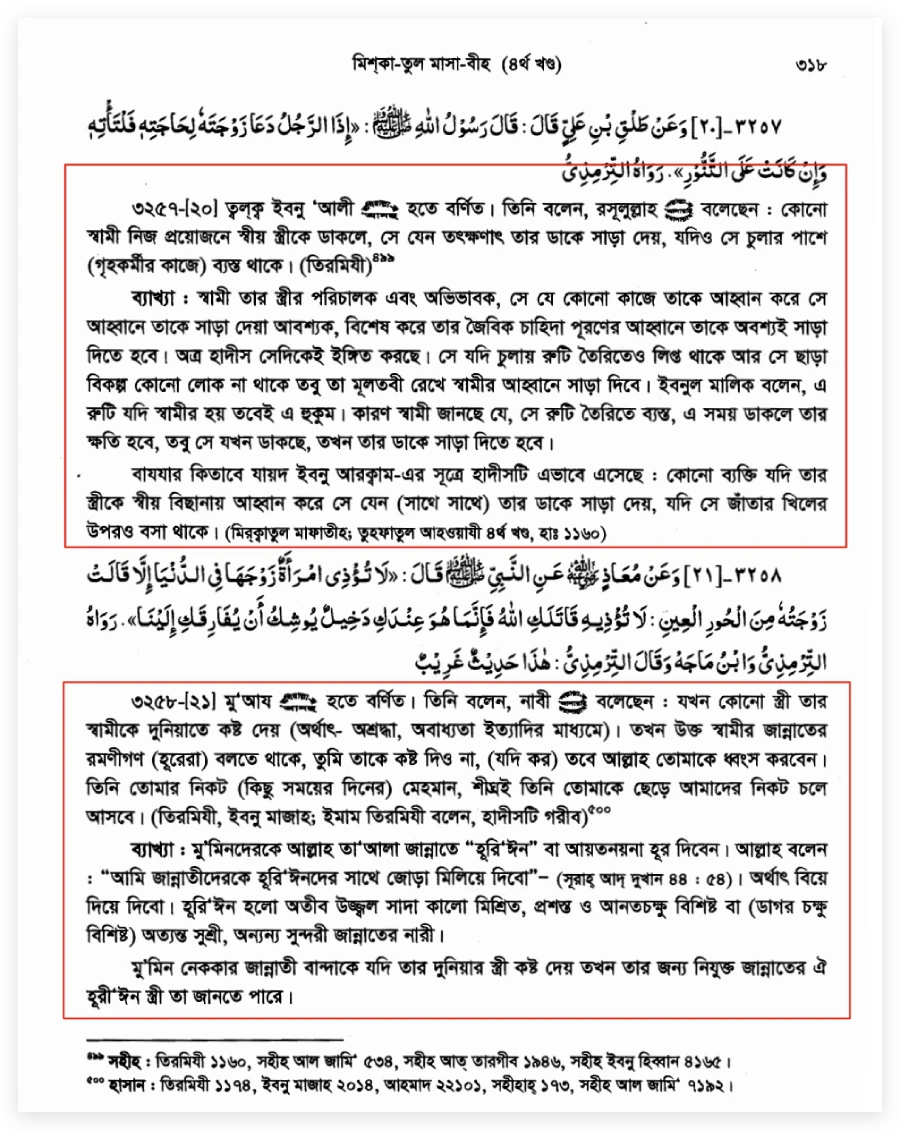
৩২৫৭-[২০] ত্বলক্ব ইবনু ’আলী (রাঃ) হতে বর্ণিত। তিনি বলেন, রাসূলুল্লাহ সাল্লাল্লাহু আলাইহি ওয়াসাল্লাম বলেছেনঃ কোনো স্বামী নিজ প্রয়োজনে স্বীয় স্ত্রীকে ডাকলে, সে যেন তৎক্ষণাৎ তার ডাকে সাড়া দেয়, যদিও সে চুলার পাশে (গৃহকর্মীর কাজে) ব্যস্ত থাকে। (তিরমিযী)[1]
[1] সহীহ : তিরমিযী ১১৬০, সহীহ আল জামি‘ ৫৩৪, সহীহ আত্ তারগীব ১৯৪৬, সহীহ ইবনু হিব্বান ৪১৬৫।
হাদিসের মানঃ সহিহ (Sahih)
বর্ণনাকারীঃ তালক ইবনে আলী (রাঃ)

৩২৫৭-[২০] ত্বল্ফ ইবনু 'আলী হতে বর্ণিত। তিনি বলেন, রসূলুল্লাহ বলেছেন: কোনো স্বামী নিজ প্রয়োজনে স্বীয় স্ত্রীকে ডাকলে, সে যেন তৎক্ষণাৎ তার ডাকে সাড়া দেয়, যদিও সে চুলার পাশে
(গৃহকর্মীর কাজে) ব্যস্ত থাকে। (তিরমিযী)১৯৯
ব্যাখ্যা: স্বামী তার স্ত্রীর পরিচালক এবং অভিভাবক, সে যে কোনো কাজে তাকে আহ্বান করে সে আহ্বানে তাকে সাড়া দেয়া আবশ্যক, বিশেষ করে তার জৈবিক চাহিদা পূরণের আহ্বানে তাকে অবশ্যই সাড়া দিতে হবে। অত্র হাদীস সেদিকেই ইঙ্গিত করছে। সে যদি চুলায় রুটি তৈরিতেও লিপ্ত থাকে আর সে ছাড়া বিকল্প কোনো লোক না থাকে তবু তা মূলতবী রেখে স্বামীর আহ্বানে সাড়া দিবে। ইবনুল মালিক বলেন, এ রুটি যদি স্বামীর হয় তবেই এ হুকুম। কারণ স্বামী জানছে যে, সে রুটি তৈরিতে ব্যস্ত, এ সময় ডাকলে তার ক্ষতি হবে, তবু সে যখন ডাকছে, তখন তার ডাকে সাড়া দিতে হবে।
বাযযার কিতাবে যায়দ ইবনু আরকাম-এর সূত্রে হাদীসটি এভাবে এসেছে কোনো ব্যক্তি যদি তার স্ত্রীকে স্বীয় বিছানায় আহ্বান করে সে যেন (সাথে সাথে) তার ডাকে সাড়া দেয়, যদি সে জাঁতার খিলের উপরও বসা থাকে। (মিরকাতুল মাফাতীহ; তুহফাতুল আহওয়াযী ৪র্থ খণ্ড, হাঃ ১১৬০)
٣٢٥٨ - [٢١] وَعَنْ مُعَادٍ عَنِ النَّبِيِّ ﷺ قَالَ: «لَا تُؤْذِي امْرَأَةٌ زَوْجَهَا فِي الدُّنْيَا إِلَّا قَالَتْ زَوْجَتُهُ مِنَ الْحُورِ الْعِينِ : لَا تُؤْذِيهِ قَاتَلَكِ اللهُ فَإِنَّمَا هُوَ عِنْدَكِ دَخِيلٌ يُوشِكُ أَنْ يُفَارِ قَكِ إِلَيْنَا» . رَوَاهُ التَّرْمِذِيُّ وَابْنُ مَاجَهُ وَقَالَ التَّرْمِذِيُّ : هُذَا حَدِيثٌ غَرِيبٌ
৩২৫৮-[২১] মু'আয হতে বর্ণিত। তিনি বলেন, নাবী বলেছেন: যখন কোনো স্ত্রী তার স্বামীকে দুনিয়াতে কষ্ট দেয় (অর্থাৎ- অশ্রদ্ধা, অবাধ্যতা ইত্যাদির মাধ্যমে)। তখন উক্ত স্বামীর জান্নাতের রমণীগণ (হুরেরা) বলতে থাকে, তুমি তাকে কষ্ট দিও না, (যদি কর) তবে আল্লাহ তোমাকে ধ্বংস করবেন। তিনি তোমার নিকট (কিছু সময়ের দিনের) মেহমান, শীঘ্রই তিনি তোমাকে ছেড়ে আমাদের নিকট চলে আসবে। (তিরমিযী, ইবনু মাজাহ; ইমাম তিরমিযী বলেন, হাদীসটি গরীব) ৫০০
ব্যাখ্যা: মু'মিনদেরকে আল্লাহ তা'আলা জান্নাতে "হুরি'ঈন" বা আয়তনয়না হর দিবেন। আল্লাহ বলেন : "আমি জান্নাতীদেরকে হরি'ঈনদের সাথে জোড়া মিলিয়ে দিবো"- (সূরাহ্ আদ্‌ দুখান ৪৪ ৫৪)। অর্থাৎ বিয়ে দিয়ে দিবো। হুরি'ঈন হলো অতীব উজ্জ্বল সাদা কালো মিশ্রিত, প্রশস্ত ও আনতচক্ষু বিশিষ্ট বা (ডাগর চক্ষু বিশিষ্ট) অত্যন্ত সুশ্রী, অন্যন্য সুন্দরী জান্নাতের নারী।
মু'মিন নেককার জান্নাতী বান্দাকে যদি তার দুনিয়ার স্ত্রী কষ্ট দেয় তখন তার জন্য নিযুক্ত জান্নাতের ঐ হুরী'ঈন স্ত্রী তা জানতে পারে।
সুনানে ইবনে মাজাহ
তাওহীদ পাবলিকেশন
অধ্যায়ঃ ৯/ বিবাহ
২/১৮৫৩। ‘আবদুল্লাহ্ ইবনু আবূ আওফা (রাঃ) থেকে বর্ণিত। তিনি বলেন, মুআয (রাঃ) সিরিয়া থেকে ফিরে এসে নাবী সাল্লাল্লাহু আলাইহি ওয়াসাল্লাম -কে সাজদাহ করেন। নাবী সাল্লাল্লাহু আলাইহি ওয়াসাল্লাম বলেনঃ হে মু‘আয! এ কী? তিনি বলেন, আমি সিরিয়ায় গিয়ে দেখতে পাই যে, তথাকার লোকেরা তাদের ধর্মীয় নেতা ও শাসকদেরকে সাজদাহ করে। তাই আমি মনে মনে আশা পোষণ করলাম যে, আমি আপনার সামনে তাই করবো। রসূলুল্লাহ সাল্লাল্লাহু আলাইহি ওয়াসাল্লাম বলেনঃ তোমরা তা করো না। কেননা আমি যদি কোন ব্যক্তিকে আল্লাহ্ ছাড়া অপর কাউকে সাজদাহ করার নির্দেশ দিতাম, তাহলে স্ত্রীকে নির্দেশ দিতাম তার স্বামীকে সাজদাহ করতে। সেই সত্তার শপথ, যাঁর হাতে মুহাম্মাদের প্রাণ! স্ত্রী তার স্বামীর প্রাপ্য অধিকার আদায় না করা পর্যন্ত তার প্রভুর প্রাপ্য অধিকার আদায় করতে সক্ষম হবে না। স্ত্রী শিবিকার মধ্যে থাকা অবস্থায় স্বামী তার সাথে জৈবিক চাহিদা পূরণ করতে চাইলে স্ত্রীর তা প্রত্যাখ্যান করা অনুচিত।
হাদিসের মানঃ হাসান (Hasan)
It was narrated that: Abdullah bin Abu Awfa said “When Muadh bin Jabal came from Sham, he prostrated to the Prophet who said: ‘What is this, O Muadh?’ He said: ‘I went to Sham and saw them prostrating to their bishops and patricians and I wanted to do that for you.’ The messenger of Allah said: ‘Do not do that. If I were to command anyone to prostrate to anyone other than Allah, I would have commanded women to prostrate to their husbands. By the One in Whose Hand is the soul of Muhammad! No woman can fulfill her duty towards Allah until she fulfills her duty towards her husband. If he asks her (for intimacy) even if she is on her camel saddle, she should not refuse.’ ”

মিশকাতুল মাসাবীহ (মিশকাত)
পাবলিশারঃ হাদিস একাডেমি
অধ্যায়ঃ পর্ব-১৩ঃ বিবাহ
পরিচ্ছদঃ ১০. দ্বিতীয় অনুচ্ছেদ – স্ত্রীদের সাথে সদ্ব্যবহার এবং তাদের প্রত্যেকের (স্বামী-স্ত্রীর) পারস্পরিক হক ও অধিকার সংক্রান্ত
৩২৫৫-(১৮) আবূ হুরায়রাহ্ (রাঃ) হতে বর্ণিত। তিনি বলেন, রাসূলুল্লাহ সাল্লাল্লাহু আলাইহি ওয়াসাল্লাম বলেছেনঃ আমি যদি কোনো মানবকে সিজদা করার নির্দেশ দিতাম, তবে স্ত্রীকে তার স্বামীর জন্য সিজদা করার নির্দেশ দিতাম। (তিরমিযী)
হাদিসের মানঃ হাসান (Hasan)।

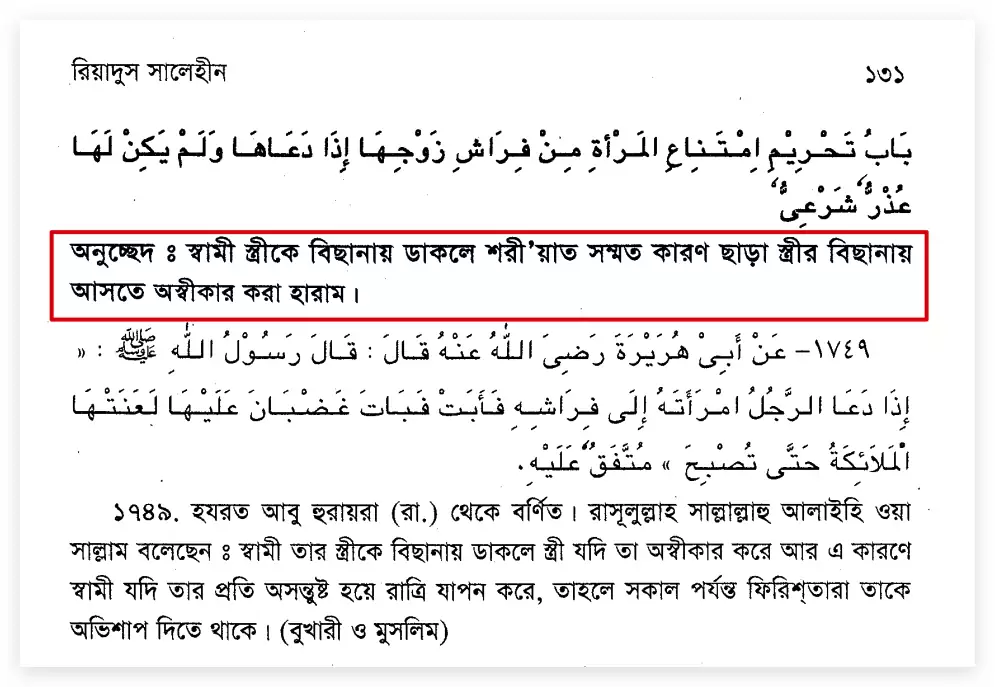
আসুন এই একই হাদিস রিয়াদুস সালেহীন গ্রন্থ থেকে পড়ি, (( রিয়াদুস সালেহীন, ইমাম নববী, ইসলামিয়া কুরআন মহল প্রকাশনী, চতুর্থ খণ্ড, পৃষ্ঠা ১৩১ ))

অনুচ্ছেদ: স্বামী স্ত্রীকে বিছানায় ডাকলে শরী'য়াত সম্মত কারণ ছাড়া স্ত্রীর বিছানায় আসতে অস্বীকার করা হারাম।

হাদিসের ব্যাখ্যাঃ স্বামী চাহিবামাত্রই স্ত্রী সঙ্গমে বাধ্য

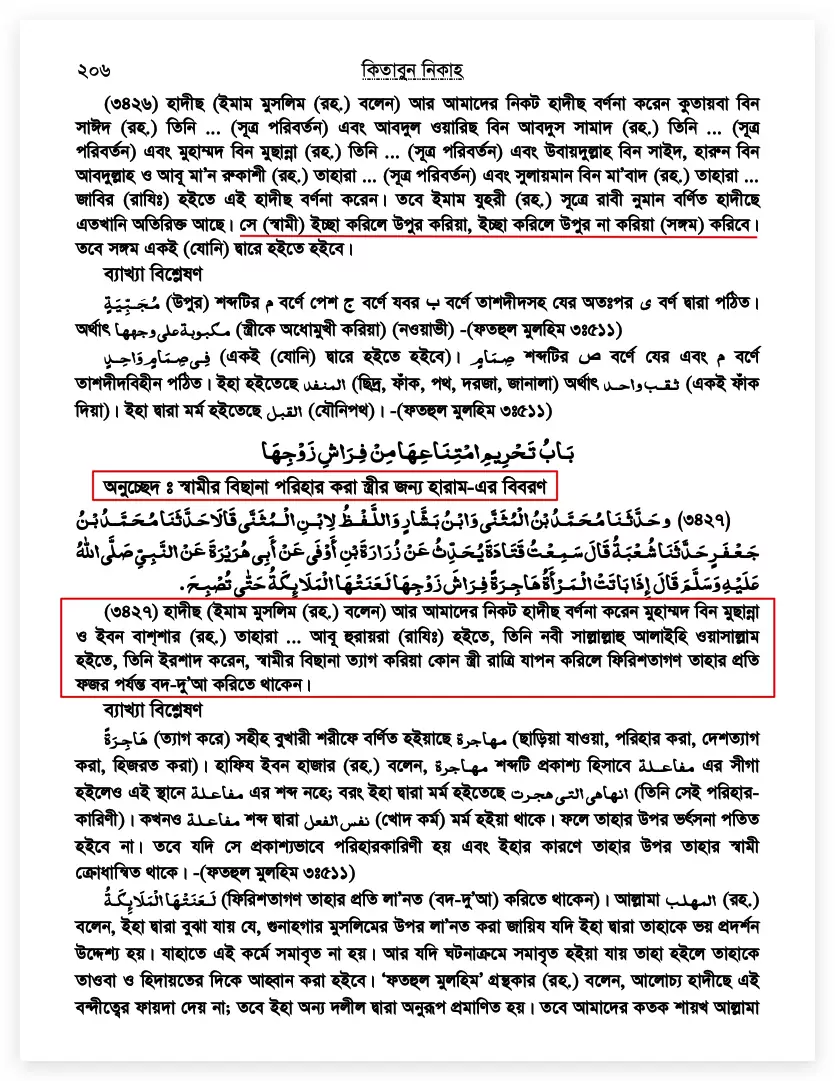
আসুন সহিহ মুসলিমের ব্যাখ্যাগ্রন্থ থেকে একটি পাতা পড়ে নিই, যেখানে বলা, স্বামীর বিছানা পরিত্যাগ করা স্ত্রীর জন্য হারাম অর্থাৎ স্বামী বিছানায় ডাকা মাত্রই স্ত্রীর সেই ডাকে সাড়া দেয়া অবশ্য কর্তব্য (( সহিহ মুসলিম শরীফ (প্রয়োজনীয় ব্যাখ্যাসহ বঙ্গানুবাদ), মাকতাবাতুল হাদীছ প্রকাশনী, ১৩তম খণ্ড, পৃষ্ঠা ২০৬ ))

(৩৪২৬) হাদীছ (ইমাম মুসলিম (রহ.) বলেন) আর আমাদের নিকট হাদীছ বর্ণনা করেন কুতায়বা বিন সাঈদ (রহ.) তিনি … (সূত্র পরিবর্তন) এবং আবদুল ওয়ারিছ বিন আবদুস সামাদ (রহ.) তিনি … (সূত্র পরিবর্তন) এবং মুহাম্মদ বিন মুছান্না (রহ.) তিনি … (সূত্র পরিবর্তন) এবং উবায়দুল্লাহ বিন সাইদ, হারুন বিন আবদুল্লাহ ও আবু মা'ন রুকাশী (রহ.) তাহারা … (সূত্র পরিবর্তন) এবং সুলায়মান বিন মা'বাদ (রহ.) তাহারা … জাবির (রাযিঃ) হইতে এই হাদীছ বর্ণনা করেন। তবে ইমাম যুহরী (রহ.) সূত্রে রাবী নুমান বর্ণিত হাদীছে এতখানি অতিরিক্ত আছে। সে (স্বামী) ইচ্ছা করিলে উপুর করিয়া, ইচ্ছা করিলে উপুর না করিয়া (সঙ্গম) করিবে। তবে সঙ্গম একই (যোনি) দ্বারে হইতে হইবে।
ব্যাখ্যা বিশ্লেষণ
مُجَنِيَةٍ )উপুর) শব্দটির বর্ণে পেশ বর্ণে যবর বর্ণে তাশদীদসহ যের অতঃপর ও বর্ণ দ্বারা পঠিত। অর্থাৎ مكبوبة على وجهها )স্ত্রীকে অধোমুখী করিয়া) (নওয়াভী) -(ফতহুল মুলহিম ৩ঃ৫১১(
فِي صِمَامٍ وَاحِدٍ )একই (যোনি) দ্বারে হইতে হইবে)। صِمّامٍ শব্দটির এ বর্ণে যের এবং বর্ণে তাশদীদবিহীন পঠিত। ইহা হইতেছে المنفد )ছিদ্র, ফাঁক, পথ, দরজা, জানালা) অর্থাৎ ثقب واحد )একই ফাঁক দিয়া)। ইহা দ্বারা মর্ম হইতেছে القبل )যৌনিপথ)। (ফতহুল মুলহিম ৩৪৫১১(
بَابُ تَحْرِيمِ امْتِنَاعِهَا مِنْ فِرَاشٍ زَوْجِهَا
অনুচ্ছেদ: স্বামীর বিছানা পরিহার করা স্ত্রীর জন্য হারাম-এর বিবরণ
(9829) وحَدَّثَنَا مُحَمَّدُ بْنُ الْمُثَنَّى وَابْنُ بَشَّارٍ وَاللَّفْظُ لِابْنِ الْمُثَنَّى قَالَا حَدَّثَنَا مُحَمَّدُ بْنُ جَعْفَرٍ حَدَّثَنَا شُعْبَةُ قَالَ سَمِعْتُ قَتَادَةَ يُحَدِّثُ عَنْ زُرَارَةَ بْنِ أَوْفَى عَنْ أَبِي هُرَيْرَةَ عَنْ النَّبِيِّ صَلَّى اللَّهُ عَلَيْهِ وَسَلَّمَ قَالَ إِذَا بَاتَتْ الْمَرْأَةُ هَاجِرَةً فِرَاشَ زَوْجِهَا لَعَنَتْهَا الْمَلَائِكَةُ حَتَّى تُصْبِحَ.
(৩৪২৭) হাদীছ (ইমাম মুসলিম (রহ.) বলেন) আর আমাদের নিকট হাদীছ বর্ণনা করেন মুহাম্মদ বিন মুছান্না ও ইবন বাশার (রহ.) তাহারা … আবু হুরায়রা (রাযিঃ) হইতে, তিনি নবী সাল্লাল্লাহু আলাইহি ওয়াসাল্লাম হইতে, তিনি ইরশাদ করেন, স্বামীর বিছানা ত্যাগ করিয়া কোন স্ত্রী রাত্রি যাপন করিলে ফিরিশতাগণ তাহার প্রতি ফজর পর্যন্ত বদ-দু'আ করিতে থাকেন।
ব্যাখ্যা বিশ্লেষণ
مَاجِرَةً )ত্যাগ করে) সহীহ বুখারী শরীফে বর্ণিত হইয়াছে مهاجرة )ছাড়িয়া যাওয়া, পরিহার করা, দেশত্যাগ করা, হিজরত করা)। হাফিয ইবন হাজার (রহ.) বলেন, مهاجرة শব্দটি প্রকাশ্য হিসাবে مفاعلة এর সীগা হইলেও এই স্থানে مفاعلة এর শব্দ নহে; বরং ইহা দ্বারা মর্ম হইতেছে انهاهي التي هجرت )তিনি সেই পরিহার-কারিণী)। কখনও مفاعلة শব্দ দ্বারা نفس الفعل )খোদ কর্ম) মর্ম হইয়া থাকে। ফলে তাহার উপর ভর্ৎসনা পতিত হইবে না। তবে যদি সে প্রকাশ্যভাবে পরিহারকারিণী হয় এবং ইহার কারণে তাহার উপর তাহার স্বামী ক্রোধান্বিত থাকে।-(ফতহুল মুলহিম ৩ঃ৫১১)

তাফসীরঃ উমর ঘুমন্ত স্ত্রীর ওপর চেপে বসতেন

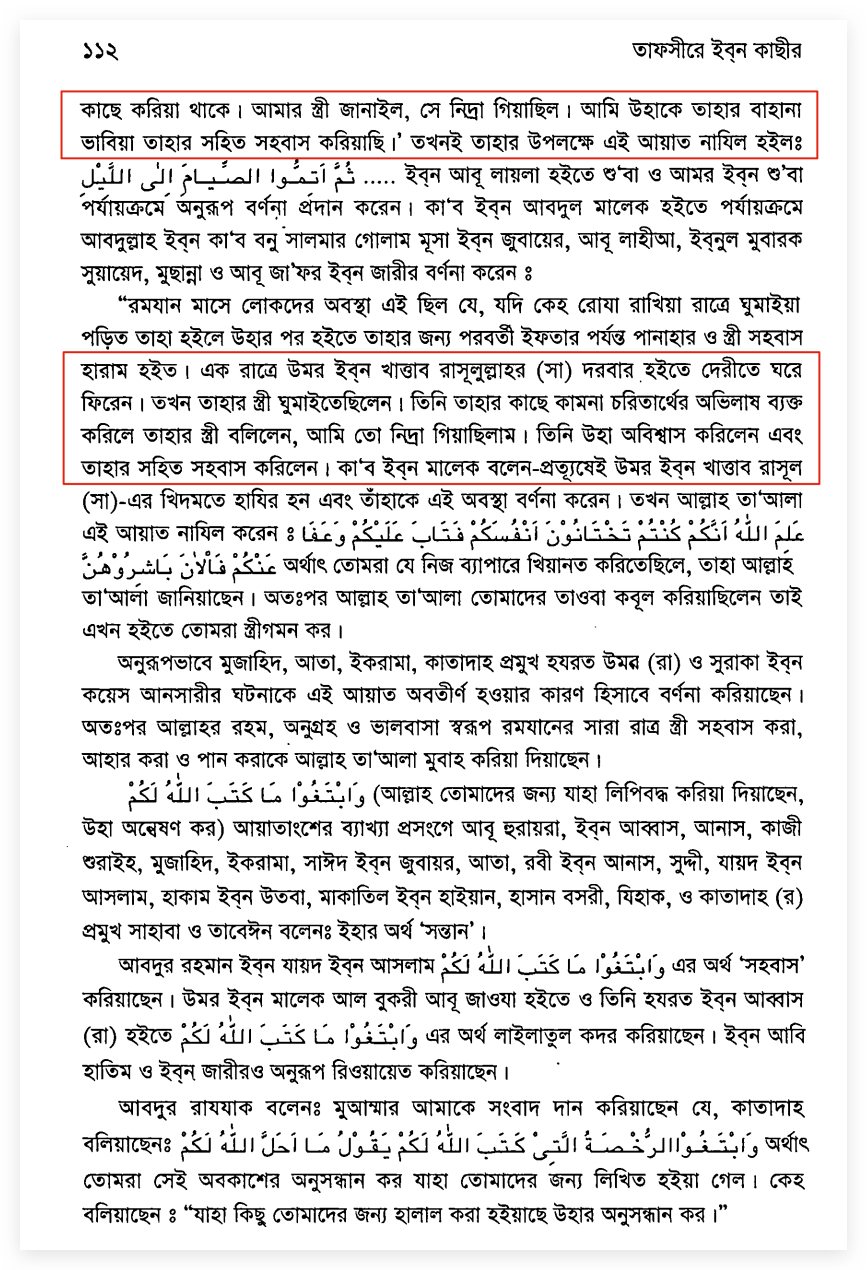
ইসলামের ইতিহাস থেকে আমরা জানতে পারি যে, নবী মুহাম্মদ এবং তার সাহাবীগণ আসলে তাদের স্ত্রীদের সম্মতির তেমন কোন গুরুত্বই দিতেন না। যৌন সঙ্গমের বিষয়ে স্বামীর ভূমিকা ছিল প্রভুর মত, আর স্ত্রীর ভূমিকা ছিল দাসীবাঁদীর মত। আসুন তাফসীরে ইবনে কাসীর থেকে একটি ঘটনা জেনে নেয়া যাক, যেখানে দেখা যাচ্ছে নবীর প্রখ্যাত সাহাবী উমর তার ঘুমন্ত স্ত্রীর ওপর চেপে বসে এবং তার অনুমতি বা সম্মতির তোয়াক্কা না করেই সঙ্গমে লিপ্ত হয়। বিষয়টি নবীকে জানাবার পরেও নবী তা নিয়ে কোন কথাই বলেন না, অর্থাৎ সেই সময়ে নবীর কাছে এটিই ছিল খুব স্বাভাবিক বিষয় (( তাফসীরে ইবনে কাসীর, ২য় খণ্ড, ইসলামিক ফাউন্ডেশন, পৃষ্ঠা ১১২))

... কাছে করিয়া থাকে। আমার স্ত্রী জানাইল, সে নিদ্রা গিয়াছিল। আমি উহাকে তাহার বাহানা ভাবিয়া তাহার সহিত সহবাস করিয়াছি।' তখনই তাহার উপলক্ষে এই আয়াত নাযিল হইলঃ ثُمَّ اَتِمُوا الصَّيَامَ إِلَى اللَّيْلِ …. ইব্‌ন আবু লায়লা হইতে শু'বা ও আমর ইবন শু'বা পর্যায়ক্রমে অনুরূপ বর্ণনা প্রদান করেন। কা'ব ইব্‌ন আবদুল মালেক হইতে পর্যায়ক্রমে আবদুল্লাহ ইব্‌ন কা'ব বনু সালমার গোলাম মূসা ইব্‌ন্ন জুবায়ের, আবু লাহীআ, ইবনুল মুবারক সুয়ায়েদ, মুছান্না ও আবূ জা'ফর ইব্‌ন জারীর বর্ণনা করেন:
"রমযান মাসে লোকদের অবস্থা এই ছিল যে, যদি কেহ রোযা রাখিয়া রাত্রে ঘুমাইয়া পড়িত তাহা হইলে উহার পর হইতে তাহার জন্য পরবর্তী ইফতার পর্যন্ত পানাহার ও স্ত্রী সহবাস হারাম হইত। এক রাত্রে উমর ইবন খাত্তাব রাসূলুল্লাহর (সা) দরবার হইতে দেরীতে ঘরে ফিরেন। তখন তাহার স্ত্রী ঘুমাইতেছিলেন। তিনি তাহার কাছে কামনা চরিতার্থের অভিলাষ ব্যক্ত করিলে তাহার স্ত্রী বলিলেন, আমি তো নিদ্রা গিয়াছিলাম। তিনি উহা অবিশ্বাস করিলেন এবং তাহার সহিত সহবাস করিলেন। কা'ব ইন্ন মালেক বলেন-প্রত্যূষেই উমর ইব্‌ন্ন খাত্তাব রাসূল (সা)-এর খিদমতে হাযির হন এবং তাঁহাকে এই অবস্থা বর্ণনা করেন। তখন আল্লাহ তা'আলা علِمَ اللَّهُ أَنَّكُمْ كُنْتُمْ تَخْتَانُونَ أَنْفُسَكُمْ فَتَابَ عَلَيْكُمْ وَعَفَا : 94 ARIG IR عَنْكُمْ فَالْأَنَ بَاشِرُوهُنَّ অর্থাৎ তোমরা যে নিজ ব্যাপারে খিয়ানত করিতেছিলে, তাহা আল্লাহ তা'আলা জানিয়াছেন। অতঃপর আল্লাহ তা'আলা তোমাদের তাওবা কবুল করিয়াছিলেন তাই এখন হইতে তোমরা স্ত্রীগমন কর।
অনুরূপভাবে মুজাহিদ, আতা, ইকরামা, কাতাদাহ প্রমুখ হযরত উমর (রা) ও সুরাকা ইন্ন কয়েস আনসারীর ঘটনাকে এই আয়াত অবতীর্ণ হওয়ার কারণ হিসাবে বর্ণনা করিয়াছেন। অতঃপর আল্লাহর রহম, অনুগ্রহ ও ভালবাসা স্বরূপ রমযানের সারা রাত্র স্ত্রী সহবাস করা, আহার করা ও পান করাকে আল্লাহ তা'আলা মুবাহ করিয়া দিয়াছেন।
, R) Cons) وَابْتَغُوا مَا كَتَبَ اللَّهُ لَكُمْ উহা অন্বেষণ কর) আয়াতাংশের ব্যাখ্যা প্রসংগে আবূ হুরায়রা, ইব্‌ন আব্বাস, আনাস, কাজী শুরাইহ, মুজাহিদ, ইকরামা, সাঈদ ইন্ন জুবায়র, আতা, রবী ইন্ন আনাস, সুদ্দী, যায়দ ইব্‌ন আসলাম, হাকাম ইন্ন উতবা, মাকাতিল ইন্ন হাইয়ান, হাসান বসরী, যিহাক, ও কাতাদাহ (র) প্রমুখ সাহাবা ও তাবেঈন বলেনঃ ইহার অর্থ 'সন্তান'।

মৃত সন্তানকে পাশে রেখে সাহাবীর যৌনসঙ্গম

ইসলামী পারিবারিক কাঠামোতে নারীর নিজস্ব আবেগ ও শোকের তুলনায় স্বামীর যৌন পরিতৃপ্তিকে কতটা প্রাধান্য দেওয়া হয়েছে, তা আবু তালহা (রা.) ও তাঁর স্ত্রী উম্মে সুলাইমের এই ঘটনাটি বিশ্লেষণ করলে স্পষ্ট হয়। এই বর্ণনায় দেখা যায়, নিজের সন্তান ঘরে মৃত অবস্থায় পড়ে থাকা সত্ত্বেও উম্মে সুলাইম তাঁর মাতৃত্বকালীন তীব্র শোক গোপন করে স্বামীর জন্য নিজেকে সুসজ্জিত করেন এবং যৌন মিলনে লিপ্ত হন (( সহীহ বুখারী, তাওহীদ পাবলিকেশন, হাদিস নম্বর: ৫৪৭০ ))। আধুনিক মনস্তত্ত্ব ও মানবিক মূল্যবোধের নিরিখে এটি একটি অত্যন্ত অস্বাভাবিক চিত্র, যেখানে একজন নারীর স্বাভাবিক আবেগীয় প্রতিক্রিয়াকে পুরোপুরি অবদমন করে তাঁকে কেবল পুরুষের যৌন চাহিদা মেটানোর একটি মাধ্যম হিসেবে দেখা হয়েছে।

সহীহ বুখারী (তাওহীদ পাবলিকেশন)
৭১/ আক্বীক্বাহ
পরিচ্ছেদঃ ৭১/১. যে সন্তানের ‘আক্বীক্বাহ দেয়া হবে না, জন্ম লাভের দিনেই তার নাম রাখা ও তাহনীক করা (কিছু চিবিয়ে তার মুখে দেয়া)।
৫৪৭০. আনাস ইবনু মালিক (রাঃ) হতে বর্ণিত। তিনি বলেন, আবূ ত্বলহার এক ছেলে অসুস্থ হয়ে পড়ল। আবূ ত্বলহা বাইরে গেলেন, তখন ছেলেটি মারা গেল। আবূ ত্বলহা ফিরে এসে জিজ্ঞেস করলেনঃ ছেলেটি কী করছে? উম্মু সুলাইম বললেনঃ সে আগের চেয়ে শান্ত। তারপর তাঁকে রাতের খাবার দিলেন। তিনি আহার করলেন। তারপর উম্মু সুলাইমের সঙ্গে যৌন সঙ্গম করলেন। যৌন সঙ্গম ক্রিয়া শেষে উম্মু সুলাইম বললেনঃ ছেলেটিকে দাফন করে আস। সকাল হলে আবূ ত্বলহা রাসূলুল্লাহ সাল্লাল্লাহু আলাইহি ওয়াসাল্লাম -এর কাছে এসে তাঁকে এ ঘটনা বললেন। তিনি জিজ্ঞেস করলেনঃ গত রাতে তুমি কি স্ত্রীর সঙ্গে রয়েছ? তিনি বললেনঃ হাঁ! নবী সাল্লাল্লাহু আলাইহি ওয়াসাল্লাম বললেনঃ হে আল্লাহ! তাদের জন্য তুমি বারাকাত দান কর।
কিছুদিন পর উম্মু সুলাইম একটি সন্তান প্রসব করল। রাবী বলেনঃ) আবূ ত্বলহা আমাকে বললেন, তাকে তুমি দেখাশোনা কর যতক্ষণ না আমি তাকে নবী সাল্লাল্লাহু আলাইহি ওয়াসাল্লাম -এর কাছে নিয়ে যাই। অতঃপর তিনি তাকে নবী সাল্লাল্লাহু আলাইহি ওয়াসাল্লাম -এর কাছে নিয়ে গেলেন। উম্মু সুলাইম সঙ্গে কিছু খেজুর দিয়ে দিলেন। নবী সাল্লাল্লাহু আলাইহি ওয়াসাল্লাম তাকে (কোলে) নিলেন এবং জিজ্ঞেস করলেন, তার সঙ্গে কিছু আছে কি? তাঁরা বললেনঃ হাঁ, আছে। তিনি তা নিয়ে চিবালেন এবং তারপর মুখ থেকে বের করে বাচ্চাটির মুখে দিলেন। তিনি এর দ্বারাই তার তাহ্নীক করলেন এবং তার নাম রাখলেন ’আবদুল্লাহ। [১৩০১; মুসলিম ৩৮/৫, হাঃ ২১৪৪] (আধুনিক প্রকাশনী- ৫০৬৫, ইসলামিক ফাউন্ডেশন- ৪৯৬১)
আনাস (রাঃ) হতে বর্ণিত। তিনি উক্ত হাদীসটিই বর্ণনা করেন। (আধুনিক প্রকাশনী- ৫০৬৫, ইসলামিক ফাউন্ডেশন- ৪৯৬২)
হাদিসের মানঃ সহিহ (Sahih)
বর্ণনাকারীঃ আনাস ইবনু মালিক (রাঃ)

সবচেয়ে তাৎপর্যপূর্ণ বিষয় হলো, মোহাম্মদ এই বিষয়টিকে অত্যন্ত ইতিবাচকভাবে গ্রহণ করেন এবং তাঁদের সেই মিলনের ওপর আল্লাহর বারাকাত বা কল্যাণ কামনা করে বিশেষ দোয়া করেন। মৃত সন্তানের লাশের পাশে এই যৌনক্রিয়াকে একটি 'মহত' বা 'বরকতময়' কাজ হিসেবে উপস্থাপন করা মূলত নারীর মানবিক মর্যাদা ও ব্যক্তিসত্তার চরম অবমাননা। এটি সমাজে এই বার্তাই দেয় যে, যেকোনো পরিস্থিতিতেই নারীর প্রধান ও আবশ্যিক কর্তব্য হলো তাঁর শরীরকে স্বামীর কামনাবাসনা চরিতার্থ করার জন্য লভ্য রাখা, এমনকি নিজের সন্তানের মৃত্যুর মতো চরম বিয়োগান্তক মুহূর্তেও। নবীর পক্ষ থেকে এই আচরণের ভূয়সী প্রশংসা ও দোয়া প্রমাণ করে যে, ধর্মীয় এই বিধানে নারীর মানসিক স্বাস্থ্যের বা যন্ত্রণার চেয়ে পুরুষের তথাকথিত যৌন অধিকারের স্থান অনেক উঁচুতে। এ ধরনের বর্ণনা নারীকে কেবল একটি যৌনদাসীসুলভ অবস্থানে নামিয়ে আনে, যেখানে তার মাতৃত্ব বা মানবিক সত্তার চেয়ে স্বামীর তৃপ্তিই চূড়ান্ত মাপকাঠি হিসেবে বিবেচিত হয়।


সহবাসে অসম্মতি জানালে মারপিট করে বাধ্য করার ফতোয়া

নিচে এই সম্পর্কিত সমস্ত দলিল প্রমাণ এক এক করে উল্লিখিত হচ্ছে। এই ফতোয়াগুলো সবই ইসলামী বিশ্বে সর্বাধিক অথেনটিক দলিল হিসেবে পরিগণিত হয়। দলিলগুলো দেখার আগে আসুন একটি ভিডিও দেখে নিই,

0:00
–:––

রওজাতুত তালেবীন (Rawdat at-Taalibeen)- দাসী সংক্রান্ত বিধান

ইসলামি আইনশাস্ত্র বা ফিকহ্-এর ইতিহাসে 'রওজাতুত তালেবীন ওয়া উমদাতুল মুফতীন' একটি অত্যন্ত গুরুত্বপূর্ণ ও আকর গ্রন্থ। এটি শাফি’ঈ মাযহাবের প্রামাণ্য দলিল হিসেবে গণ্য। কিতাবটি রচনা করেছেন জগদ্বিখ্যাত ইসলামিক মুহাদ্দিস ও ফকিহ ইমাম মুহিউদ্দিন আবু জাকারিয়া ইয়াহইয়া ইবনে শরাফ আন-নববী (র.) (মৃত্যু: ৬৭৬ হিজরি)। তিনি অত্যন্ত সুশৃঙ্খলভাবে এই গ্রন্থে ইবাদত, মুয়ামালাত (লেনদেন) এবং পারিবারিক আইনের সূক্ষ্মাতিসূক্ষ্ম বিষয়গুলো আলোচনা করেছেন। বিশেষ করে ফতোয়া প্রদানের ক্ষেত্রে এই গ্রন্থটিকে শাফি’ঈ ঘরানায় চূড়ান্ত মানদণ্ড হিসেবে বিবেচনা করা হয়।


মূল আরবি পাঠ (নির্বাচিত অংশ) - এই অংশে দাসী ও সংশ্লিষ্ট মাসআলা সংক্রান্ত মূল ইবারত নিচে দেওয়া হলো, (( ويحرم على الزوجة والأمة تحريما غليظا أن تمتنع إذا طلبها للاستمتاع الجائز ))

ويحرم على الزوجة والأمة تحريما غليظا أن تمتنع إذا طلبها للاستمتاع الجائز
It is strongly forbidden for a wife or slave concubine to refuse when her husband or master seeks permissible sexual intimacy from her.
— Rawdat at-Taalibeen

বাংলা অনুবাদঃ "...এবং স্ত্রী বা দাসীর জন্য (মালিক বা স্বামীর) বৈধ উপভোগের আহ্বানে সাড়া না দিয়ে নিজেকে বিরত রাখা কঠোরভাবে হারাম।

আসুন সরাসরি বই থেকে দেখে নেয়া যাক,
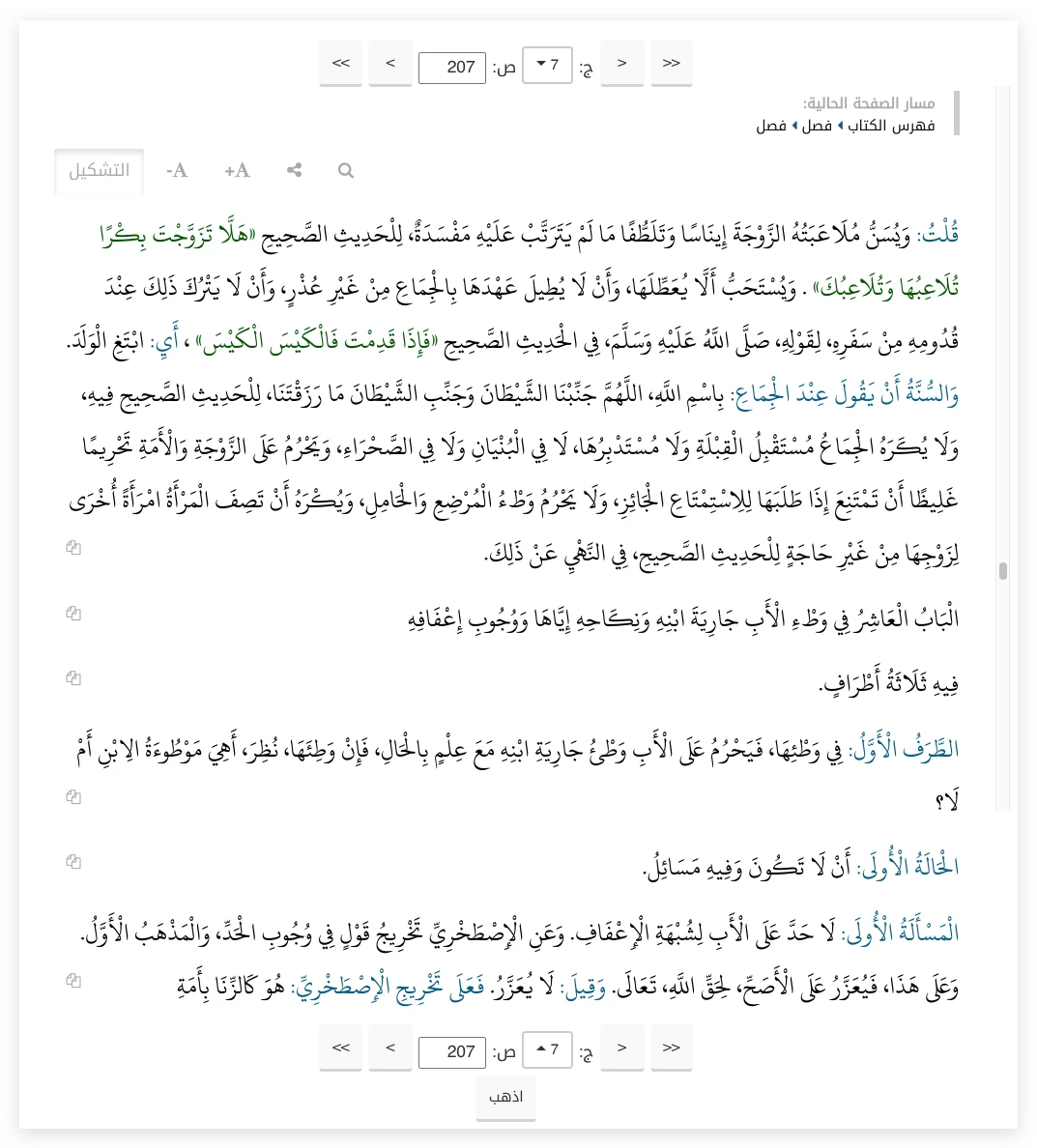

অর্থাৎ, স্ত্রী বা দাসীর সম্মতির কোনো মূল্য নেই; তার কর্তব্য হলো তার স্বামী বা মালিককে খুশি রাখা, সন্তুষ্ট রাখা এবং যখনই তার স্বামী বা মালিক চাইবে শরীয়া সম্মত কোন কারণ (যেমন মারাত্মক অসুস্থতা) না থাকলে তাকে যৌনসুখ প্রদান করা।


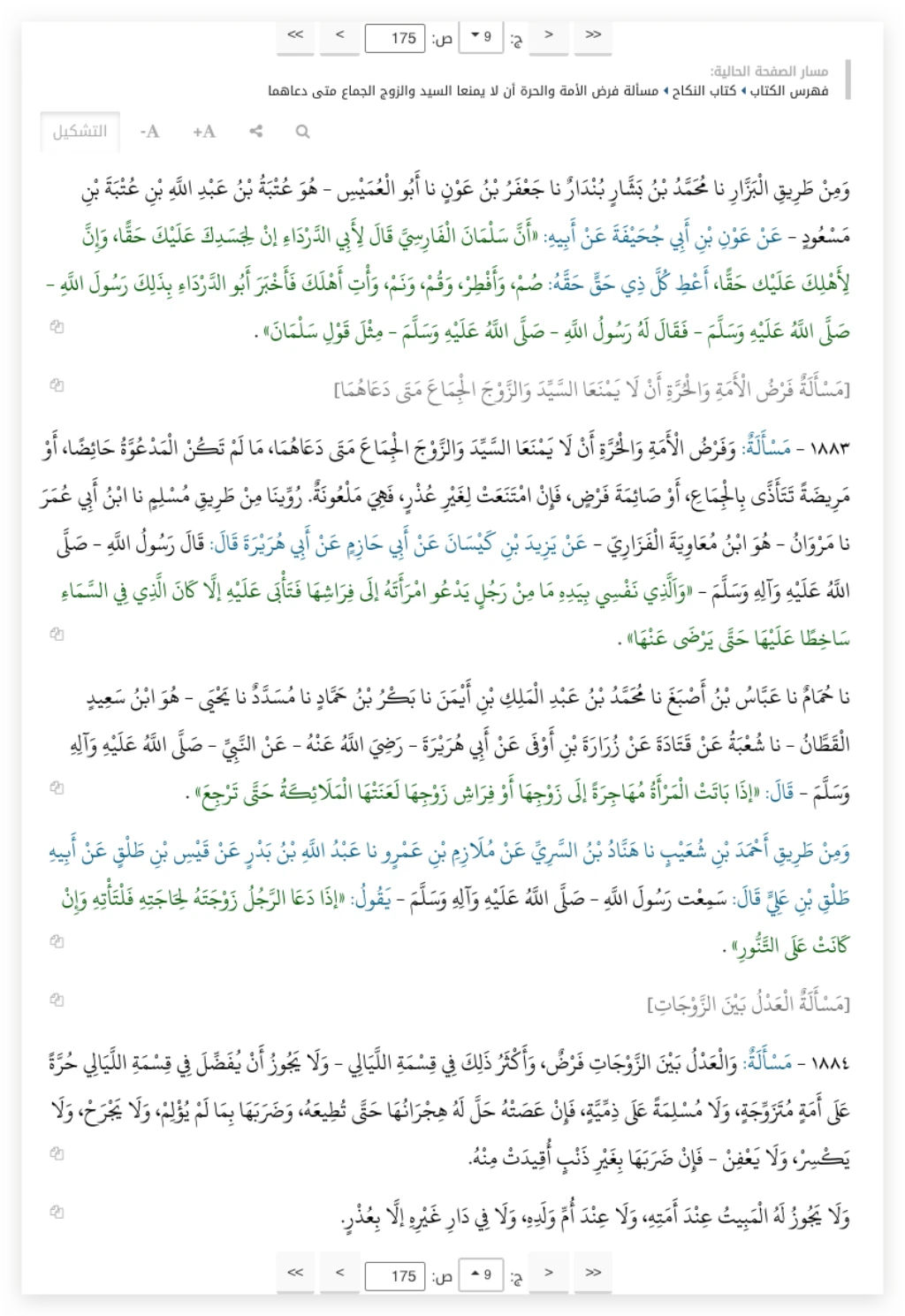
আল-মুহাল্লা বিল-আসার (Al-Muhalla bi’l-Aathaar)

"আল-মুহাল্লা বিল-আসার" হলো ইমাম ইবনে হাজম আল-আন্দালুসি (র.) রচিত ফিকহ্ শাস্ত্রের একটি কিংবদন্তি গ্রন্থ। এটি জাহিরি মাজহাবের প্রধান নির্ভরযোগ্য আকর। এই গ্রন্থে ইমাম ইবনে হাজম কুরআন ও সুন্নাহর সরাসরি পাঠের ওপর ভিত্তি করে ইসলামি আইনের ব্যাখ্যা দিয়েছেন এবং যুক্তি বা অনুমানের (কিয়াস) পরিবর্তে দলিলকে প্রাধান্য দিয়েছেন। তুলনামূলক আইনশাস্ত্র বা 'ইখতিলাফুল ফুকাহা' (আলেমদের মতভেদ) বোঝার জন্য এই গ্রন্থটিকে ইতিহাসের অন্যতম শ্রেষ্ঠ কাজ হিসেবে বিবেচনা করা হয়। এই গ্রন্থে দাসী ও স্ত্রীর সম্মতি (Consent) এবং তাদের ওপর অর্পিত দায়িত্ব সম্পর্কে বলা হয়েছে,

[مَسْأَلَةٌ فَرْضُ الْأَمَةِ وَالْأَمَةِ وَالْحُرَّةِ أَنْ لَا يَمْنَعَا السَّيِّدَ وَالزَّوْجَ الْجِمَاعَ مَتَى دَعَاهُمَا]
অনুবাদ: স্বাধীন স্ত্রী এবং দাসী উভয়ের জন্য ফরজ (আবশ্যক) হলো তারা যেন স্বামী বা মালিককে সহবাসে বাধা না দেয় যখনই তিনি তাদের আহ্বান করেন।
"…مَسْأَلَةٌ: وَفَرْضُ الْأَمَةِ وَالْحُرَّةِ أَنْ لَا يَمْنَعَا السَّيِّدَ وَالزَّوْجَ الْجِمَاعَ مَتَى دَعَاهُمَا، مَا لَمْ تَكُنْ الْمَدْعُوَّةُ حَائِضًا، أَوْ مَرِيضَةً تَتَأَذَّى بِالْجِمَاعِ، أَوْ صَائِمَةَ فَرْضٍ، فَإِنْ امْتَنَعَتْ لِغَيْرِ عُذْرٍ، فَهِيَ مَلْعُونَةٌ…"
অনুবাদ: "দাসীর ওপর এবং স্বাধীন স্ত্রীর ওপর এটি আবশ্যকীয় কর্তব্য যে, মালিক বা স্বামী যখনই তাদের মেলামেশার জন্য ডাকবেন, তারা যেন বাধা না দেয়— যতক্ষণ না সেই নারী ঋতুবতী হয়, অথবা এমন অসুস্থ হয় যে সহবাসে অনেক কষ্ট হবে, কিংবা ফরজ রোজা পালনকারী হয়। যদি কোনো ওজর (উপযুক্ত কারণ) ছাড়া সে বিরত থাকে, তবে সে অভিশপ্ত।"
"…عَنْ النَّبِيِّ - صَلَّى اللَّهُ عَلَيْهِ وَآلِهِ وَسَلَّمَ - قَالَ: «إذَا بَاتَتْ الْمَرْأَةُ مُهَاجِرَةً إلَى زَوْجِهَا أَوْ فِرَاشِ زَوْجِهَا لَعَنَتْهَا الْمَلَائِكَةُ حَتَّى تَرْجِعَ»…"
অনুবাদ: "…নবীজি (সা.) থেকে বর্ণিত, তিনি বলেছেন: যদি কোনো নারী তার স্বামীর বিছানা ত্যাগ করে (বিমুখ হয়ে) রাত কাটায়, তবে ফিরে না আসা পর্যন্ত ফেরেশতারা তাকে অভিশাপ দিতে থাকে।"
"…قَالَ رَسُولُ اللَّهِ - صَلَّى اللَّهُ عَلَيْهِ وَآلِهِ وَسَلَّمَ -: «إذَا دَعَا الرَّجُلُ زَوْجَتَهُ لِحَاجَتِهِ فَلْتَأْتِهِ وَإِنْ كَانَتْ عَلَى التَّنُّورِ»…"
অনুবাদ: "…রাসূলুল্লাহ (সা.) বলেছেন: যখন কোনো ব্যক্তি তার স্ত্রীকে নিজ প্রয়োজনে (শারীরিক চাহিদা মেটাতে) ডাকে, সে যেন অবশ্যই আসে— এমনকি সে যদি চুলার (রান্নার) কাজেও ব্যস্ত থাকে।"

আসুন এই গ্রন্থ থেকে দেখে নেয়া যাক, ((  مسألة فرض الأمة والحرة أن لا يمنعا السيد والزوج الجماع متى دعاهما ))

সালিহ আল মুনাজ্জিদ (islamqa.info)

ইসলামের আরেকটি সর্বাধিক নির্ভরযোগ্য ফতোয়া ওয়েবসাইট Islamqa-এর একটি ফতোয়া Fatwa No. 33597- এ বলা হয়েছে (( Islamqa, Fatwa No. 33597 )) -

إجبار الزوج زوجته على الجماع
السؤال: 33597
هل يجوز للرجل أن يُجبر زوجته أو أمته على الجماع إذا رفضت ؟.
الجواب
الحمد لله والصلاة والسلام على رسول الله، وبعد:
ليس للمرأة أن تمنع نفسها من زوجها ، بل يجب عليها أن تلبي طلبه كلما دعاها ما لم يضرها أو يشغلها عن واجب .
روى البخاري (3237) ومسلم (1436) عن أبي هريرة رضي الله عنه قال : قال رسول الله صلى الله عليه وسلم : ( إذا دعا الرجل امرأته إلى فراشه فأبت فبات غضبان عليها لعنتها الملائكة حتى تصبح ) .
فإن امتنعت من غير عذر كانت عاصية ناشزا ، تسقط نفقتها وكسوتها .
وعلى الزوج أن يعظها ويخوفها من عقاب الله ، ويهجرها في المضجع ، وله أن يضربها ضرباً غير مُبَرِّح، قال الله تعالى :
( وَاللاتِي تَخَافُونَ نُشُوزَهُنَّ فَعِظُوهُنَّ وَاهْجُرُوهُنَّ فِي الْمَضَاجِعِ وَاضْرِبُوهُنَّ فَإِنْ أَطَعْنَكُمْ فَلا تَبْغُوا عَلَيْهِنَّ سَبِيلًا إِنَّ اللَّهَ كَانَ عَلِيًّا كَبِيرًا ) النساء/34 .
وسئل شيخ الإسلام ابن تيمية رحمه الله عما يجب على الزوج إذا منعته من نفسها إذا طلبها ؟ فأجاب : ( لا يحل لها النشوز عنه ، ولا تمنع نفسها منه ، بل إذا امتنعت منه وأصرت على ذلك فله أن يضربها ضربا غير مبرح ، ولا تستحق نفقة ولا قسما ) مجموع الفتاوى 32/279 .
وسئل عن رجل له زوجة وهي ناشز تمنعه نفسها فهل تسقط نفقتها وكسوتها وما يجب عليها ؟
فأجاب : ( تسقط نفقتها وكسوتها إذا لم تمكنه من نفسها ، وله أن يضربها إذا أصرت على النشوز . ولا يحل لها أن تمتنع من ذلك إذا طالبها به ، بل هي عاصية لله ورسوله ، وفي الصحيح : " إذا طلب الرجل المرأة إلى فراشه فأبت عليه كان الذي في السماء ساخطا عليها حتى تصبح " )
انتهى من مجوع الفتاوى 32/278 ، والحديث رواه مسلم (1736) .
فينبغي وعظ الزوجة أولا ، وتحذيرها من النشوز وغضب الله عليها ولعنة الملائكة لها ، فإن لم تستجب هجرها الزوج في الفراش ، فإن لم تستجب ضربها ضربا غير مبرح ، فإن لم ينفع معها ذلك ، منع عنها النفقة والكسوة ، وله أن يطلقها أو يخالعها لتفتدي منه بمالها .
وكذلك الأمة ليس لها أن تمتنع من تلبية رغبة سيدها إلا من عذر ، فإن فعلت كانت عاصية ، وله أن يؤدبها بما يراه مناسباً وأذن الشرع به .
والله أعلم .

প্রশ্ন নং: 33597
প্রশ্ন:
কোনো পুরুষ কি তার স্ত্রী বা দাসীকে জোর করে সহবাসে বাধ্য করতে পারবে, যদি সে অস্বীকার করে?
উত্তর
আল্লাহর প্রশংসা এবং রাসূল ﷺ-এর প্রতি দরূদ ও সালাম:
নারীর জন্য বৈধ নয় যে, সে নিজেকে স্বামী থেকে বিরত রাখবে। বরং তার উচিত স্বামীর আহ্বানে সাড়া দেওয়া, যখনই স্বামী তাকে আহ্বান করে, যদি না এমন কোনো ক্ষতি বা অজুহাত থাকে যা তাকে বৈধভাবে বিরত রাখে।
সহীহ বুখারী (হাদিস 3237) ও সহীহ মুসলিমে (হাদিস 1436) আবূ হুরায়রা (রা.) থেকে বর্ণিত:
রাসূলুল্লাহ ﷺ বলেছেন:
“যখন কোনো পুরুষ তার স্ত্রীকে শয্যায় আহ্বান করে, আর সে অস্বীকার করে, তখন স্বামী রাগ করে রাত কাটালে ফেরেশতারা তাকে (স্ত্রীকে) সকাল পর্যন্ত লানত করতে থাকে।”
সুতরাং, যদি কোনো নারী অকারণে অস্বীকৃতি জানায়, তবে তাকে অবাধ্য গণ্য করা হবে, এবং এর ফলে তার ভরণপোষণ ও পোশাকের অধিকার নষ্ট হয়ে যাবে।
স্বামীর কর্তব্য হলো, তাকে (স্ত্রীকে) আল্লাহর ভয় দেখানো ও উপদেশ দেওয়া; যদি না শোনে, তবে তাকে শয্যা থেকে পৃথক করা; আর তাতেও কাজ না হলে হালকা প্রহার করা—কিন্তু এমন প্রহার নয় যা আঘাত বা ক্ষত সৃষ্টি করে। আল্লাহ বলেন:
“আর যেসব নারীর অবাধ্যতার আশঙ্কা কর, তাদের উপদেশ দাও, তাদের শয্যা ত্যাগ কর, এবং প্রহার কর; তারপর যদি তারা অনুগত হয়, তবে তাদের বিরুদ্ধে অন্য কোনো পথ অবলম্বন করো না। নিশ্চয় আল্লাহ সর্বোচ্চ, মহান।” (সূরা নিসা ৪:৩৪)
শায়খুল ইসলাম ইবনে তাইমিয়াহ (রহ.) বলেছেন:
স্ত্রীর জন্য বৈধ নয় যে, সে নিজেকে স্বামী থেকে বিরত রাখবে। বরং যখন স্বামী আহ্বান করবে, তখনই তার সাড়া দেওয়া ওয়াজিব, যদি না শরীয়তসম্মত কোনো কারণ থাকে যা তাকে বিরত রাখে। (মাজমূআ ফাতাওয়া ৩২/২৭৯)

প্রশ্ন:
যদি কোনো পুরুষ তার স্ত্রীর ভরণপোষণ ও পোশাক দেয়, অথচ স্ত্রী তাকে (সহবাসে) নিজেকে দিতে অস্বীকৃতি জানায়—এক্ষেত্রে কী হবে?
উত্তর:
সে (স্ত্রী) যদি বৈধ অজুহাত ছাড়াই স্বামীকে নিজেকে না দেয়, তবে তার ভরণপোষণ ও পোশাকের অধিকার বাতিল হয়ে যাবে। আর তাকে প্রহার করা বৈধ হবে, তবে এমনভাবে নয় যে এতে গুরুতর ক্ষতি হয়।
কিন্তু, যদি অস্বীকৃতি শরীয়তসিদ্ধ কোনো কারণে হয়, তবে স্ত্রী গোনাহগার হবে না। বরং গোনাহ হবে স্বামীর, যদি সে তখনও জোর করে।
উপসংহার
স্ত্রীর জন্য স্বামীর আহ্বান অকারণে প্রত্যাখ্যান করা বৈধ নয়।
অকারণে অস্বীকার করলে ফেরেশতাদের লানতের শিকার হবে, এবং তার ভরণপোষণ ও পোশাকের অধিকার নষ্ট হবে।
স্বামীকে প্রথমে উপদেশ দিতে হবে, তারপর শয্যা আলাদা করতে হবে, এবং প্রয়োজনে হালকা প্রহার করতে পারবে।

শরীয়তসম্মত কারণ থাকলে স্ত্রী অস্বীকৃতি জানাতে পারবে, এবং সেক্ষেত্রে দায় স্বামীর ওপর বর্তাবে।
ইবনে তাইমিয়ার মাজমু’আ ফাতাওয়া থেকে উদ্ধৃতি শেষ হলো (৩২/২৭৮)। আর হাদিসটি সহীহ মুসলিমে বর্ণিত হয়েছে (১৭৩৬)।
অতএব, প্রথমে স্বামীর উচিত স্ত্রীকে উপদেশ দেওয়া, তাকে অবাধ্যতার (নুশূজ) ভয় দেখানো, আল্লাহর শাস্তির ভয় দেখানো, ফেরেশতাদের লানতের কথা স্মরণ করানো। যদি স্ত্রী তারপরও সাড়া না দেয়, তবে স্বামী শয্যা ত্যাগ করে তার থেকে দূরে থাকবে। যদি তবুও সে সাড়া না দেয়, তবে তাকে এমনভাবে প্রহার করতে পারবে, যা ব্যথাদায়ক হলেও ক্ষতিকর নয়। যদি তবুও কোনো উপকার না হয়, তবে স্বামী তার ভরণপোষণ ও পোশাক বন্ধ করে দিতে পারে, এমনকি চাইলে তাকে তালাক দিতে পারে বা তার থেকে আলাদা হয়ে অন্য বিয়ে করতে পারে।
একইভাবে, দাসীর ক্ষেত্রেও—তার জন্য বৈধ নয় যে, সে কোনো অজুহাত ছাড়া মালিকের যৌন চাহিদা পূরণ থেকে বিরত থাকবে। যদি বিরত থাকে, তবে সে গুনাহগার হবে। আর মালিকের অধিকার আছে তাকে শাস্তি দেওয়ার এবং যেভাবে উপযুক্ত মনে করে, শরীয়তের অনুমোদিত সীমার মধ্যে তার ওপর ব্যবস্থা নেওয়ার।
আল্লাহই সর্বাধিক জানেন।


কাতারের সর্বোচ্চ ফতোয়া কমিটি (islamweb.net)

আরেকটি অত্যন্ত বিখ্যাত ফতোয়া ওয়েবসাইট Islamweb-এর ফতোয়াতেও একই কথা পুনরাবৃত্তি করা হয়েছে: (( مسألة فرض الأمة والحرة أن لا يمنعا السيد والزوج الجماع متى دعاهما ))

معلومات الكتاب
المحلى بالآثار
ابن حزم الأندلسي - علي بن أحمد بن سعيد بن حزم
إظهار / إخفاء التشكيل بحث في الكتاب
1883 - مسألة : وفرض الأمة والحرة أن لا يمنعا السيد والزوج الجماع متى دعاهما ، ما لم تكن المدعوة حائضا ، أو مريضة تتأذى بالجماع ، أو صائمة فرض ، فإن امتنعت لغير عذر ، فهي ملعونة . روينا من طريق مسلم نا ابن أبي عمر نا مروان - هو ابن معاوية الفزاري - عن يزيد بن كيسان عن أبي حازم عن أبي هريرة قال : قال رسول الله صلى الله عليه وآله وسلم { والذي نفسي بيده ما من رجل يدعو امرأته إلى فراشها فتأبى عليه إلا كان الذي في السماء ساخطا عليها حتى يرضى عنها } .
نا حمام نا عباس بن أصبغ نا محمد بن عبد الملك بن أيمن نا بكر بن حماد نا مسدد نا يحيى - هو ابن سعيد القطان - نا شعبة عن قتادة عن زرارة بن أوفى عن أبي هريرة رضي الله عنه عن النبي صلى الله عليه وآله وسلم قال : { إذا باتت المرأة مهاجرة إلى زوجها أو فراش زوجها لعنتها الملائكة حتى ترجع } .
ومن طريق أحمد بن شعيب نا هناد بن السري عن ملازم بن عمرو نا عبد الله بن بدر عن قيس بن طلق عن أبيه طلق بن علي قال : سمعت رسول الله صلى الله عليه وآله وسلم يقول : { إذا دعا الرجل زوجته لحاجته فلتأته وإن كانت على التنور } .

এবারে আসুন ফতোয়াটি বাংলা অনুবাদ দেখি, ( AI দ্বারা অনুদিত )

ফতোয়া নম্বর ১৮৮৩
দাসী এবং স্ত্রী — উভয়ের জন্যই স্বামী বা মালিক যখন যৌন সম্পর্কের জন্য আহ্বান জানায়, তখন তা মেনে নেওয়া আবশ্যক।
যদি স্ত্রী ঋতুমতী না হয়, প্রসূতি অবস্থায় না থাকে, অসুস্থ না হয়, অথবা কোনো বৈধ অজুহাত ছাড়া অস্বীকৃতি জানায়, তাহলে সে গোনাহগার ও অবাধ্য (ناشزة/নাশিজা) হিসেবে গণ্য হবে।
এ ব্যাপারে মুসলিম ইমাম ইবনু আবী উমর আল-মারওয়ান, ইবনু মু’আবিয়া আল-ফারাযী, ইয়াজীদ ইবনু কিসান, আবূ হাযিম, এবং আবূ হুরায়রা (রা.) থেকে বর্ণিত হয়েছে।
রাসূলুল্লাহ ﷺ বলেছেন:
“যে পুরুষ তার স্ত্রীকে শয্যায় ডাকে, আর স্ত্রী অস্বীকার করে, ফলে স্বামী রাগ করে রাত কাটায়—তাহলে আসমানের ফেরেশতারা সকাল পর্যন্ত তাকে অভিশাপ দিতে থাকে।”
(সহীহ হাদিস: বুখারী ও মুসলিমে বর্ণিত)
হাম্মাম ইবন আব্বাস, ইবন আসবাহ, মুহাম্মদ ইবন আবদুল মালিক, ইবন আইয়ূব, ইবন জাহাদ, ইবন মাসউদ ইত্যাদি রাবিদের সূত্রেও এসেছে।
শা’বী থেকে হাদিস: আয়েশা (রা.) বলেছেন, নবী ﷺ বলেছেন:
“যদি কোনো নারী রাত কাটায় এভাবে যে তার স্বামী তার শয্যা থেকে তাকে ডাকছে অথচ সে সাড়া দেয়নি, তাহলে ফেরেশতারা তাকে সকাল পর্যন্ত অভিশাপ দিতে থাকে।”
অন্য সূত্রে আলী (রা.) বলেছেন: আমি রাসূলুল্লাহ ﷺ -কে বলতে শুনেছি:
“যখন কোনো পুরুষ তার স্ত্রীকে শয্যায় আহ্বান করে, আর সে অস্বীকৃতি জানায়, তখন আসমানের মালিক (আল্লাহ) তার প্রতি ক্রোধান্বিত থাকেন, যতক্ষণ না সে স্বামীর ডাকে সাড়া দেয়।”
সারসংক্ষেপঃ
স্ত্রী বা দাসী উভয়ের জন্য স্বামী/মালিকের যৌন আহ্বান প্রত্যাখ্যান করা বৈধ নয়, যদি না কোনো বৈধ শরয়ী অজুহাত থাকে।
অকারণে অস্বীকার করলে ফেরেশতাদের লানত ও আল্লাহর ক্রোধের শিকার হতে হবে।
এই হাদিসগুলোকে প্রমাণ হিসেবে ব্যবহার করে ফিকহবিদরা স্ত্রীর ওপর স্বামীর যৌন অধিকারের বাধ্যতামূলকতা প্রতিষ্ঠা করেছেন।
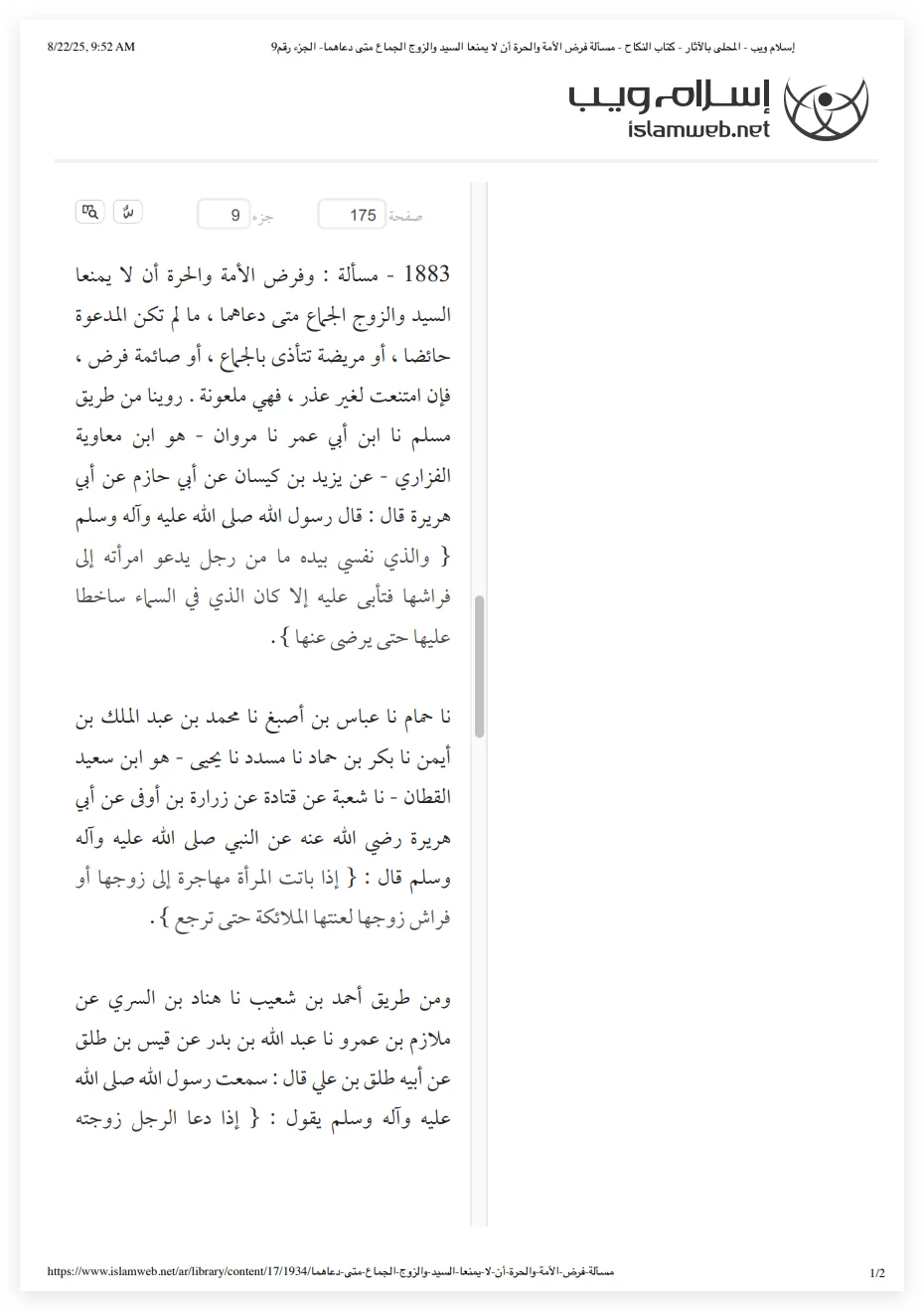
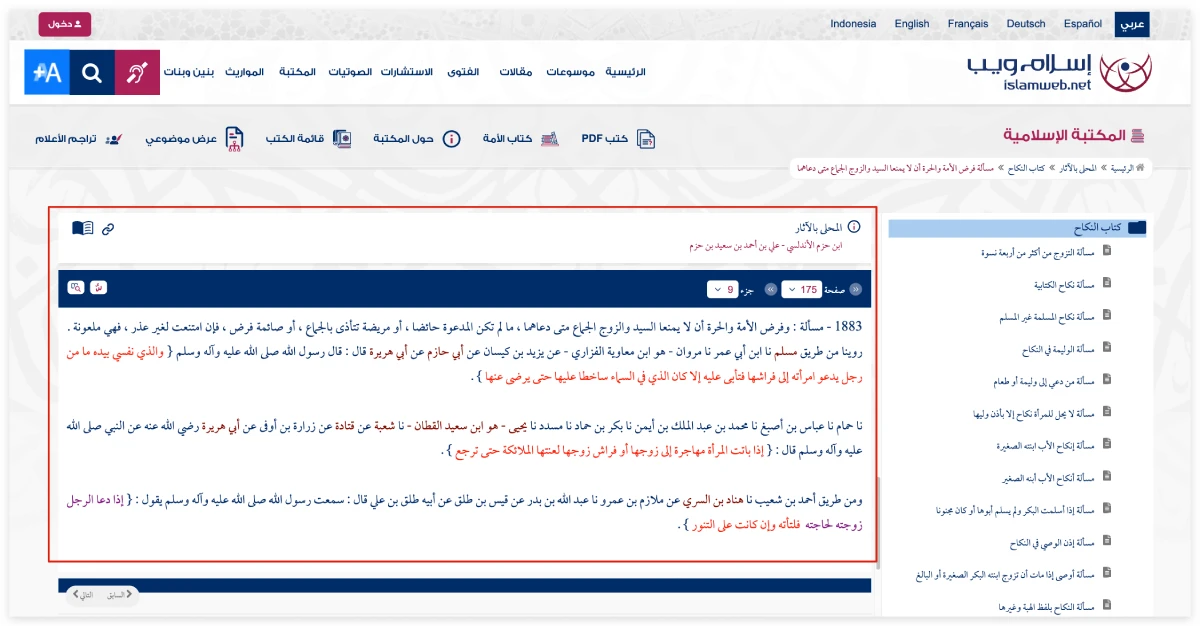
এসব ফতোয়া থেকে স্পষ্ট হয় যে ইসলামি শরিয়াহ স্ত্রী বা দাসীর সম্মতি অস্বীকার করে এবং যৌন সম্পর্ককে স্বামী বা প্রভুর আইনগত অধিকার হিসেবে ঘোষণা করে।


বিশেষ কারণে স্ত্রীকে গোলামের মতো পেটাতে নিষেধ

কিছু হাদিসে নবী মুহাম্মদ স্ত্রীদেরকে "গোলামের মতো" বা “দাসীর মতো”, আবার অনেক হাদিসে "গৃহপালিত পশুর মতো" প্রহার করতে নিষেধ করেছেন। এই বক্তব্যকে অনেক সময় স্ত্রী-নির্যাতনের বিরুদ্ধে ইসলামের অবস্থান দেখাবার জন্য ব্যবহৃত হয়। কিন্তু বর্ণনাটির ভেতরের যুক্তি লক্ষ্য করলে বিষয়টি সম্পূর্ণ ভিন্ন হয়ে দাঁড়ায়। সেখানে স্ত্রীদেরকে "গোলামের মতো" বা “দাসীর মতো”, আবার অনেক হাদিসে "গৃহপালিত পশুর মতো" মারতে নিষেধ করার কারণ হিসেবে বলা হচ্ছে, দিনের শেষে সেই স্ত্রীর সঙ্গেই আবার সহবাস করতে হবে। অর্থাৎ নিষেধাজ্ঞার ভিত্তি স্ত্রীর মানবিক মর্যাদা, শারীরিক নিরাপত্তা বা সহিংসতার নৈতিক প্রত্যাখ্যান নয়; বরং অতিরিক্ত প্রহারের ফলে স্বামীর পরবর্তী যৌনসম্পর্কে অসুবিধা হতে পারে—এই ব্যবহারিক বিবেচনা।

এই ধরনের ভাষ্য প্রহারকে নীতিগতভাবে অস্বীকার করে না। বরং প্রহারের মাত্রা এমন পর্যায়ে না নেওয়ার পরামর্শ দেয়, যাতে স্ত্রী পরে স্বামীর যৌন চাহিদা পূরণে অনাগ্রহী হয়ে পড়ে। এতে নারী একজন স্বাধীন ব্যক্তি হিসেবে নয়, স্বামীর বৈবাহিক ভোগাধিকারভুক্ত সত্তা হিসেবেই বিবেচিত হয়। তার ওপর সহিংসতা চালানো যাবে কি না, সেটি মুখ্য নয়; মুখ্য হয়ে দাঁড়ায়, সহিংসতার পরও স্বামীর যৌন সুবিধা অক্ষুণ্ণ থাকবে কি না। তাই এই বর্ণনাকে স্ত্রী-নির্যাতনবিরোধী নৈতিক ঘোষণা হিসেবে পড়া যায় না। এটি বরং সীমিত প্রহারের ধারণাকে ধরে রেখে মাত্রাতিরিক্ত প্রহারের অসুবিধা ব্যাখ্যা করে। স্ত্রীকে দাসীর মতো না মারার নির্দেশ এখানে স্ত্রীর শরীরের প্রতি সম্মান থেকে আসেনি; সহবাস বিষয়ে তার মতামতের ক্ষেত্রে আসেনি, এসেছে সেই শরীরের ওপর স্বামীর পরবর্তী প্রবেশাধিকার বজায় রাখার হিসাব থেকে (( সহিহ বুখারী, ইসলামিক ফাউন্ডেশন, খণ্ড ৮, পৃষ্ঠা ৪৭৭ )) -
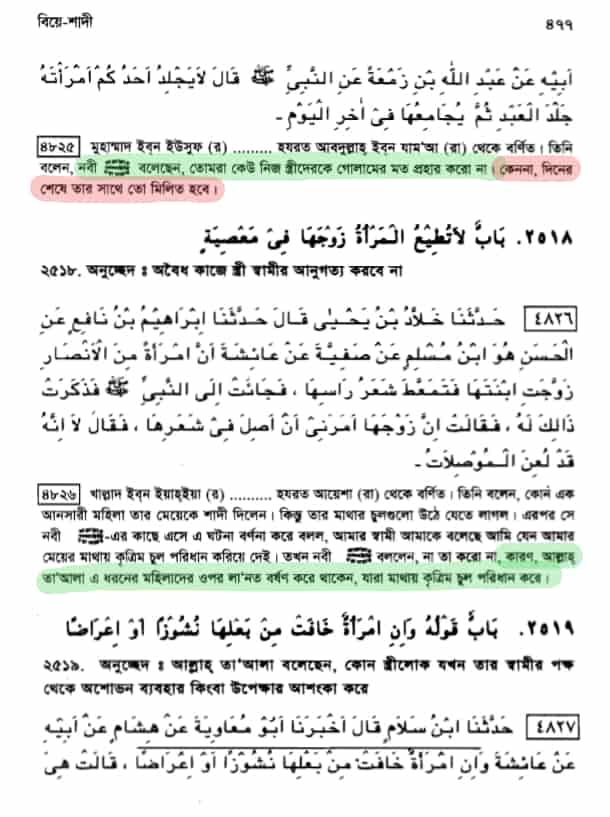

এবার একই বক্তব্য আরেকটি হাদিসগ্রন্থ থেকে পড়া যাক, যেখানে স্ত্রীকে গোলামের মতো প্রহার করতে নিষেধ করার কারণটি আরও স্পষ্টভাবে উঠে এসেছে। হাদিসটির একটি বর্ণনা অনুসারে, গোলামের মতো প্রহার করলে স্ত্রী দিনের শেষে সহবাসে অনাগ্রহ প্রকাশ করতে পারে। (( মিশকাতুল মাসাবীহ (মিশকাত), হাদিসঃ ৩২৪২ ))

মিশকাতুল মাসাবীহ (মিশকাত)
পর্ব-১৩: বিবাহ
পরিচ্ছেদঃ ১০. প্রথম অনুচ্ছেদ - স্ত্রীদের সাথে সদ্ব্যবহার এবং তাদের প্রত্যেকের (স্বামী-স্ত্রীর) পারস্পরিক হক ও অধিকার সংক্রান্ত
৩২৪২-[৫] ‘আব্দুল্লাহ ইবনু যাম্‘আহ্ (রাঃ) হতে বর্ণিত। তিনি বলেন, রাসূলুল্লাহ সাল্লাল্লাহু আলাইহি ওয়াসাল্লাম বলেছেনঃ তোমাদের কেউ যেন ক্রীতদাসীর ন্যায় স্ত্রীকে না মারে (অত্যাচার না করা হয়), অথচ দিনের শেষেই তার সাথে সহবাস করে।
অপর বর্ণনায় আছে- তোমাদের কেউ যেন ইচ্ছা করে স্ত্রীকে ক্রীতদাসীর ন্যায় মারমুখো না হয়, হয়তো দিন শেষে তার সাথে সহবাস করতে চাইবে; আর এতে সে অনাগ্রহ প্রকাশ করবে। অতঃপর তিনি (সাল্লাল্লাহু আলাইহি ওয়াসাল্লাম) বায়ু নির্গত হওয়ায় হাসি-ঠাট্টাচ্ছলের কারণে উপদেশ করলেন, যে কাজ নিজে কর অন্যের সে কাজে তোমরা কেন হাসবে! (বুখারী ও মুসলিম)[1]
[1] সহীহ : বুখারী ৪৯৪২, মুসলিম ১৪৭০।
হাদিসের মানঃ সহিহ (Sahih)
বর্ণনাকারীঃ আবদুল্লাহ ইবনু যাম‘আহ (রাঃ)

এই বর্ণনায় স্ত্রীকে প্রহার করার নৈতিকতা সরাসরি প্রত্যাখ্যান করা হয়নি। বরং অতিরিক্ত প্রহারের অসংগতিকে বোঝাতে বলা হয়েছে, একই ব্যক্তি দিনের বেলায় স্ত্রীকে দাসীর মতো মারবে এবং দিনের শেষেই আবার তার সঙ্গে সহবাস করবে। অন্য বর্ণনায় বিষয়টি আরও স্পষ্ট: এমন প্রহারের পর স্ত্রী সহবাসে অনাগ্রহী হয়ে যেতে পারে। অর্থাৎ উদ্বেগের কেন্দ্রে নির্যাতিত নারীর যন্ত্রণা নয়, বরং নির্যাতনের ফলে স্বামীর যৌনপ্রাপ্তি ব্যাহত হওয়ার সম্ভাবনা।

এখানে “দাসীর মতো” প্রহার নিষিদ্ধ করার অর্থ স্ত্রীকে কোনোভাবেই প্রহার করা যাবে না—এমন নয়। বরং দাসীর মতো কঠোর বা মাত্রাতিরিক্ত প্রহার না করার কথা বলা হচ্ছে। ফলে বর্ণনাটি স্ত্রী প্রহারের বিরুদ্ধে সার্বিক নিষেধাজ্ঞা প্রতিষ্ঠা না করে, বৈধ প্রহারের একটি সীমা নির্ধারণ করে। আর সেই সীমা নির্ধারণের অন্যতম ব্যবহারিক কারণ হলো, স্ত্রীকে এমন অবস্থায় না পৌঁছানো যাতে সে পরে স্বামীর সঙ্গে সহবাসে অনাগ্রহী হয়ে পড়ে।


ঘৃণা সত্ত্বেও বিছানায় আসতে বাধ্য স্ত্রী

স্ত্রী স্বামীর সঙ্গে যৌনসম্পর্কে অনিচ্ছুক হলে তাকে কীভাবে বাধ্য করা যাবে, প্রাচীন ইসলামি ফিকহে তার একটি স্পষ্ট বিবরণ পাওয়া যায় আছ-ছাওরীর সূত্রে বর্ণিত মুসান্নাফ আব্দুর রাযযাক হাদিস গ্রন্থের ১১,৮৭৮ নম্বর বর্ণনায়। এখানে স্ত্রীর অবাধ্যতা সংশোধনের জন্য প্রথমে উপদেশ, পরে কথা বলা বন্ধ করা ও কঠোর ভাষা প্রয়োগ এবং শেষ পর্যন্ত প্রহারের বিধান দেওয়া হয়েছে। এই প্রক্রিয়ার চূড়ান্ত লক্ষ্যও অস্পষ্ট রাখা হয়নি: স্ত্রী স্বামীকে ঘৃণা করলেও তাকে বিছানায় আসতে হবে। বিছানায় উপস্থিত হয়ে যৌন আনুগত্য প্রদর্শন করলেই তাকে অনুগত হিসেবে গণ্য করা হবে (( মুসান্নাফ আব্দুর রাযযাক পরিচ্ছেদ, হাদিস ১১৮৭৮ ))।

উল্লেখ্য, নিচে সংরক্ষিত বাংলা অনুবাদের একটি বাক্য যথাযথ নয়। সেখানে “هَجَرَهَا بِلِسَانِهِ” অংশটির অনুবাদ করা হয়েছে, “সে তার জিহ্বার মাধ্যমে তাকে বর্জন করবে।” এটি বাংলায় অস্পষ্ট ও আক্ষরিক অনুবাদ। এর সঠিক অর্থ হবে: “সে তার সঙ্গে কথা বলা বন্ধ করবে এবং এ বিষয়ে তার সঙ্গে কঠোর ভাষায় কথা বলবে।” হাদিসের সম্পূর্ণ বর্ণনাটি নিচে দেওয়া হলো—

হাদিস ১১,৮৭৮
মূল আরবি
عَنِ الثَّوْرِيِّ قَالَ: قَالَ أَصْحَابُنَا: " يَبْدَأُ فَيَعِظُهَا فَإِنْ قَبِلَتْ، وَإِلَّا هَجَرَهَا بِلِسَانِهِ، وَأَغْلَظَ لَهَا فِي ذَلِكَ، فَإِنْ قَبِلَتْ وَإِلَّا ضَرَبَهَا ضَرْبًا غَيْرَ مُبَرِّحٍ، فَإِنْ أَطَعْنَكُمْ [النساء: 34] أَتَتِ الْفِرَاشَ وَهِيَ تَبْغَضُكَ فَلَا تَبْغُوا عَلَيْهِنَّ سَبِيلًا [النساء: 34] "
বাংলা অনুবাদ
আছ-ছাওরী থেকে বর্ণিত, তিনি বলেন: আমাদের সাথীগণ বলেছেন, সে (স্বামী) প্রথমে তাকে নসীহত করবে। যদি সে মেনে নেয় (তবে ভালো)। অন্যথায়, সে তার জিহ্বার মাধ্যমে তাকে বর্জন করবে এবং এ বিষয়ে তার প্রতি কঠোরতা অবলম্বন করবে। যদি সে মেনে নেয় (তবে ভালো)। অন্যথায়, সে তাকে হালকা প্রহার করবে, যা আঘাতের চিহ্ন ফেলে না। আর (আল্লাহর বাণী) "ফাইন আতা’নাকুম [সূরা আন-নিসা: ৩৪]" (এর অর্থ হলো): সে বিছানায় আসবে, যদিও সে তোমাকে ঘৃণা করে। (তখন তোমরা তাকে আর কিছু বলবে না), "ফালা তাবগু আলাইহিন্না সাবীলান [সূরা আন-নিসা: ৩৪]" (সুতরাং তোমরা তাদের বিরুদ্ধে অন্যায় পথ অনুসন্ধান করো না)।

এই বর্ণনায় প্রহারের সঙ্গে যৌন আনুগত্যের সম্পর্ক সরাসরি প্রতিষ্ঠিত হয়েছে। স্ত্রী কেন স্বামীর বিছানায় যেতে চাইছে না, তার মানসিক অবস্থা কী, স্বামীর প্রতি তার অনিচ্ছা বা ঘৃণার কারণ কী, এসবের কোনো মূল্য এখানে নেই। বরং স্ত্রী বিছানায় না এলে তাকে প্রথমে মানসিক চাপ, পরে মৌখিক কঠোরতা এবং শেষ পর্যন্ত শারীরিক প্রহারের মাধ্যমে বাধ্য করার কথা বলা হয়েছে। সে স্বামীকে ঘৃণা করলেও বিছানায় উপস্থিত হলেই তাকে “অনুগত” হিসেবে গণ্য করা হবে। অর্থাৎ স্ত্রীর আন্তরিক ইচ্ছা বা যৌন সম্মতি নয়, তার শারীরিক আত্মসমর্পণই এই ফিকহি ব্যবস্থায় আনুগত্যের চূড়ান্ত মানদণ্ড। আসুন একই হাদিস গ্রন্থ থেকে আরেকটি বর্ণনা পড়ি, (( মুসান্নাফ আব্দুর রাযযাক পরিচ্ছেদ, হাদিস ১৭৯৭৪ ))

হাদিস ১৭,৯৭৪
মূল আরবি
عَنْ مَعْمَرٍ، عَنِ الزُّهْرِيِّ قَالَ: «لَا تُقَادُ الْمَرْأَةُ مِنْ زَوْجِهَا فِي الْأَدَبِ» يَقُولُ: «لَوْ ضَرَبَهَا فَشَجَّهَا، وَلَكِنْ إِنِ اعْتَدَى عَلَيْهِا فَقَتَلَهَا كَانَ الْقَوَدُ»
বাংলা অনুবাদ
আয-যুহরী থেকে বর্ণিত, তিনি বলেন: নারীকে তার স্বামীর বিরুদ্ধে শিষ্টাচারমূলক প্রহারের ক্ষেত্রে কিসাস (প্রতিশোধ) নেওয়া যাবে না। তিনি আরো বলেন: যদি স্বামী তাকে প্রহার করে এবং জখমও করে ফেলে, (তবুও কিসাস হবে না)। তবে যদি সে (স্বামী) তার উপর বাড়াবাড়ি করে এবং তাকে হত্যা করে ফেলে, তবে কিসাস ওয়াজিব হবে।

সম্মতি বা কনসেন্টের বর্তমান সময়ের ধারণায় ভয়, ধর্মীয় হুমকি, পারিবারিক শাস্তি কিংবা শারীরিক প্রহারের মুখে দেওয়া যৌন সম্মতি কোনো স্বাধীন সম্মতি নয়। এখানে স্বামী নিজে প্রহারের ক্ষমতা প্রয়োগ করছে এবং প্রহারের পর স্ত্রীকে সেই একই ব্যক্তির বিছানায় যেতে হচ্ছে। ফলে এটি পারস্পরিক ভালোবাসা বা স্বেচ্ছামূলক দাম্পত্য সম্পর্কের বিধান নয়; এটি সহিংসতা প্রয়োগ করে যৌন আনুগত্য আদায়ের একটি সুস্পষ্ট কাঠামো। “অপ্রচণ্ড” বা “গুরুতর আঘাত সৃষ্টি করে না”—এমন বিশেষণ প্রহারকে সম্মতিতে রূপান্তরিত করে না। মারধরের মাত্রা কম হলেও তার উদ্দেশ্য যদি স্ত্রীর যৌন প্রত্যাখ্যান ভেঙে তাকে বিছানায় নিয়ে আসা হয়, তবে সেটি বলপ্রয়োগমূলক যৌনতারই ধর্মীয় ও আইনগত অনুমোদন।

এই বর্ণনাটি নবী মুহাম্মদের সরাসরি উক্তি বা কোনো নির্দিষ্ট সাহাবীর ব্যক্তিগত ঘটনার বিবরণ নয়; এটি আছ-ছাওরীর সূত্রে সংরক্ষিত প্রাচীন ফিকহি অবস্থান। কিন্তু ঠিক এই কারণেই এর ঐতিহাসিক গুরুত্ব রয়েছে। এটি দেখায় যে সহবাসে অস্বীকৃতির কারণে স্ত্রীকে প্রহার এবং ঘৃণা সত্ত্বেও বিছানায় আসতে বাধ্য করার ব্যাখ্যা কোনো সাম্প্রতিক উগ্র ফতোয়া নয়; ইসলামের প্রাথমিক ফিকহি চিন্তাতেই এই ধারণা সুস্পষ্টভাবে উপস্থিত ছিল।


স্বামীর যৌন চাহিদার সামনে স্ত্রীর ইবাদতও অধস্তন

ইসলামী বৈবাহিক কাঠামোতে স্বামীর যৌন চাহিদাকে কতটা প্রাধান্য দেওয়া হয়েছে, তার একটি তাৎপর্যপূর্ণ উদাহরণ পাওয়া যায় সাফওয়ান ইবনু মুআত্তালের স্ত্রীসংক্রান্ত সহীহ ইবনু হিব্বান এর একটি বর্ণনায়। একজন নারী সরাসরি মুহাম্মদের কাছে অভিযোগ করেছিলেন যে তাঁর স্বামী নামাজ পড়ার সময় তাঁকে প্রহার করেন এবং রোজা রাখলে তাঁর রোজা ভেঙে দেন। স্বামী প্রহারের অভিযোগ অস্বীকার করেননি; বরং ব্যাখ্যা দিয়েছিলেন যে স্ত্রী নামাজে দুটি সূরা পড়েন, যদিও তিনি তাঁকে তা করতে নিষেধ করেছিলেন। রোজা ভাঙানোর কারণ হিসেবে তিনি আরও স্পষ্টভাবে বলেন, স্ত্রী ঘন ঘন রোজা রাখেন, অথচ তিনি একজন যুবক এবং যৌন সংযম করতে পারেন না (( সহীহ ইবনু হিব্বান, হাদিস ১৪৮৬ ))

হাদিস ১,৪৮৬
মূল আরবি
أَخْبَرَنَا أَحْمَدُ بْنُ عَلِيِّ بْنِ الْمُثَنَّى، حَدَّثَنَا أَبُو خَيْثَمَةَ، حَدَّثَنَا جَرِيرٌ، عَنِ الْأَعْمَشِ، عَنْ أَبِي صَالِحٍ، عَنْ أَبِي سَعِيدٍ الْخُدْرِيِّ، قَالَ: جَاءَتِ امْرَأَةٌ إِلَى النَّبِيِّ صَلَّى اللَّهُ عَلَيْهِ وَسَلَّمَ، فَقَالَتْ: يَا رَسُولَ اللَّهِ، إِنَّ زَوْجِي صَفْوَانَ بْنَ الْمُعَطَّلِ يَضْرِبُنِي إِذَا صَلَّيْتُ، وَيُفَطِّرُنِي إِذَا صُمْتُ، وَلَا يُصَلِّي صَلَاةَ الْفَجْرِ حَتَّى تَطْلُعَ الشَّمْسُ، قَالَ: - وَصَفْوَانُ عِنْدَهُ - فَسَأَلَهُ عَمَّا قَالَتْ، فَقَالَ: يَا رَسُولَ اللَّهِ أَمَّا قَوْلُهَا: يَضْرِبُنِي إِذَا صَلَّيْتُ، فَإِنَّهَا تَقْرَأُ بِسُورَتِي وَقَدْ نَهَيْتُهَا عَنْهَا، فَقَالَ النَّبِيُّ صَلَّى اللَّهُ عَلَيْهِ وَسَلَّمَ: «لَوْ كَانَتْ سُورَةً وَاحِدَةً لَكَفَتِ النَّاسَ»، قَالَ: وَأَمَّا قَوْلُهَا: يُفَطِّرُنِي إِذَا صُمْتُ، فَإِنَّهَا تَنْطَلِقُ فَتَصُومُ، وَأَنَا رَجُلٌ شَابٌّ وَلَا أَصْبِرُ، فَقَالَ رَسُولُ اللَّهِ صَلَّى اللَّهُ عَلَيْهِ وَسَلَّمَ يَوْمَئِذٍ: «لَا تَصُومُ امْرَأَةٌ إِلَّا بِإِذْنِ زَوْجِهَا»، قَالَ: وَأَمَّا قَوْلُهَا: لَا أُصَلِّي حَتَّى تَطْلُعَ الشَّمْسُ، فَإِنَّا أَهْلُ بَيْتٍ لَا نَكَادُ نَسْتَيْقِظُ حَتَّى تَطْلُعَ الشَّمْسُ، فَقَالَ صَلَّى اللَّهُ عَلَيْهِ وَسَلَّمَ: «فَإِذَا اسْتَيْقَظْتَ فَصَلِّ».
বাংলা অনুবাদ
আবূ সাঈদ খুদরী রাদ্বিয়াল্লাহু আনহু থেকে বর্ণিত, তিনি বলেন, এক নারী রাসূল সাল্লাল্লাহু আলাইহি ওয়া সাল্লামের কাছে এসে বলেন, হে আল্লাহর রাসূল সাল্লাল্লাহু আলাইহি ওয়া সাল্লাম, আমার স্বামী সাফওয়ান বিন মুআত্তাল, যখন আমি সালাত আদায় করি, তখন তিনি আমাকে প্রহার করেন; আমি যখন সিয়াম রাখি, তখন তিনি আমার সিয়াম ভেঙে দেন; এবং সূর্য উদিত না হওয়া পর্যন্ত তিনি ফজরের সালাত আদায় করেন না। এই সময় সাফওয়ান তাঁর কাছেই উপস্থিত ছিলেন। তখন রাসূল সাল্লাল্লাহু আলাইহি ওয়া সাল্লাম তাঁকে তাঁর স্ত্রীর অভিযোগ সম্পর্কে জিজ্ঞেস করেন। তিনি বলেন, হে আল্লাহর রাসূল, তার বক্তব্য—“যখন আমি সালাত আদায় করি, তখন তিনি আমাকে প্রহার করেন”—এর কারণ হলো, সে নামাজে দুটি সূরা পড়ে, অথচ আমি তাকে তা করতে নিষেধ করেছি। তখন নবী সাল্লাল্লাহু আলাইহি ওয়া সাল্লাম বলেন, “যদি একটি সূরা হতো, তবে সেটিই মানুষের জন্য যথেষ্ট হতো।” সাফওয়ান বলেন, তার অভিযোগ—“আমি যখন সিয়াম রাখি, তখন তিনি আমার সিয়াম ভেঙে দেন”—এর কারণ হলো, সে একের পর এক সিয়াম রাখে, অথচ আমি একজন যুবক এবং আমি সংযম করতে পারি না। তখন রাসূল সাল্লাল্লাহু আলাইহি ওয়া সাল্লাম বলেন, “কোনো নারী তার স্বামীর অনুমতি ছাড়া নফল সিয়াম পালন করবে না।” সাফওয়ান বলেন, তার অভিযোগ—“তিনি সূর্য উদিত না হওয়া পর্যন্ত ফজরের সালাত আদায় করেন না”—এর কারণ হলো, আমরা এমন পরিবারের মানুষ, যারা প্রায়ই সূর্য উদিত না হওয়া পর্যন্ত জাগতে পারি না। রাসূল সাল্লাল্লাহু আলাইহি ওয়া সাল্লাম বলেন, “যখন তুমি জাগ্রত হবে, তখনই সালাত আদায় করে নেবে।”
তথ্যসূত্র: মুসনাদ আহমাদ ৩/৮০; সুনান আবু দাউদ ২৪৫৯; তাহাবী, মুশকিলুল আসার ২/৪২৪; আল-হাকিম ১/৪৩৬। শুআইব আল-আরনাউত সনদটিকে বুখারী ও মুসলিমের শর্ত অনুযায়ী সহিহ বলেছেন। নাসিরুদ্দিন আলবানীও বর্ণনাটিকে সহিহ বলেছেন—সহিহ আবু দাউদ ২১২২; আস-সিলসিলাতুস সহীহাহ ৩৯৫।

এই ঘটনার সবচেয়ে গুরুত্বপূর্ণ দিক হলো, নারীটির অভিযোগ শুনে মুহাম্মদ তাঁর স্বামীকে স্ত্রী প্রহারের জন্য তিরস্কার বা শাস্তি দেননি। স্বামী নিজেই স্বীকার করেছেন যে স্ত্রী নামাজে তাঁর নির্ধারিত সীমার চেয়ে বেশি পাঠ করায় তিনি তাঁকে মারতেন। অথচ প্রতিক্রিয়ায় প্রহারকে অন্যায় ঘোষণা না করে স্ত্রী কতটুকু সূরা পড়বেন, সেই বিষয়ে স্বামীর অভিযোগকেই কার্যত গ্রহণ করা হয়েছে। এর ফলে একজন প্রাপ্তবয়স্ক নারীর ব্যক্তিগত ইবাদতও স্বামীর নিয়ন্ত্রণ ও শারীরিক শাস্তির আওতায় পড়ে যায়। স্বামীর নির্দেশ অমান্য করে নামাজ দীর্ঘ করলে প্রহার—এমন আচরণের বিরুদ্ধে বর্ণনায় কোনো নৈতিক আপত্তি পাওয়া যায় না।

রোজার ঘটনাটি আরও প্রত্যক্ষভাবে স্বামীর যৌন অধিকারের সঙ্গে সম্পর্কিত। সাফওয়ান বলেছিলেন, তাঁর স্ত্রী ঘন ঘন রোজা রাখেন, অথচ তিনি একজন যুবক এবং যৌন সংযম করতে পারেন না। অর্থাৎ স্ত্রী রোজা রাখলে দিনের বেলায় স্বামী তাঁর সঙ্গে যৌনসম্পর্ক স্থাপন করতে পারবেন না—এটিই তাঁর অভিযোগের মূল কারণ। মুহাম্মদ এই দাবিকে প্রত্যাখ্যান করেননি এবং বলেননি যে স্ত্রীর নিজের শরীর ও ইবাদতের বিষয়ে সিদ্ধান্ত নেওয়ার অধিকার রয়েছে। বরং বিধান দিয়েছেন, স্বামীর অনুমতি ছাড়া স্ত্রী নফল রোজা রাখতে পারবে না। ফলে স্ত্রীর ধর্মীয় সাধনা, শারীরিক স্বাধীনতা এবং ব্যক্তিগত সিদ্ধান্ত—সবকিছুর ওপর স্বামীর সম্ভাব্য যৌন চাহিদাকে অগ্রাধিকার দেওয়া হয়েছে।

এই হাদিসে সরাসরি বলা হয়নি যে সাফওয়ান স্ত্রীকে ধরে জোরপূর্বক সহবাস করেছিলেন। কিন্তু এতে যে ক্ষমতার কাঠামো প্রতিষ্ঠিত হয়েছে, তা দ্ব্যর্থহীন। স্ত্রী রোজা রাখার সিদ্ধান্ত নিলে স্বামী সেই রোজা ভাঙিয়ে দিতে পারেন, কারণ তাঁর যৌন চাহিদা রয়েছে; আর স্ত্রী স্বামীর অনুমতি ছাড়া পুনরায় নফল রোজা রাখতেও পারবেন না। অর্থাৎ বিবাহের মাধ্যমে স্বামী স্ত্রীর দেহের ওপর এমন একটি স্থায়ী যৌন অগ্রাধিকার লাভ করছেন, যার কারণে স্ত্রীর আল্লাহর উদ্দেশ্যে করা ব্যক্তিগত ইবাদতও তাঁর অনুমতির অধীন হয়ে যায়। আধুনিক ভাষায় এটি সমান অংশীদারত্ব নয়; এটি স্ত্রীর শরীর ও সময়ের ওপর স্বামীর প্রাতিষ্ঠানিক নিয়ন্ত্রণ।

আরও লক্ষণীয়, একই ঘটনার মধ্যে স্ত্রী প্রহারের অভিযোগ, রোজা ভেঙে দেওয়ার অভিযোগ এবং স্বামীর যৌন অসংযমের বক্তব্য পাশাপাশি এসেছে। তারপরও সিদ্ধান্তের ভার প্রধানত স্ত্রীর ওপরই চাপানো হয়েছে—সে নামাজ সংক্ষিপ্ত করবে এবং স্বামীর অনুমতি ছাড়া নফল রোজা রাখবে না। স্বামীর প্রহার বা নিজের যৌন আকাঙ্ক্ষা নিয়ন্ত্রণে অক্ষমতাকে সমানভাবে নৈতিক সমস্যা হিসেবে চিহ্নিত করা হয়নি। এর ফলে সহিংস স্বামীর আচরণ সংশোধিত না হয়ে স্ত্রীকেই এমনভাবে নিয়ন্ত্রিত করা হয়েছে, যেন তাঁর ইবাদত ও শরীরের ব্যবহার স্বামীর সুবিধার সঙ্গে সামঞ্জস্যপূর্ণ থাকে। এই বর্ণনা দেখায়, ইসলামী বৈবাহিক কাঠামোয় স্ত্রীর ব্যক্তিস্বাধীনতার তুলনায় স্বামীর কর্তৃত্ব ও যৌন সুবিধাই অধিকতর গুরুত্বপূর্ণ।


বিবাহ আসলে স্বামীর দাসী হওয়ার নামান্তর

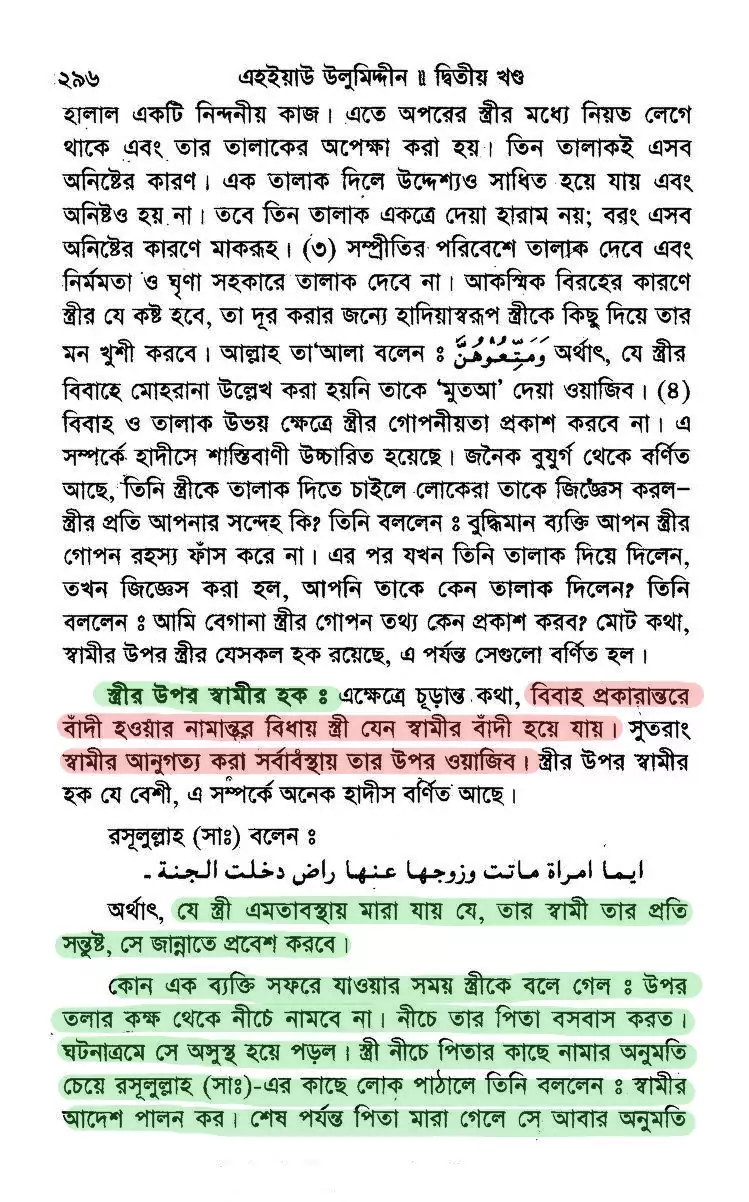
ইসলামের ইতিহাসে সর্বকালের শ্রেষ্ঠ মুসলিম দার্শনিক ইমাম আবু হামেদ মুহাম্মদ ইবনে মুহাম্মদ আল-গাযযালী রচিত ‘এহইয়াউ উলুমিদ্দীন’ বিগত আট শতাধিক বছর ধরে সমগ্র মুসলিম জাহানে সর্বাধিক পঠিত একটি মহাগ্রন্থ। আজ পর্যন্ত মুসলিমদের মধ্যে এ গ্রন্থটি একটি অনন্য এবং অপ্রতিদ্বন্দ্বী ইসলামী গ্রন্থ হিসেবে গণ্য করা হয় । এই গ্রন্থে স্ত্রীর ওপর স্বামীর হক পরিচ্ছেদে বলা আছে, স্ত্রী হওয়া আসলে স্বামীর দাসী হোওয়ারই নামান্তর। তাই একজন মুসলিম নারীর সদাসর্বদাই স্বামীর প্রভুত্ব মেনে তার দাসীর মতই জীবন যাপন করা উচিত (( এহইয়া্উ উলুমিদ্দীন, ২য় খণ্ড, মদিনা পাবলিকেশান্স, পৃষ্ঠা ২৯৬-২৯৮ ))

স্ত্রীর উপর স্বামীর হক: এক্ষেত্রে চূড়ান্ত কথা, বিবাহ প্রকারান্তরে বাঁদী হওয়ার নামান্তর বিধায় স্ত্রী যেন স্বামীর বাঁদী হয়ে যায়। সুতরাং স্বামীর আনুগত্য করা সর্বাবস্থায় তার উপর ওয়াজিব। স্ত্রীর উপর স্বামীর হক যে বেশী, এ সম্পর্কে অনেক হাদীস বর্ণিত আছে।
রসূলুল্লাহ (সাঃ) বলেন:
ايما امرأة ماتت وزوجها عنها راض دخلت الجنة .
অর্থাৎ, যে স্ত্রী এমতাবস্থায় মারা যায় যে, তার স্বামী তার প্রতি সন্তুষ্ট, সে জান্নাতে প্রবেশ করবে।
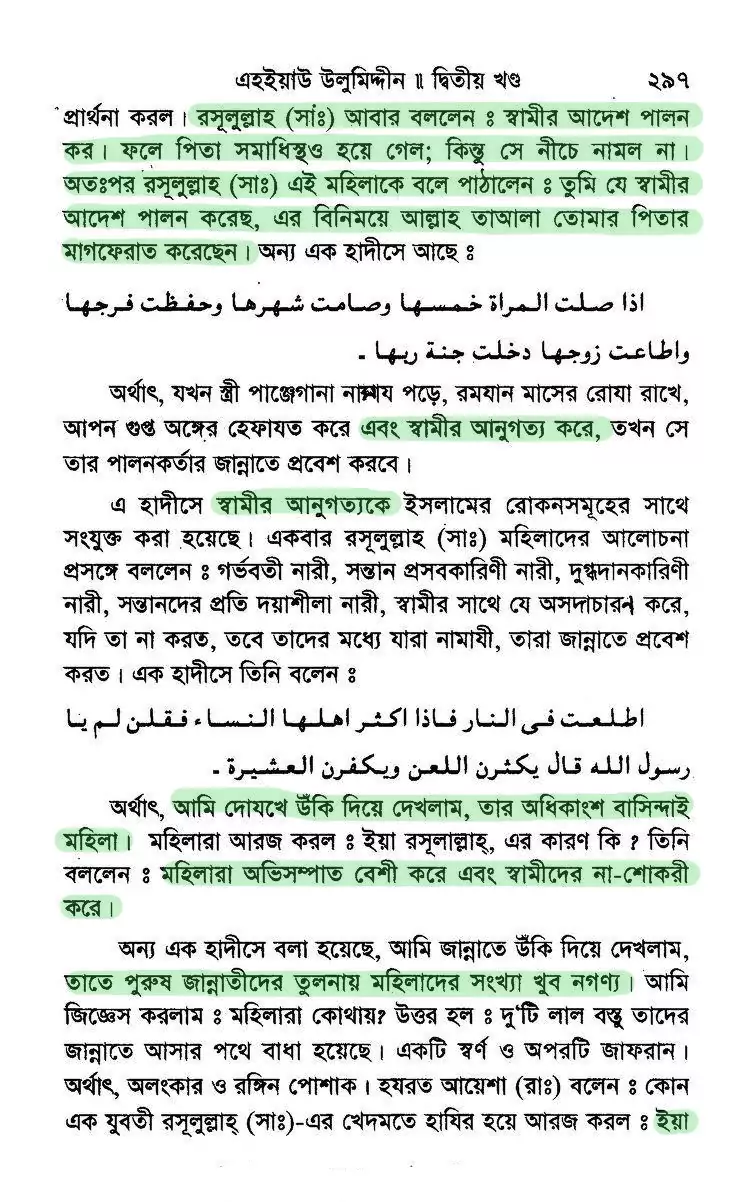
কোন এক ব্যক্তি সফরে যাওয়ার সময় স্ত্রীকে বলে গেল: উপর তলার কক্ষ থেকে নীচে নামবে না। নীচে তার পিতা বসবাস করত। ঘটনাক্রমে সে অসুস্থ হয়ে পড়ল। স্ত্রী নীচে পিতার কাছে নামার অনুমতি চেয়ে রসূলুল্লাহ (সাঃ)-এর কাছে লোক পাঠালে তিনি বললেন: স্বামীর আদেশ পালন কর। শেষ পর্যন্ত পিতা মারা গেলে সে আবার অনুমতি 'প্রার্থনা করল। রসূলুল্লাহ (সাঃ) আবার বললেন: স্বামীর আদেশ পালন কর। ফলে পিতা সমাধিস্থও হয়ে গেল; কিন্তু সে নীচে নামল না। অতঃপর রসূলুল্লাহ (সাঃ) এই মহিলাকে বলে পাঠালেন: তুমি যে স্বামীর আদেশ পালন করেছ, এর বিনিময়ে আল্লাহ তাআলা তোমার পিতার মাগফেরাত করেছেন। অন্য এক হাদীসে আছে:
اذا صلت المرأة خمسها وصامت شهرها وحفظت فرجها
واطاعت زوجها دخلت جنة ربها
অর্থাৎ, যখন স্ত্রী পাঞ্জেগানা নামায পড়ে, রমযান মাসের রোযা রাখে, আপন গুপ্ত অঙ্গের হেফাযত করে এবং স্বামীর আনুগত্য করে, তখন সে তার পালনকর্তার জান্নাতে প্রবেশ করবে।
এ হাদীসে স্বামীর আনুগত্যকে ইসলামের রোকনসমূহের সাথে সংযুক্ত করা হয়েছে। একবার রসূলুল্লাহ (সাঃ) মহিলাদের আলোচনা প্রসঙ্গে বললেন: গর্ভবতী নারী, সন্তান প্রসবকারিণী নারী, দুগ্ধদানকারিণী নারী, সন্তানদের প্রতি দয়াশীলা নারী, স্বামীর সাথে যে অসদাচারণ করে, যদি তা না করত, তবে তাদের মধ্যে যারা নামাযী, তারা জান্নাতে প্রবেশ করত। এক হাদীসে তিনি বলেন:
اطلعت في النار فاذا اكثر اهلها النساء فقلن لم يا
رسول الله قال يكثرن اللعن ويكفرن العشيرة .
অর্থাৎ, আমি দোযখে উঁকি দিয়ে দেখলাম, তার অধিকাংশ বাসিন্দাই মহিলা। মহিলারা আরজ করল: ইয়া রসূলাল্লাহ্, এর কারণ কি? তিনি বললেন: মহিলারা অভিসম্পাত বেশী করে এবং স্বামীদের না-শোকরী করে।
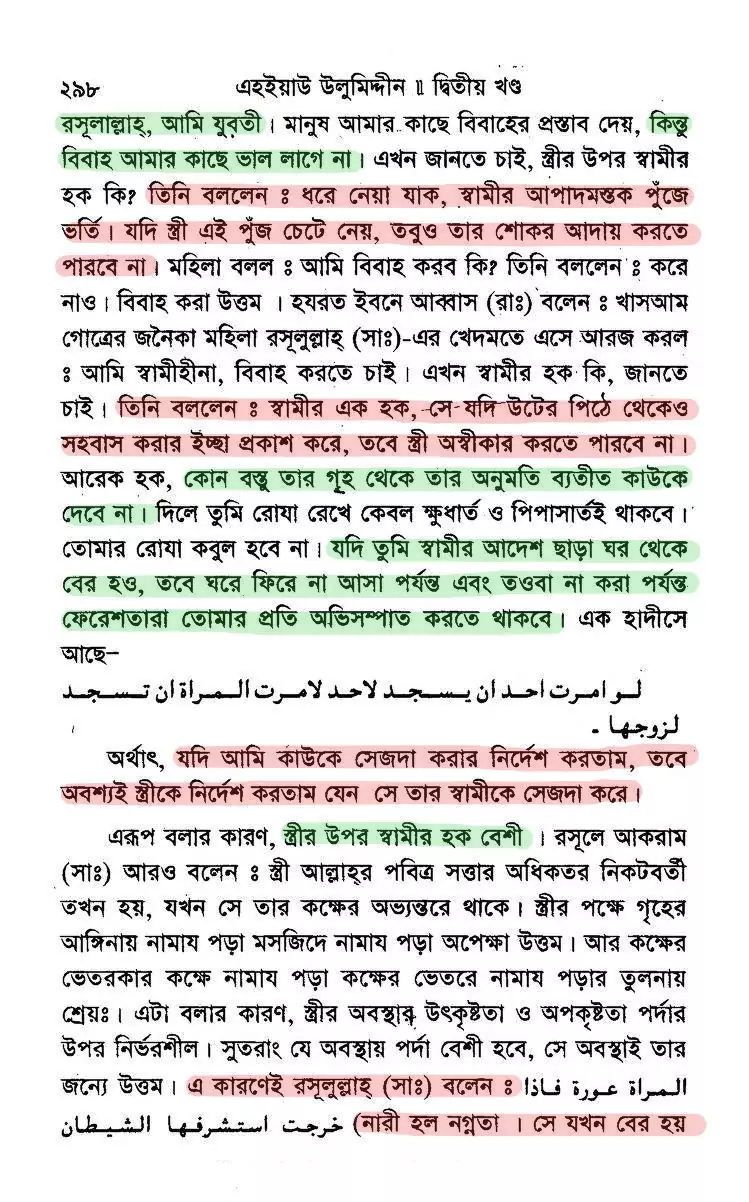
অন্য এক হাদীসে বলা হয়েছে, আমি জান্নাতে উঁকি দিয়ে দেখলাম, তাতে পুরুষ জান্নাতীদের তুলনায় মহিলাদের সংখ্যা খুব নগণ্য। আমি জিজ্ঞেস করলাম: মহিলারা কোথায়? উত্তর হল: দু'টি লাল বস্তু তাদের জান্নাতে আসার পথে বাধা হয়েছে। একটি স্বর্ণ ও অপরটি জাফরান। অর্থাৎ, অলংকার ও রঙ্গিন পোশাক। হযরত আয়েশা (রাঃ) বলেন: কোন এক যুবতী রসূলুল্লাহ্ (সাঃ)-এর খেদমতে হাযির হয়ে আরজ করল: ইয়া রসূলাল্লাহ্, আমি যুবতী। মানুষ আমার কাছে বিবাহের প্রস্তাব দেয়, কিন্তু বিবাহ আমার কাছে ভাল লাগে না। এখন জানতে চাই, স্ত্রীর উপর স্বামীর হক কি? তিনি বললেন: ধরে নেয়া যাক, স্বামীর আপাদমস্তক পুঁজে ভর্তি। যদি স্ত্রী এই পুঁজ চেটে নেয়, তবুও তার শোকর আদায় করতে পারবে না। মহিলা বলল: আমি বিবাহ করব কি? তিনি বললেনঃ করে নাও। বিবাহ করা উত্তম। হযরত ইবনে আব্বাস (রাঃ) বলেন: খাসআম গোত্রের জনৈকা মহিলা রসূলুল্লাহ্ (সাঃ)-এর খেদমতে এসে আরজ করল : আমি স্বামীহীনা, বিবাহ করতে চাই। এখন স্বামীর হক কি, জানতে চাই। তিনি বললেন: স্বামীর এক হক, সে-যদি উটের পিঠে থেকেও সহবাস করার ইচ্ছা প্রকাশ করে, তবে স্ত্রী অস্বীকার করতে পারবে না। আরেক হক, কোন বস্তু তার গৃহ থেকে তার অনুমতি ব্যতীত কাউকে দেবে না। দিলে তুমি রোযা রেখে কেবল ক্ষুধার্ত ও পিপাসার্তই থাকবে। তোমার রোযা কবুল হবে না। যদি তুমি স্বামীর আদেশ ছাড়া ঘর থেকে বের হও, তবে ঘরে ফিরে না আসা পর্যন্ত এবং তওবা না করা পর্যন্ত ফেরেশতারা তোমার প্রতি অভিসম্পাত করতে থাকবে। এক হাদীসে আছে-
لو امرت احد أن يسجد لأحد لأمرت المرأة أن تسجد
لزوجها .
অর্থাৎ, যদি আমি কাউকে সেজদা করার নির্দেশ করতাম, তবে অবশ্যই স্ত্রীকে নির্দেশ করতাম যেন সে তার স্বামীকে সেজদা করে।
এরূপ বলার কারণ, স্ত্রীর উপর স্বামীর হক বেশী। রসূলে আকরাম (সাঃ) আরও বলেন: স্ত্রী আল্লাহ্র পবিত্র সত্তার অধিকতর নিকটবর্তী তখন হয়, যখন সে তার কক্ষের অভ্যন্তরে থাকে। স্ত্রীর পক্ষে গৃহের আঙ্গিনায় নামায পড়া মসজিদে নামায পড়া অপেক্ষা উত্তম। আর কক্ষের ভেতরকার কক্ষে নামায পড়া কক্ষের ভেতরে নামায পড়ার তুলনায় শ্রেয়ঃ। এটা বলার কারণ, স্ত্রীর অবস্থার উৎকৃষ্টতা ও অপকৃষ্টতা পর্দার উপর নির্ভরশীল। সুতরাং যে অবস্থায় পর্দা বেশী হবে, সে অবস্থাই তার জন্যে উত্তম। এ কারণেই রসূলুল্লাহ্ (সাঃ) বলেন : المراة عورة فاذا خرجت استشرفها الشيطان )নারী হল নগ্নতা। সে যখন বের হয়
বাংলাদেশের বর্তমান পরিস্থিতি

আসুন একটি ভিডিও দেখি। এই ভিডিওতে একজন শিশুকে প্রাপ্তবয়স্ক একজন পুরুষের সাথে বাবা মা জোর করে বিয়ে দিচ্ছে, যা ইসলামী শরীয়তে বৈধ (( আয়িশা কি নয়বছর বয়সে বয়ঃসন্ধিকালে পৌঁছেছিলেন? ))। ভাবুন তো, এই শিশু মেয়েটির সাথে বাসর রাতে কী ঘটতে যাচ্ছে?

0:00
–:––

এবারে আসুন একটি নিউজ পড়ি, (( বৈবাহিক ধর্ষণে কিশোরীর মৃত্যু: এরপরও কেন এটি বৈধ? )) (( ওয়েব আর্কাইভ লিংক বৈবাহিক ধর্ষণে কিশোরীর মৃত্যু: এরপরও কেন এটি বৈধ? ))

বৈবাহিক ধর্ষণে কিশোরীর মৃত্যু: এরপরও কেন এটি বৈধ?
ছবি: নূরনাহার ও তার স্বামী রাজিব খান।
গত ২৫ অক্টোবর টাঙ্গাইল থেকে আসা ১৪ বছরের এক কিশোরী ঢাকা মেডিকেল কলেজ হাসপাতালে চিকিৎসাধীন অবস্থায় মারা যায়। সংবাদপত্রে প্রকাশিত তথ্য মতে, তার মৃত্যুর কারণ ছিল যোনিপথে অত্যধিক রক্তক্ষরণ।
পুলিশ ও স্থানীয় বাসিন্দারা জানিয়েছেন, ভুক্তভোগীর নাম নূরনাহার। টাঙ্গাইলের বাসাইল উপজেলার কাউলজানি ইউনিয়নের কালিয়া গ্রামের মেয়ে নূরনাহার কালিয়া বিদ্যালয়ের শিক্ষার্থী ছিল। নূরনাহারের পরিবারের আর্থিক টানাপোড়েন লেগেই ছিল। তার বাবা-মা দুই জনেই দিনমজুর হিসেবে সারাদিন কাজ করেন। দিনমজুরির কাজে দিনের বড় একটা সময় তারা বাসার বাইরে থাকতেন। বাড়িতে থাকার সময়টুকু কাটত কলহে। এমন পরিবেশ থেকে নূরনাহারকে দূরে রাখার জন্য মাত্র চার বছর বয়সে তার নানা লাল খান তাকে নিজ বাড়িতে নিয়ে যান। নূরনাহার তার নানার কাছেই মানুষ হচ্ছিল। লাল খানই নূরনাহারকে স্কুলে ভর্তি করিয়ে দেন। দিনমজুর হিসেবে পাওয়া সামান্য উপার্জন থেকে নাতনির লেখাপড়া ও অন্যান্য খরচ চালাতেন। মেধাবী শিক্ষার্থী হিসেবে নূরনাহারের সুনাম ছিল। বার্ষিক পরীক্ষায় দ্বিতীয় স্থান অধিকার করে সে এ বছর অষ্টম শ্রেণিতে পড়া শুরু করেছিল।
কিন্তু বিধি বাম। করোনার আঘাতে লাল খানের ছোট্ট সংসার পর্যদুস্ত হয়ে পড়ে। এ অবস্থায় গত ২০ সেপ্টেম্বর পার্শ্ববর্তী গ্রামের ৩৪/৩৫ বছরের রাজিব খানের সঙ্গে নূরনাহারের বাল্যবিয়ে হয়। অভিবাসী শ্রমিক রাজিব আরব আমিরাতে কাজ করেন। ছুটিতে দেশে এসেছিলেন। রাজিব ভালো উপার্জন করেন, এমন কথার ভিত্তিতে নূরনাহারের পরিবার রাজিবের সঙ্গে মেয়েকে বিয়ে দিতে আগ্রহী হয়। লাল খান ৩০ হাজার টাকা খরচ করে নাতনির বিয়ের অনুষ্ঠানের আয়োজন করেছিলেন। বাল্যবিবাহ নিরোধ আইন ২০১৭’র বিধান অনুযায়ী, নূরনাহারের বয়স বিবাহযোগ্য না হওয়ায় (১৮ বছর) উভয় পরিবার বিয়ে নিবন্ধন না করার সিদ্ধান্ত নেয়। বিয়ের পর নূরনাহার বাসাইল উপজেলার ফুলকি পশ্চিমপাড়া গ্রামে তার শ্বশুরবাড়িতে চলে যায়।
একটি পত্রিকাকে দেওয়া সাক্ষাৎকারে লাল খান বলেন, ‘আমার নাতনি আমাকে খবর দেয় যে, বিয়ের প্রথম রাত থেকেই তার রক্তক্ষরণ হচ্ছিল।’ রাজিব তার নববধূর উপযুক্ত চিকিৎসার ব্যবস্থা তো করেননি, বরং মেয়েটির গভীর ক্ষতকে উপেক্ষা করে তিনি সহবাস চালিয়ে যান। রক্তপাত না থামায় নূরনাহারের শাশুড়ি তাকে স্থানীয় কবিরাজি দাওয়াই এনে খাওয়ান। পরবর্তীতে নূরনাহারের অবস্থা সংকটাপন্ন হলে ২২ অক্টোবর টাঙ্গাইলের একটি বেসরকারি ক্লিনিকে তাকে নেওয়া হয় এবং সুকৌশলে পুত্রবধূর যাবতীয় দায়-দায়িত্ব বাপের বাড়ির লোকের ওপর বুঝিয়ে দিয়ে শ্বশুরবাড়ির লোকেরা চলে যান।
অবস্থার অবনতিতে মেয়েটিকে তারপর মির্জাপুরের কুমুদিনী হাসপাতালে নেওয়া হয়। চিকিৎসার খরচ মেটাতে নূরনাহারের পরিবার হিমশিম খাচ্ছিল। তখন পাড়া-প্রতিবেশীরা এগিয়ে এসে ৬০ হাজার টাকা জোগাড় করে পরিবারের হাতে তুলে দেয়। শেষ পর্যন্ত নূরনাহারকে ঢাকা মেডিকেল কলেজে আনা নয়। কিন্তু, ততক্ষণে অনেক দেরি হয়ে গিয়েছিল। অবশেষে ২৫ অক্টোবর নূরনাহার পরাজয় স্বীকার করে। পরের দিন ময়নাতদন্ত শেষে নানাবাড়ির নিকটবর্তী স্থানীয় গোরস্থানে তার দাফনকার্য সম্পাদিত হয়। লাল খান তার নাতনির মৃত্যুর জন্য রাজিবকে দায়ী করেছেন। রাজীব তার সদ্যমৃত স্ত্রীর জানাজায় পর্যন্ত যাননি।
নূরনাহারের শাশুড়ি বিলকিস বেগমের বক্তব্য, ‘নূরনাহারকে জিনে ধরেছিল। তাই তার যোনিপথে এত রক্তক্ষরণ হয়েছে।’ বাসাইল উপজেলা স্বাস্থ্য ও পরিবার পরিকল্পনা কর্মকর্তা ডা. ফিরোজুর রহমান সংবাদমাধ্যমকে জানিয়েছেন যে, মেয়েদের প্রথম মিলনের ক্ষেত্রে ভয় ও আতঙ্ক বোধ করা খুবই স্বাভাবিক। তা ছাড়া, অপরিণত বয়সে বিয়ে হলে যোনিপথে রক্তক্ষরণের ঝুঁকি বেড়ে যায়। এসব ক্ষেত্রে রক্তক্ষরণ বন্ধ করার জন্য বিলম্ব না করে গাইনোকোলজিস্ট দেখানো জরুরি।
গ্রাম্য সালিশে নূরনাহারের শ্বশুরবাড়ির লোকেরা টাকা দিয়ে বিষয়টি ‘মিটমাট’ করে ফেলার প্রস্তাব দিয়েছেন। তবে, জানা গিয়েছে যে, নূরনাহারের পরিবার বাসাইল থানায় শ্বশুরবাড়ির নামে অভিযোগ দাখিল করেছেন। প্রসঙ্গত, উল্লেখ্য যে, বাল্যবিবাহ সংঘটনের মাধ্যমে নূরনাহারের পরিবারের লোকেরাও বাল্যবিবাহ নিরোধ আইন ২০১৭’র ৮ ধারা অনুযায়ী অপরাধী। যার জন্য তাদের সর্বোচ্চ শাস্তি হিসেবে দুই বছরের কারাদণ্ড বা ৫০ হাজার টাকা জরিমানা বা উভয় দণ্ডেই দণ্ডিত করা যায়।
নূরনাহারের পরিবারের একটিবারও মনে হয়নি যে, নূরনাহারের মতো একজন মেধাবী শিক্ষার্থী একদিন তাদের দারিদ্র্যের কষাঘাত থেকে মুক্তি এনে দেবে। তাদের কাছে মোটা টাকা কামানো প্রবাসী পাত্রের সঙ্গে মেয়ের বিয়ে দেওয়াটাই বড় ছিল। অথচ নূরনাহারের নানা কিনা নিজ উদ্যোগে নাতনিকে স্কুলে পড়াচ্ছিলেন! আজও এ সমাজে মেয়ের বিয়ের কাছে তাদের লেখাপড়া, তাদের স্বনির্ভরতা, তাদের দক্ষতা অর্জন হেরে যাচ্ছে।
একটি বিষয় পরিষ্কার হওয়া জরুরি যে, নূরনাহার মারা গেছে তার বরের জবরদস্তিমূলক উপর্যুপরি সঙ্গমের কারণে। কিন্তু, দুঃখের বিষয় এই যে, বাংলাদেশের আইনে ১৩ বছরের বেশি বয়সের স্ত্রীর সঙ্গে সহবাস ধর্ষণ বলে বিবেচিত না। রাজিবের এই পাশবিকতা আমাদের দণ্ডবিধি ১৮৬০’র ৩৭৫ ধারায় (যে ধারায় ধর্ষণের সংজ্ঞা দেওয়া হয়েছে) অপরাধ হিসেবে বিবেচিত হবে না। উপরন্তু, দণ্ডবিধির ৩৭৬ ধারা অনুযায়ী (যেখানে ধর্ষণের শাস্তি বর্ণিত হয়েছে) বৈবাহিক ধর্ষণের শাস্তি কেবল তখনই দেওয়া যেতে পারে, যখন স্ত্রীর বয়স ১২ বছরের কম হবে এবং সেই শাস্তির পরিমাণ মাত্র অনূর্ধ্ব দুই বছরের কারাদণ্ড বা জরিমানা।
এই আইনগুলো আমাদের দেশে ব্রিটিশ আমলে তৈরি করা। ঔপনিবেশিক শাসনকালে যখন ভিক্টোরিয়ান নৈতিকতা সমাজের সর্বস্তরে বিরাজমান, তখন এই আইনের সৃষ্টি। ভিক্টোরিয়ান নৈতিকতায় স্ত্রীকে তার ‘স্বামী’ অর্থাৎ মালিকের সহধর্মিণী না, বরং সম্পত্তি ভাবা হতো। সেই সমাজে নিজের স্ত্রীকে যথেচ্ছা ভোগ করার জন্য পুরুষকে দায়বদ্ধ করা ছিল অকল্পনীয়। এমন একটি রক্ষণশীল ধর্ষণের সংজ্ঞা আমরা উত্তরাধিকারসূত্রে প্রাপ্ত সম্পত্তির মতো আজও আগলে রেখেছি।
স্বাধীনতা পরবর্তী বাংলাদেশে নারীর প্রতি সহিংসতা নিরোধের জন্য এই পর্যন্ত তিন বার বিশেষ আইন প্রণীত হয়েছে। প্রথমে ১৯৮৩ সালে, এরপর ১৯৯৫ এবং সর্বশেষ ২০০০ সালে। কিন্তু, প্রতিবারই আমাদের আইন প্রণেতারা সজ্ঞানে দণ্ডবিধি থেকে বৈবাহিক ধর্ষণের দায়মুক্তি দেওয়া ওই ব্যতিক্রম ধারা বাতিলের পরিবর্তে বহাল রেখেছেন। এই আইনের হোতা যেই ব্রিটিশ, তারা কিন্তু সেই ১৯৯১ সালেই বৈবাহিক ধর্ষণকে অপরাধ হিসেবে স্বীকৃতি দিয়েছে। এমনকি পাকিস্তান (দেশভাগের পর ওই আইন পাকিস্তানেও বলবত ছিল) ২০০৬ সালে বৈবাহিক ধর্ষণের ওই ব্যতিক্রম ধারা বাতিল করেছে।
নারীর প্রতি সহিংসতা সংক্রান্ত জাতীয় জরিপের (২০১৫ সাল) তথ্য অনুযায়ী, বিবাহিত নারীদের ২৭ দশমিক ৩ শতাংশ তাদের বৈবাহিক জীবনে স্বামীর কাছে জবরদস্তিমূলক সহবাসের পাশাপাশি অন্যান্য যৌন সহিংসতার শিকার হয়েছেন। অর্থাৎ বাংলাদেশ পরিসংখ্যান ব্যুরোর কাছে সাক্ষাৎকার দেওয়া ১৯ হাজার ৯৮৭ জন নারীর মধ্যে পাঁচ হাজার ৩৯০ জন নারী বলেছেন, তাদের স্বামী তাদের ধর্ষণ করেছেন। ধর্ষণের ব্যতিক্রম ধারা বহাল রেখে আমরা এই নারীদের কী বার্তা দিচ্ছি?
আমরা বলছি যে, হাজারো নারী ও কিশোরী যারা নিঃসন্দেহে বৈবাহিক ধর্ষণের শিকার হয়েছেন ও হচ্ছেন, তাদের বিচার চাওয়ার কোনো অধিকার নেই। আমাদের আইন আমাদের শেখাচ্ছে যে নারী আসলে তার স্বামীর সম্পত্তি। আমরা বলছি যে, কাবিননামায় সই করে বা কবুল বলে বা মন্ত্রপাঠে সাত পাঁকে বাঁধা পড়ে একজন নারী অনন্তকালের জন্য যৌন সম্পর্কের সম্মতি দিয়ে দিচ্ছেন। এ সম্মতি কখনো ফেরত নেওয়া যাবে না। নারীর শরীর খারাপ থাকুক, মর্জি না থাকুক, পরিবেশ না থাকুক, বর ‘চাহিবামাত্র’ নারীকে সহবাস করতেই হবে। তাকে রাজি হতে হবে না। তার রাজি-খুশি নিয়ে আইন চিন্তিত নয়। আমরা মেনে নিতে বাধ্য হচ্ছি যে, নূরনাহারের মতো বাল্যবিয়ের শিকার হওয়া কিশোরীরা যখন জবরদস্তিমূলক যৌনসঙ্গমে মারা যাচ্ছে, সেই জবরদস্তিমূলক সহবাস আসলে ধর্ষণ না, কেবল এ কারণে যে ওই পুরুষটি মেয়েটির ‘স্বামী’। জোর করে বিয়ে দেওয়া হবে। তারপর জোর করে সহবাস করা হবে। কিন্তু নারী ‘না’ বলতে পারবে না।
রাজিব এবং সংশ্লিষ্ট অন্যান্যদের এখন যেই এক অপরাধের জন্য দায়ী করা যাবে, তা হলো বাল্যবিবাহ নিরোধ আইনের ৭ নম্বর ধারার অধীনে বাল্যবিবাহ করার অপরাধে সর্বোচ্চ দুই বছরের কারাদণ্ড ও জরিমানা। তবে, শাস্তি শুধু জরিমানাও হতে পারে। কাজেই, কোনো পুরুষ যদি মনে করে যে, বাল্যবিবাহের মাধ্যমে তিনি বৈধ উপায়ে প্রতি রাতে একটি বাচ্চা মেয়েকে সবরকম দায়মুক্তভাবে ভোগ (ধর্ষণ) করবে, তাহলে অন্তত আইনত তার সিদ্ধান্ত সঠিক। আমাদের সমাজে বিয়ে দিয়ে ঘাড় থেকে নামানোর মতো মেয়ের সংখ্যা তো কম নয়! কোনো থানা বা আদালতও বৈবাহিক ধর্ষণের অভিযোগ নিতে পারবে না, ইচ্ছা থাকলেও।
এটাই আমাদের আইন। এটাই আমাদের বাস্তবতা। আমাদের জানতে হবে। আমাদের ঘৃণা করতে হবে। আমাদের আপত্তি জানাতে হবে।
তাকবির হুদা, বাংলাদেশ লিগ্যাল অ্যাইড ও সার্ভিসেস ট্রাস্টের (ব্লাস্ট) গবেষণা বিশেষজ্ঞ
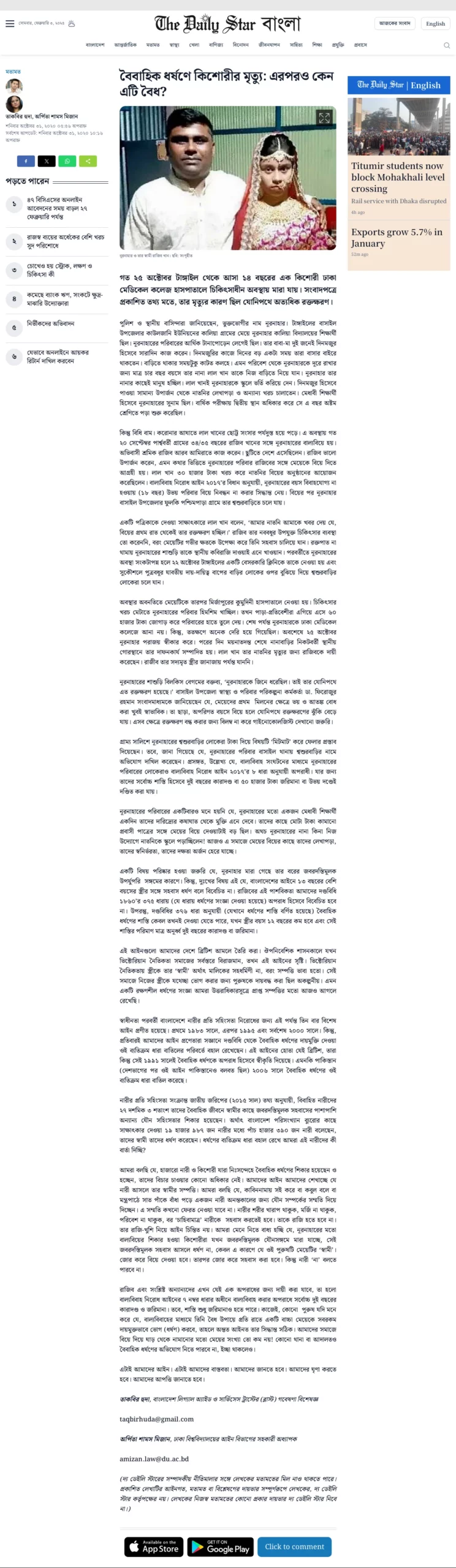
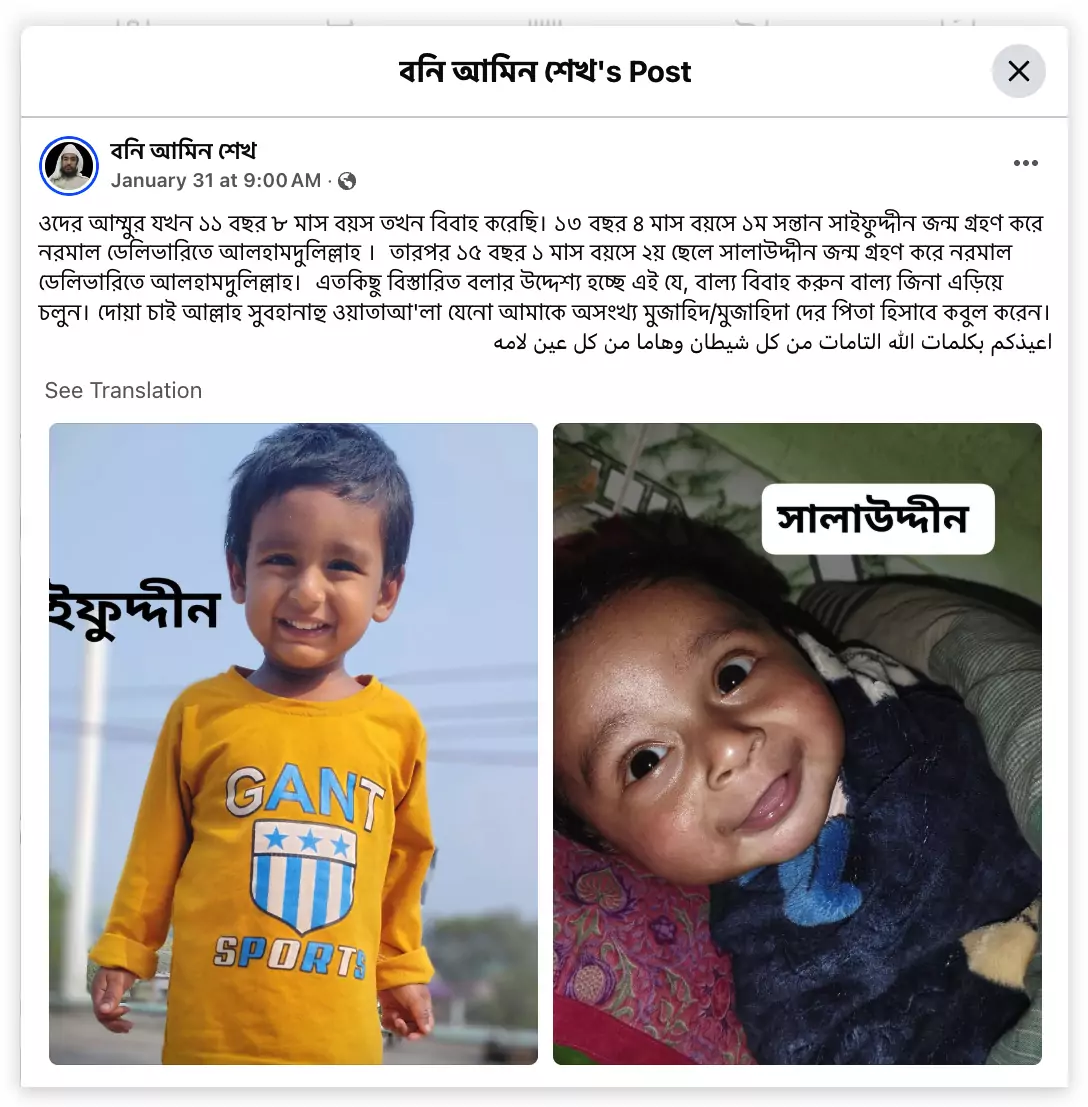
এবারে আসুন একটি ফেইসবুক স্ট্যাটাস দেখি। উল্লেখ্য, এরকম ফেসবুক স্ট্যাটাসের সংখ্যা অগণিত,

ভ্রাতৃত্বের নামে স্ত্রী উপহারঃ উদারতা নাকি অবমাননা?

ইসলামী ইতিহাসে মদিনার আনসার এবং মক্কার মুহাজিরদের মধ্যে স্থাপিত 'ভ্রাতৃত্ব বন্ধন' (মুয়াখাত)-কে এক অনন্য ত্যাগের নিদর্শন হিসেবে প্রচার করা হয়। তবে এই ত্যাগের আড়ালে নারীর মানবিক মর্যাদা ও সম্মতির অধিকারকে যেভাবে পদদলিত করা হয়েছে, তার এক ভয়াবহ চিত্র পাওয়া যায় সহিহ বুখারীর ৩৭৮০ নম্বর হাদিসে। বর্ণনায় দেখা যায়, সা’দ ইবনু রাবী‘ (রা.) তাঁর মুহাজির ভাই আবদুর রহমান ইবনু ‘আওফ (রা.)-কে প্রস্তাব দিচ্ছেন: "আমার দু’জন স্ত্রী রয়েছে, আপনার যাকে পছন্দ হয় বলুন, আমি তাকে তালাক দিয়ে দিব। ইদ্দত শেষে আপনি তাকে বিয়ে করে নিবেন" (( সহীহ বুখারী, তাওহীদ পাবলিকেশন, হাদিস নম্বর: ৩৭৮০ ))। প্রথাগত ইসলামী আলোচনায় এটিকে সা’দ-এর চরম 'উদারতা' হিসেবে দেখা হলেও, আধুনিক মানবাধিকার ও যুক্তির নিরিখে এটি নারীকে একটি জড় বস্তু বা স্থাবর সম্পত্তির সমান্তরালে নামিয়ে আনার নামান্তর।

সহীহ বুখারী (তাওহীদ পাবলিকেশন)
৬৩/ আনসারগণ [রাযিয়াল্লাহু ‘আনহুম]-এর মর্যাদা
পরিচ্ছেদঃ ৬৩/৩. নাবী সাল্লাল্লাহু আলাইহি ওয়াসাল্লাম কর্তৃক মুহাজির ও আনসারগণের মধ্যে ভ্রাতৃত্ব স্থাপন।
৩৭৮০. ‘আবদুর রহমান ইবনু ‘আওফ (রাঃ) হতে বর্ণিত, তিনি বলেন, যখন মুহাজিরগণ মদিনা্য় আগমন করলেন, তখন রাসূলুল্লাহ্ সাল্লাল্লাহু আলাইহি ওয়াসাল্লাম আবদুর রাহমান ইবনু ‘আউফ ও সা‘দ ইবনু রাবী‘ (রাঃ) এর মধ্যে ভ্রাতৃত্ব বন্ধন স্থাপন করে দিলেন। তখন তিনি [সা‘দ (রাঃ)] ‘আবদুর রাহমান (রাঃ) কে বললেন, আনসারদের মধ্যে আমিই সব থেকে বেশি সম্পদের অধিকারী। আপনি আমার সম্পদকে দু’ভাগ করে নিন। আমার দু’জন স্ত্রী রয়েছে, আপনার যাকে পছন্দ হয় বলুন, আমি তাকে তালাক দিয়ে দিব। ইদ্দত শেষে আপনি তাকে বিয়ে করে নিবেন। ‘আবদুর রহমান (রাঃ) বললেন, আল্লাহ আপনার পরিবারে এবং সম্পদে বরকত দান করুন। আপনাদের বাজার কোথায়? তারা তাঁকে বনূ কায়নুকার বাজার দেখিয়ে দিলেন। যখন ঘরে ফিরলেন তখন কিছু পনির ও কিছু ঘি সাথে নিয়ে ফিরলেন। এরপর প্রতিদিন সকাল বেলা বাজার যেতে লাগলেন। একদিন নবী সাল্লাল্লাহু আলাইহি ওয়াসাল্লাম-এর কাছে এমন অবস্থায় আসলেন যে, তাঁর শরীর ও কাপড়ে হলুদ রং এর চিহ্ন ছিল। নবী সাল্লাল্লাহু আলাইহি ওয়াসাল্লাম বললেন, ব্যাপার কী! তিনি (রাঃ) বললেন, আমি বিয়ে করেছি। নবী সাল্লাল্লাহু আলাইহি ওয়াসাল্লাম জিজ্ঞেস করলেন, তাকে কী পরিমাণ মাহর দিয়েছ? তিনি বললেন, খেজুরের এক আঁটির পরিমাণ অথবা খেজুরের এক আঁটির ওজন পরিমাণ স্বর্ণ দিয়েছি। (২০৪৮) (আধুনিক প্রকাশনীঃ ৩৪৯৮, ইসলামিক ফাউন্ডেশনঃ ৩৫০৬)
হাদিসের মানঃ সহিহ (Sahih)
বর্ণনাকারীঃ আবদুর রহমান ইবনু ‘আওফ (রাঃ)

এই হাদিসটি কয়েকটি গুরুত্বপূর্ণ প্রশ্ন সামনে নিয়ে আসে:

ব্যক্তিসত্তার বিলোপ ও পণ্যায়ন
এখানে সা’দ তাঁর সম্পদ ও স্ত্রীকে একই পাল্লায় পরিমাপ করেছেন। তাঁর বক্তব্যে স্ত্রী কোনো মানুষ নয়, বরং পনির বা ঘি-এর মতো একটি পণ্য, যা প্রয়োজনবোধে অন্যকে দান করা যায়। একজন নারী কার সাথে সংসার করবেন, কার শয্যাসঙ্গিনী হবেন—এটি কি কোনো পুরুষ নিজের 'উদারতা' দেখানোর জন্য অন্যকে দিয়ে দেওয়ার এখতিয়ার রাখেন?
সম্মতির অনুপস্থিতি (Absence of Consent)
পুরো ঘটনায় সংশ্লিষ্ট নারীদের কোনো মতামত বা সম্মতির ছিটেফোঁটা চিহ্নও নেই। একজন পুরুষ আরেকজন পুরুষকে বলছেন— "যাকে আপনার পছন্দ হয় তাকে বেছে নিন"। এটি কোনো স্বাধীন মানুষের মর্যাদা নয়, বরং হাটে গরু-ছাগল কেনাবেচার মানসিকতার প্রতিফলন। বৈবাহিক সম্পর্কে নারীর ওপর এর মানসিক প্রভাব নিয়ে চিন্তার কোনো অবকাশ এখানে ছিল না।
তালাক যখন পুরুষের খেলনা
স্রেফ বন্ধুর উপকারের জন্য বা ভ্রাতৃত্ব রক্ষার জন্য একটি সুসংহত পরিবার ভেঙে দেওয়ার এবং স্ত্রীকে তালাক দেওয়ার প্রস্তাব দেওয়া হচ্ছে। এটি প্রমাণ করে যে, সপ্তম শতাব্দীর সেই কাঠামোতে বৈবাহিক সম্পর্ক নারীর জন্য কোনো নিরাপত্তা ছিল না, বরং তা ছিল পুরুষের মর্জির ওপর নির্ভরশীল একটি চুক্তি মাত্র।
নবীর নীরব সমর্থন
সবচেয়ে উদ্বেগের বিষয় হলো, নবী মুহাম্মাদ এই ধরনের প্রস্তাবের নৈতিকতা নিয়ে কোনো প্রশ্ন তোলেননি। যদি স্ত্রীকে অন্যকে দিয়ে দেওয়া বা বিনিময় করা অনুচিত হতো, তবে নবীর উচিত ছিল সা’দ-এর এই দৃষ্টিভঙ্গিকে সংশোধন করা। তা না করা প্রমাণ করে যে, নারীকে পুরুষের অধীনস্থ 'ব্যবহারযোগ্য সম্পদ' হিসেবে দেখাই ছিল স্বাভাবিক সংস্কৃতি।

আধুনিক সভ্যতার চূড়ান্ত অর্জন হচ্ছে ব্যক্তির 'শারীরিক অখণ্ডতা' (Body Autonomy) এবং 'সম্মতি' (Consent)-কে পরম ও অলঙ্ঘনীয় অধিকার হিসেবে স্বীকৃতি দেওয়া। এই মানদণ্ডে বিচার করলে, একজন নারীকে তাঁর অস্তিত্ব, আবেগ এবং ইচ্ছা থেকে সম্পূর্ণ বিচ্ছিন্ন করে কেবল হস্তান্তরযোগ্য পণ্য হিসেবে বিলিয়ে দেওয়ার ঘটনাকে যখন কোনো ধর্মতাত্ত্বিক বয়ানে 'মহৎ ত্যাগ' বা 'উদারতা' হিসেবে মহিমান্বিত করা হয়, তখন তা কেবল নৈতিক স্খলন নয়—বরং একটি সামষ্টিক মানসিক বিকৃতির নামান্তর। এটি নগ্নভাবে উন্মোচিত করে যে, সপ্তম শতাব্দীর সেই কঠোর পুরুষতান্ত্রিক ও ধর্মতাত্ত্বিক কাঠামোতে নারীর অবস্থান ছিল স্রেফ একটি 'স্থাবর সম্পত্তি' বা 'জৈবিক উপযোগবাদী বস্তু'র মতো। সেখানে একজন দাসেরও হয়তো নির্দিষ্ট শ্রমের অধিকার থাকতো, কিন্তু এই ঘটনায় নারীরা ছিলেন পুরুষদের মধ্যকার সামাজিক ও রাজনৈতিক মৈত্রীকে শক্তিশালী করার এক একটি সস্তা মাধ্যম মাত্র। যাকে যখন ইচ্ছা বন্ধুদেরকে উপহার দেয়া যেতো, বিনিময় করা যেতো।

সা’দ ইবনু রাবী‘ এবং আবদুর রহমান ইবনু ‘আওফ-এর মধ্যকার এই লেনদেনে নারীর নিজস্ব পছন্দ-অপছন্দ বা আবেগীয় অবস্থাকে সম্পূর্ণ ধূলিসাৎ করা হয়েছে। একজন পুরুষ যখন আরেকজন পুরুষকে তাঁর দুই স্ত্রীর মধ্যে যাকে 'পছন্দ' তাকে বেছে নিতে বলেন, তখন সেখানে সেই নারীদের কোনো স্বাধীন মানবসত্তা অবশিষ্ট থাকে না; বরং তারা হাটে গরু-ছাগল কেনাবেচার মতো একটি অবমাননাকর পরিস্থিতির শিকার হন। এই তথাকথিত 'ভ্রাতৃত্ব' রক্ষার চুক্তিতে নারীর আত্মমর্যাদাকে যে চরম অবজ্ঞা করা হয়েছে, তা প্রমাণ করে যে তৎকালীন ইসলামী চিন্তাধারায় নারীকে কোনো সম্মানজনক অংশীদার হিসেবে নয়, বরং পুরুষের মর্জির ওপর নির্ভরশীল একটি 'ব্যবহারযোগ্য সম্পদ' হিসেবেই গণ্য করা হতো। একবিংশ শতাব্দীতে দাঁড়িয়ে এই পদ্ধতিগত অমানবিকীকরণকে নৈতিকতার পরাকাষ্ঠা হিসেবে প্রচার করা মূলত লিঙ্গীয় দাসত্বকে বৈধতা দেওয়ারই নামান্তর।


বৈবাহিক ধর্ষণ বিষয়ে আধুনিক মানবাধিকার

এই হাদিসগুলো এবং হাদিসের ব্যাখ্যাগুলোতে মূলত বলা হয়েছে যে, নারীর কর্তব্য হলো স্বামীর চাহিদা পূরণ করা, এমনকি স্বামী যদি যৌন চাহিদা প্রকাশ করেন এবং স্ত্রী এতে সাড়া না দেন, তবে সেটা স্ত্রীর পক্ষ থেকে চরম অন্যায় এবং ভয়াবহ পাপের কাজ। অনেকগুলো হাদিসে বলা হয়েছে যে, যদি আল্লাহর পরে কাউকে সিজদা করার নির্দেশ দেওয়া হতো, তবে সেটি স্ত্রীকে তার স্বামীকে করার নির্দেশ দেওয়া হতো। এটি নারীর প্রতি এমন একটি মানসিকতা তৈরি করে যে, তিনি তার স্বামীর সম্পত্তি, এবং তার কাজ হলো শুধু স্বামীর চাহিদা ও ইচ্ছার পূরণ করা, নিজের ইচ্ছার বা সম্মতির কোনো মূল্য নেই। এই ধরনের দৃষ্টিভঙ্গি নারীর প্রতি এক চরম বৈষম্যমূলক এবং অসম্মানজনক মনোভাবের প্রতিফলন।

এই হাদিসে আরও বলা হয়েছে, স্ত্রীর নিজের প্রভুর প্রতি কর্তব্য পূরণ করার মতই তার স্বামীর চাহিদা পূরণ করতে হবে। এটি নারীর নিজস্ব আত্মমর্যাদাকে সম্পূর্ণরূপে উপেক্ষা করে এবং তাকে স্বামীর সেবাদাসী হিসেবে বিবেচনা করে। এই হাদিস নারীর ইচ্ছা, স্বাধীনতা, মতামত এবং সম্মানের প্রতি কোনো গুরুত্ব দেয় না এবং তাকে পুরুষের অধীনস্থ ও নিয়ন্ত্রিত রাখার নির্দেশ দেয়। আন্তর্জাতিক মানবাধিকার সনদ অনুযায়ী, প্রত্যেক ব্যক্তি তার শরীরের ওপর সম্পূর্ণ অধিকার রাখে এবং কারও জোরপূর্বক বা চাপের মুখে তার ইচ্ছার বিরুদ্ধে কোনো কাজ করানো মানবাধিকার লঙ্ঘন। জাহান্নামের ভয়ভীতি দেখিয়ে কোন নারীকে ধর্ষিত হতে বাধ্য করা চরমভাবে মানবাধিকারের লঙ্ঘন। জাতিসংঘের “নারীর প্রতি সকল প্রকার বৈষম্য বিলোপ সনদ” (CEDAW) নারীর সম্মান, ইচ্ছা ও মতামতকে সম্মান করার ওপর বিশেষ গুরুত্ব দিয়েছে। কিন্তু ইসলামের এই হাদিস নারীর ইচ্ছাকে উপেক্ষা করে তাকে শুধুমাত্র স্বামীর যৌন চাহিদা পূরণের একটি বস্তু হিসেবে বিবেচনা করে, যা সরাসরি নারীর মৌলিক মানবাধিকারকে লঙ্ঘন করে।

একজন নারী তার শরীরের অধিকার এবং ইচ্ছার প্রতি সম্মান পাওয়ার অধিকার রাখে। যদি স্বামী তার সঙ্গে শারীরিক সম্পর্ক স্থাপন করতে চান এবং স্ত্রী এতে সম্মতি না দেন, তবে সেটি স্ত্রীর মৌলিক অধিকার। সেটি যে কারণেই হোক না কেন। একই কথা প্রযোজ্য পুরুষটির বেলাতেও। কিন্তু এই হাদিসে বলা হয়েছে, “যদি স্বামী স্ত্রীর কাছে শারীরিক চাহিদা প্রকাশ করেন এবং স্ত্রী যদি তা প্রত্যাখ্যান করেন, এটি নিষিদ্ধ বা হারাম।” এই ধরনের দৃষ্টিভঙ্গি একটি নারীর ইচ্ছা, সম্মতি এবং শারীরিক অধিকারকে পুরোপুরি অগ্রাহ্য করে। নারীর ওপর এটি একটি চাপ সৃষ্টি, যেন আল্লাহর অভিশাপের ভয়ভীতির কারণে ইচ্ছে না থাকা সত্ত্বেও সে কাজটি করতে বাধ্য হয়। আর যৌন কাজে কোন ভাবে চাপ প্রয়োগ, ভয়ভীতি দেখানো, এগুলো সবই সংজ্ঞানুসারে ধর্ষণের অন্তর্ভূক্ত।


বিভিন্ন দেশে মানবাধিকার হরণ

মানবাধিকারের মূলনীতি হলো সম্মতি এবং শারীরিক অখণ্ডতা, যা জাতিসংঘের ইউনিভার্সাল ডিক্লারেশন অফ হিউম্যান রাইটস (১৯৪৮)-এ স্পষ্ট। সকল মানুষ সমান অধিকারসম্পন্ন, এবং কোনো ধর্মীয় বা সাংস্কৃতিক কারণে নারীদের যৌন স্বাধীনতা অস্বীকার করা যাবে না। কিন্তু উল্লিখিত হাদিসগুলো নারীর সম্মতিকে অগ্রাহ্য করে, যা সরাসরি মানবাধিকার লঙ্ঘন।

ইসলামী সমাজে এই হাদিসগুলোর প্রভাব দেখা যায় শরিয়া আইনে, যেখানে বৈবাহিক ধর্ষণ অপরাধ নয়। মুসলিম সংখ্যাগরিষ্ঠ দেশগুলোতে, যেমন সৌদি আরব, ইরান, বাংলাদেশে, নারীর অধিকার হরণের জন্য এই হাদিসগুলোকে ব্যবহার করা হয়। বাংলাদেশের দণ্ডবিধিতে ১৩ বছরের বেশি বয়সী স্ত্রীর সাথে সহবাস ধর্ষণ নয়, যা ব্রিটিশ আমলের আইনের অবশেষ। এটি CEDAW (কনভেনশন অন দ্য এলিমিনেশন অফ অল ফর্মস অফ ডিসক্রিমিনেশন অ্যাগেইনস্ট উইমেন)-এর সাথে সাংঘর্ষিক, যা নারীর প্রতি সকল বৈষম্য বিলোপের উপর জোর দেয়। বাংলাদেশ CEDAW-এ স্বাক্ষর করলেও বৈবাহিক ধর্ষণ অপরাধ হিসেবে গণ্য করেনি, যা নারীদের অধিকার লঙ্ঘন করে।

আরব লীগ দেশগুলোতে বৈবাহিক ধর্ষণ অপরাধ নয়, যেমন জর্ডান, প্যালেস্টাইন, সিরিয়ায় আইন স্পষ্টভাবে এটি বাদ দেয়। এটি নারীর যৌন স্বাধীনতা অস্বীকার করে, যা জাতিসংঘের মানবাধিকার চুক্তির বিপরীত। এই ধর্মীয় আইনগুলো কোনো প্রমাণ ছাড়া মেনে নেওয়া অন্ধবিশ্বাস, যা নারীর মর্যাদা হরণ করে।


মানসিক ট্রমা, শারীরিক ক্ষতি এবং শিশুদের উপর প্রভাব

হাদিসসমূহে বর্ণিত নারীর সম্মতি অগ্রাহ্য করে স্বামীর যৌন চাহিদা পূরণের নির্দেশনাগুলো সপ্তম শতাব্দীর পুরুষতান্ত্রিক সমাজের স্পষ্ট প্রতিফলন। একইসাথে, আধুনিক মানবাধিকার ও বিজ্ঞানের আলোকে এগুলো সম্পূর্ণ অসমর্থিত এবং ক্ষতিকর। এই ধরনের বর্ণনাগুলো নারীকে যৌন বস্তু হিসেবে দেখায়, যা বৈবাহিক ধর্ষণকে প্রশ্রয় দেয় এবং তার ফলে সৃষ্ট মানসিক, শারীরিক এবং সামাজিক ক্ষতিগুলোকে অস্বীকার করে। বৈজ্ঞানিক গবেষণা স্পষ্টভাবে দেখায় যে অসম্মতিভিত্তিক যৌনতা—বিশেষ করে বৈবাহিক সম্পর্কে—গুরুতর ট্রমা সৃষ্টি করে, যা শুধুমাত্র নারীর উপর নয়, বরং পরিবারের অন্যান্য সদস্যদের, বিশেষ করে শিশুদের উপরও গভীর প্রভাব ফেলে। এই হাদিসসমূহকে সত্য বলে মেনে নেওয়া অন্ধবিশ্বাসের সমতুল্য, কারণ কোনো প্রমাণ ছাড়াই এগুলোকে গ্রহণ করা যুক্তির সাথে সাংঘর্ষিক এবং মানবিক অধিকারের লঙ্ঘন।

বৈবাহিক ধর্ষণের মানসিক প্রভাবগুলো অত্যন্ত গুরুতর এবং দীর্ঘস্থায়ী, যা গবেষণায় বারবার প্রমাণিত হয়েছে। উদাহরণস্বরূপ, অসম্মতিভিত্তিক যৌনতা পোস্ট-ট্রম্যাটিক স্ট্রেস ডিসঅর্ডার (PTSD), ডিপ্রেশন, অ্যাঙ্গজাইটি, ফোবিয়া এবং যৌন ডিসফাংশনের মতো সমস্যা সৃষ্টি করে। একটি গবেষণায় দেখা গেছে যে বৈবাহিক ধর্ষণের শিকার নারীরা অপরিচিত ব্যক্তির দ্বারা ধর্ষণের চেয়ে বেশি মানসিক কষ্ট ভোগ করে, কারণ এটি বিশ্বাসঘাতকতা এবং ঘনিষ্ঠ সম্পর্কের ভাঙ্গনের সাথে যুক্ত। এই ট্রমা সেল্ফ-ব্লেম, লো সেল্ফ-ইস্টিম, নেগেটিভ সেল্ফ-ইমেজ, ইনটিমেসি সমস্যা এবং সামাজিক বিচ্ছিন্নতা সৃষ্টি করে, যা নারীর দৈনন্দিন জীবনকে প্রভাবিত করে। আরও গভীর বিশ্লেষণে দেখা যায় যে এই ধরনের ট্রমা নিউরোবায়োলজিকাল পরিবর্তন ঘটায়, যেমন হরমোনাল ইমব্যালেন্স এবং ব্রেন ফাংশনের পরিবর্তন, যা দীর্ঘমেয়াদী ডিপ্রেশন এবং অ্যাঙ্গজাইটির কারণ হয় (( Marital Rape and Domestic Violence )) (( The Relative Effects of Intimate Partner Physical and Sexual Violence on Post-Traumatic Stress Disorder Symptomatology )) (( Marital Rape: New Research and Directions )) (( Investigating psychological and interpersonal problems in traumatic marriages among women: A phenomenological analysis of unwanted marriages ))। হাদিসে যেমন স্বামীর চাহিদা পূরণকে ধর্মীয় কর্তব্য বলা হয়েছে, তা নারীর মানসিক স্বাস্থ্যকে ধ্বংস করতে সহায়ক।

শারীরিক ক্ষতিগুলোও কম নয়; বৈবাহিক ধর্ষণে নারীরা ভ্যাজাইনাল এবং অ্যানাল ইনজুরি, ল্যাসারেশন, ব্রুইজিং, টর্ন মাসলস, ফ্যাটিগ এবং ভমিটিংয়ের মতো সমস্যা ভোগ করে। গাইনোকলজিকাল সমস্যা যেমন ভ্যাজাইনাল স্ট্রেচিং, পেলভিক ইনফ্লেমেশন, অনওয়ান্টেড প্রেগন্যান্সি, মিসক্যারেজ, স্টিলবার্থ, ব্ল্যাডার ইনফেকশন, STI এবং ইনফার্টিলিটি সাধারণ। এই ক্ষতিগুলো বিশেষ করে শিশুবিয়ে এবং কিশোরীদের ক্ষেত্রে আরও গুরুতর, কারণ তাদের শরীর প্রজননের জন্য প্রস্তুত নয়। বাল্যবিয়ে এবং বৈবাহিক ধর্ষণের ফলে কিশোরীরা যোনিপথে অত্যধিক রক্তক্ষরণ, প্রিম্যাচিওর বার্থ, স্টিলবার্থ এবং মাতৃমৃত্যুর ঝুঁকিতে থাকে। বিজ্ঞান দেখায় যে এই ধরনের অসম্মতিভিত্তিক যৌনতা নারীর শারীরিক স্বাস্থ্যকে দীর্ঘমেয়াদী ক্ষতি করে।

শিশুদের উপর বৈবাহিক ধর্ষণের প্রভাব আরও ভয়াবহ, কারণ এটি ইন্টারজেনারেশনাল ট্রমা সৃষ্টি করে। পরিবারে বৈবাহিক ধর্ষণ বা ধর্ষণের মতো অসম্মতিভিত্তিক যৌনতা দেখে শিশুরা অ্যাঙ্গজাইটি, ডিপ্রেশন, PTSD, অ্যাগ্রেশন, সাবস্ট্যান্স অ্যাবিউজ এবং ফিজিক্যাল হেলথ প্রবলেম ভোগ করে। শিশুরা যখন মায়ের উপর ধর্ষণ বা ভায়োলেন্স দেখে বা বোঝে, তাদের মানসিক বিকাশ বাধাগ্রস্ত হয়, যা পরবর্তী জীবনে তারা নিজেরা ভায়োলেন্সের শিকার বা পারপেট্রেটর হয়ে উঠতে পারে। বাল্যবিয়ে এবং বৈবাহিক ধর্ষণের ক্ষেত্রে কিশোরীরা PTSD, ডিপ্রেশন এবং অ্যাঙ্গজাইটি ভোগ করে, যা তাদের শিক্ষা, স্বাস্থ্য এবং ভবিষ্যতকে ধ্বংস করে। এই প্রভাবগুলো হাদিসের পুরুষতান্ত্রিক দৃষ্টিভঙ্গির ফল, যা বিজ্ঞানের সাথে সাংঘর্ষিক এবং কোনো প্রমাণ ছাড়া মেনে নেওয়া যায় না।

সারাংশে, ইসলামী হাদিসসমূহের এই বর্ণনাগুলো বৈজ্ঞানিকভাবে সমাজের সুস্থতার জন্য অত্যন্ত ক্ষতিকর। বিজ্ঞান দেখায় যে অসম্মতিভিত্তিক যৌনতা মানসিক এবং শারীরিক ক্ষতি করে, এবং শিশুদের উপর তার প্রভাব দীর্ঘস্থায়ী। এই ধরনের হাদিস মধ্যযুগীয় পুরুষতান্ত্রিক সমাজের ফল, যা বর্জন করাই সুস্থ সুন দর সমাজে কাম্য।


কিন্তু মুসলিম নারীরা কী সমানাধিকার চায়?

এখানেই প্রশ্ন ওঠে—মুসলিম নারীরা কী চান? আত্মমর্যাদা, সমান অধিকার প্রত্যাশা করেন নাকি তারা স্বেচ্ছায় সেই কাঠামোকে সমর্থন করেন, যেখানে একজন স্ত্রী স্বামীর দাসীর মত মর্যাদা সম্পন্ন উনমানুষ? আসুন কিছু ভিডিও দেখা যাক, যেখানে বোরখাপরা এক মুসলিম নারী নিজে নারী হয়েও সমঅধিকারের বিরোধিতা করছেন, নিজেরা নারী হয়ে পুরুষতন্ত্রের উকালতি করছেন এবং বাংলাদেশে শরিয়া আইন প্রতিষ্ঠার পক্ষে মত প্রকাশ করছেন,

0:00
–:––

0:00
–:––

উপসংহারঃ একবিংশ শতাব্দীর চ্যালেঞ্জ

সামগ্রিক আলোচনায় এটি স্পষ্ট যে, ইসলামী ধর্মীয় গ্রন্থ, ফিকহী ব্যাখ্যা এবং ঐতিহাসিক বিবরণগুলোতে নারীর অবস্থানকে একজন স্বাধীন পূর্ণাঙ্গ মানুষের পরিবর্তে পুরুষের অধীনস্থ এবং ভোগযোগ্য সম্পদ হিসেবে চিত্রায়িত করা হয়েছে। 'মুলক আল-বুদহ' বা যৌনাঙ্গের মালিকানার মতো আইনি ধারণাগুলো কেবল তাত্ত্বিক আলোচনা নয়, বরং এগুলো সরাসরি বৈবাহিক ধর্ষণকে এক ধরনের 'ধর্মীয় ও আইনি বৈধতা' প্রদান করে। যখন একজন স্বামী তাঁর স্ত্রীর অসম্মতি সত্ত্বেও যৌন সম্পর্ক স্থাপনকে নিজের 'হক' বা পাওনা হিসেবে গণ্য করেন, তখন সেখানে সম্মতির (Consent) আধুনিক ও মানবিক ধারণাটি সমূলে বিনাশপ্রাপ্ত হয়।

এই ব্যবস্থার অমানবিকতা আরও প্রকট হয় যখন আমরা দেখি:

ব্যক্তিসত্তার অবমাননা
সা’দ ইবনু রাবী‘ এবং আবদুর রহমান ইবনু ‘আওফ-এর মধ্যকার সেই ঐতিহাসিক ঘটনা প্রমাণ করে যে, তৎকালীন সমাজ ব্যবস্থায় নারী ছিল পুরুষদের মধ্যকার 'উদারতা' প্রদর্শনের বিনিময়যোগ্য বস্তু মাত্র (( সহীহ বুখারী, হাদিস নম্বর: ৩৭৮০ ))
মানবাধিকারের লঙ্ঘন
বৈবাহিক সম্পর্কের ভেতর জবরদস্তি বা বলপ্রয়োগকে যখন 'প্রহারের অনুমতি' বা 'ফেরেশতাদের অভিশাপের ভয়' দেখিয়ে জায়েজ করা হয়, তখন তা সরাসরি জাতিসংঘের মানবাধিকার সনদ এবং নারীর প্রতি সকল প্রকার বৈষম্য বিলোপ সনদের (CEDAW) পরিপন্থী হয়ে দাঁড়ায়।
মানসিক ও শারীরিক ট্রমা
বিজ্ঞান ও মনোবিজ্ঞান স্পষ্টভাবে প্রমাণ করেছে যে, বৈবাহিক ধর্ষণ অপরিচিত ব্যক্তির দ্বারা ধর্ষণের মতোই বিধ্বংসী ট্রমা এবং দীর্ঘমেয়াদী শারীরিক ক্ষতি তৈরি করে। ধর্মীয় অনুভূতির দোহাই দিয়ে এই বাস্তবতাকে অস্বীকার করা কেবল অযৌক্তিকই নয়, বরং এক ধরনের নিষ্ঠুরতা।

পরিশেষে বলা যায়, এই হাদিস ও বিধানগুলো কোনো শাশ্বত বা ডিভাইন সত্য নয়; বরং এগুলো সপ্তম শতাব্দীর আরব উপদ্বীপের অত্যন্ত কঠোর পুরুষতান্ত্রিক সংস্কৃতির আইনি ও সামাজিক প্রতিফলন। আজ একবিংশ শতাব্দীতে দাঁড়িয়ে যখন মানবসভ্যতা সাম্য, মর্যাদা এবং ব্যক্তিগত স্বাধীনতার ওপর ভিত্তি করে পরিচালিত হচ্ছে, তখন দেড় হাজার বছর আগের এই ধ্যান-ধারণাগুলোকে অভ্রান্ত মনে করা কেবল অন্ধবিশ্বাস ছাড়া আর কিছুই নয়। মনে রাখতে হবে,

যুক্তি, অধিকার এবং মানবিকতা কোনো ধর্মীয় অনুভূতির কাছে দায়বদ্ধ নয়।

মুসলিম সমাজকে যদি আধুনিক বিশ্বের সাথে তাল মিলিয়ে চলতে হয় এবং নারীর মৌলিক অধিকার নিশ্চিত করতে হয়, তবে এই ক্ষতিকর টেক্সট এবং ব্যাখ্যাগুলোকে হয় সমূলে বর্জন করতে হবে, না হয় সরাসরি প্রত্যাখ্যান করতে হবে। সত্য ও ন্যায়ের লড়াইয়ে প্রমাণের অভাব বা অন্ধ আনুগত্যের কোনো স্থান নেই। নারীর শরীর তাঁর নিজস্ব সম্পদ—এটি কোনো চুক্তির বিষয়বস্তু বা পুরুষের মর্জির ওপর নির্ভরশীল বস্তু নয়। যুক্তি ও অধিকারের পক্ষে থাকতে হলে আমাদের অবশ্যই বিশ্বাসের অন্ধ গলি থেকে বেরিয়ে এসে বৈজ্ঞানিক ও মানবাধিকারমূলক দৃষ্টিভঙ্গি গ্রহণ করতে হবে।

The Sanction of Marital Rape in Islam

It imposes a law that a wife is bound to have sex with her husband the moment he demands it — a law that plays a crucial role in enabling heinous and horrific events like marital rape.

Introduction

In modern society, women's rights are recognized as equal to men's, with women contributing equally in education, the workplace, leadership and social participation. But in Islamic religious texts and interpretations, women are assigned a compulsory role of satisfying their husbands' sexual needs, which grants legal legitimacy to a grave crime like marital rape. For example, Sunan Ibn Majah (Hadith 1853) narrates that a wife cannot refuse her husband's sexual demand even if she is on her camel saddle. Similarly, Mishkat al-Masabih (Hadith 3255) states that if anyone were commanded to prostrate to anyone, a wife would have been commanded to prostrate to her husband. These hadiths portray women as their husbands' property, whose will or consent carries no value. At the same time, the Islamic Sharia interpretation of the dower (mahr) reveals that by paying the dower, a husband becomes the owner of his wife's sexual organ, which horrendously tramples upon the very idea of equal human rights (( Dower | The Price of Enjoying a Woman's Private Parts in Islam )). Likewise, Islam also grants the husband the right to force a disobedient wife into submission by beating her.

The commentary of Sahih Muslim states that it is forbidden (haram) for a wife to abandon her husband's bed, meaning that responding to the husband's call is obligatory. A similar narration is found in Riyad us-Saliheen. These narrations deny a woman's freedom and consent, which runs contrary to modern rationalism and human rights. In Islamic history, Tafsir Ibn Kathir records that the Companion Umar would mount his sleeping wife and have intercourse with her without consent, and the Prophet raised no objection. This shows that in the seventh-century society, a woman's consent carried no weight.


The Legal Nature of Marriage: 'Milk al-Bud'' or Ownership of the Sexual Organ

If one closely examines the legal definition and framework of marriage given in Islamic jurisprudence (fiqh), it becomes clear that marriage is not a spiritual bond or a human partnership; rather, it is a bare 'contract of exchange' (Mu'awadah). In nearly every foundational text of classical Islamic law, marriage is defined as 'milk al-bud'', that is, a means of acquiring ownership over the wife's sexual organ. In other words, the dower (Mahr) given by the husband to the wife is not a gift; it is the legal price or consideration for enjoying or using the wife's sexual organ (( The Dower: The Price of a Woman's Private Parts )). In 'Al-Hidayah', the most reliable and authoritative book of the Hanafi school, the definition of marriage states:

"Marriage is a contract that intentionally grants ownership of the right to sexual enjoyment (Ownership of the right to sexual intercourse)." (( Al-Hidayah, Kitab an-Nikah, Vol. 2, Page 302 ))

The same philosophy is reflected in 'Bada'i' as-Sana'i'' by Imam Kasani (may Allah have mercy on him). There, marriage is compared to a sale-and-purchase contract in which the husband is the buyer, the wife (or her guardian) is the seller, and the dower is the price of the commodity. Under this legal framework, the wife's sexual organ is treated as 'ma'qud 'alaih' (Subject matter of the contract), i.e., the 'object' of the contract. In other words, once the dower is paid or promised, the husband acquires exclusive right of use over that 'object'.

It is precisely because of this 'ownership' philosophy that the term 'marital rape' is entirely absent and irrelevant in Islamic Sharia. Because, according to legal logic, when a person 'purchases' or acquires the right of enjoyment of a thing through a contract, there is no need to seek fresh permission every time it is used. According to medieval jurists, it is the wife's duty to maintain 'tamkin' (Submission), i.e., to keep herself always available to her husband. If a wife withholds herself, she is deemed 'nashizah' (disobedient) and consequently loses her right to maintenance (Nafaqah). This very clearly denies a woman's bodily integrity and her own right over her body. In this system:

A Woman's Body as a Commodity
In exchange for the dower, the wife's body is turned into a commodity whose 'lease' (ijarah) or ownership is transferred to the husband.
Contempt for Consent
In modern civilized society, 'consent' (Consent) is a matter of every moment, but in this juristic system, saying 'qabul' once at the time of marriage is a lifelong deed of sexual servitude.
The Legitimization of Marital Rape
Since the husband is believed to be merely exacting his 'haqq' or right, coercion or force in this matter is seen not as a crime but as the husband's legal right.

This concept strips a woman of her status as a free human being and a full citizen, reducing her to a mere 'sexual asset' or 'object of enjoyment'. According to the principles of modern human rights, no one may have ownership over another person's body. But Islamic juristic law continues to legitimize this medieval, slave-like system to this day, which is directly and utterly opposed to women's fundamental human rights, bodily freedom and self-respect. This proves that this legal framework is no divine or eternal justice; it is merely a legal instrument of the seventh century's extreme patriarchal and tribal mentality.


Statements of Scholars: A Husband May Force His Wife

In modern civilized society, women enjoy rights equal to men. They participate equally with men in education, employment, leadership and social service. In modern society there are countless such incidents where a husband engages in sexual relations with his wife without her will and consent or forces her to do so. In modern civilized society this counts as rape, although in Islamic countries the husband is given legal sanction for this rape. Let us hear the statements of some scholars,

0:00
–:––

0:00
–:––

0:00
–:––

The Hadith Accounts: Rejecting a Husband's Call Is Forbidden

Let us now read what the hadiths say about this matter, (( Mishkat al-Masabih (Mishkat), Hadith: 3257 )) (( Mishkat al-Masabih (Mishkat), Vol. 4, Hadith Academy, Page 318 )) (( Sunan Ibn Majah, Tawhid Publication, Hadith: 1853 )) (( Mishkat al-Masabih (Mishkat), Hadith Academy, Hadith: 3255 ))

Mishkat al-Masabih (Mishkat)
Part-13: Marriage
Section: 10. Second sub-section - kind treatment of wives and their mutual (husband-wife) rights
3257-[20] Narrated by Talq ibn 'Ali (RA). He said, the Messenger of Allah (SAW) said: when a husband calls his wife for his own need, she should respond to his call immediately, even if she is busy beside the stove (doing the work of a maidservant). (at-Tirmidhi)[1]
[1] Sahih: at-Tirmidhi 1160, Sahih al-Jami' 534, Sahih at-Targhib 1946, Sahih Ibn Hibban 4165.
Grade of hadith: Sahih (Authentic)
Narrator: Talq ibn 'Ali (RA)

3257-[20] Narrated by Talq ibn 'Ali. He said, the Messenger of Allah (peace and blessings of Allah be upon him) said: when a husband calls his wife for his own need, she should respond to his call immediately, even if she is busy beside the stove
(doing housework). (at-Tirmidhi)199
Explanation: The husband is the manager and guardian of his wife; whatever work he calls her to, it is obligatory for her to respond to that call, and in particular she must respond when he calls her to fulfill his biological need. The above hadith points to this very thing. Even if she is engaged in baking bread on the stove and there is no alternative person besides her, she should still set it aside and respond to the husband's call. Ibn al-Malik says: this ruling applies only if the bread belongs to the husband, because the husband knows that she is busy making bread and that calling her at this time would cause her harm; yet since he is calling her, she must respond to his call.
In the book of Bazzar, the hadith is narrated through Zayd ibn Arqam in these words: if a man calls his wife to his own bed, she should respond to his call (at once), even if she is sitting on the mill-stone. (Mirqat al-Mafatih; Tuhfat al-Ahwadhi, Vol. 4, Hadith: 1160)
٣٢٥٨ - [٢١] وَعَنْ مُعَاذٍ عَنِ النَّبِيِّ ﷺ قَالَ: «لَا تُؤْذِي امْرَأَةٌ زَوْجَهَا فِي الدُّنْيَا إِلَّا قَالَتْ زَوْجَتُهُ مِنَ الْحُورِ الْعِينِ : لَا تُؤْذِيهِ قَاتَلَكِ اللهُ فَإِنَّمَا هُوَ عِنْدَكِ دَخِيلٌ يُوشِكُ أَنْ يُفَارِقَكِ إِلَيْنَا» . رَوَاهُ التَّرْمِذِيُّ وَابْنُ مَاجَهُ وَقَالَ التَّرْمِذِيُّ : هُذَا حَدِيثٌ غَرِيبٌ
3258-[21] Narrated by Mu'adh. He said, the Prophet (peace be upon him) said: when a wife causes her husband trouble in this world (that is, through disrespect, disobedience, etc.), then the women of Paradise (the houris) of that husband keep saying: do not cause him trouble; (if you do), Allah will destroy you. He is (a guest of some days) a visitor with you; soon he will leave you and come to us. (at-Tirmidhi, Ibn Majah; Imam at-Tirmidhi says: this hadith is gharib) 500
Explanation: Allah will give the believers in Paradise "Hur al-'Ain", that is, wide-eyed houris. Allah says: "I will pair the people of Paradise with Hur al-'Ain" (Surah ad-Dukhan 44:54). That is, they will be given in marriage. Hur al-'Ain are the women of Paradise of extremely bright white mixed with black, with wide, inclined (or large, beautiful) eyes, of matchless beauty. When the believing wife of a righteous believer in Paradise is harmed, his designated houri wife in Paradise comes to know of it.

Sunan Ibn Majah
Tawhid Publication
Chapter: 9/ Marriage
2/1853. Narrated by 'Abdullah ibn Abu Awfa (RA). He said, when Mu'adh (RA) returned from Syria, he made prostration to the Prophet (SAW). The Prophet (SAW) said: O Mu'adh, what is this? He said: I went to Syria and saw its people making prostration to their religious leaders and rulers; so I wished in my heart to do the same before you. The Messenger of Allah (SAW) said: do not do that. For if I were to command anyone to make prostration to anyone other than Allah, I would have commanded the wife to make prostration to her husband. By the One in Whose Hand is the soul of Muhammad! A wife will not be able to fulfill the right due to her Lord until she fulfills the right due to her husband. If the husband wishes to fulfill his biological need with his wife while she is in the midst of household work, it is improper for her to reject him.
Grade of hadith: Hasan (Good)
It was narrated that: Abdullah bin Abu Awfa said "When Muadh bin Jabal came from Sham, he prostrated to the Prophet who said: 'What is this, O Muadh?' He said: 'I went to Sham and saw them prostrating to their bishops and patricians and I wanted to do that for you.' The messenger of Allah said: 'Do not do that. If I were to command anyone to prostrate to anyone other than Allah, I would have commanded women to prostrate to their husbands. By the One in Whose Hand is the soul of Muhammad! No woman can fulfill her duty towards Allah until she fulfills her duty towards her husband. If he asks her (for intimacy) even if she is on her camel saddle, she should not refuse.' "

Mishkat al-Masabih (Mishkat)
Publisher: Hadith Academy
Chapter: Part-13: Marriage
Section: 10. Second section - kind treatment of wives and their mutual (husband-wife) rights
3255-(18) Narrated by Abu Hurayrah (RA). He said,  the Messenger of Allah (SAW) said: if I were to command any human being to prostrate, I would have commanded the wife to prostrate to her husband. (at-Tirmidhi)
Grade of hadith: Hasan (Good).

Let us read this same hadith from the book Riyad us-Saliheen, (( Riyad us-Saliheen, Imam an-Nawawi, Islamia Quran Mahal Publication, Vol. 4, Page 131 ))

Section: When the husband calls the wife to bed, it is haram for the wife to refuse to come to bed without a reason sanctioned by the Sharia.


Commentary on the Hadith: The Wife Is Bound to Have Intercourse the Moment the Husband Calls

Let us read a page from the commentary of Sahih Muslim, where it is said, abandoning the husband's bed is haram for the wife, that is, the moment the husband calls her to bed, it is the wife's duty to respond to that call (( Sahih Muslim Sharif (Bengali translation with essential commentary), Maktabatul Hadith Publication, Vol. 13, Page 206 ))

(3426) Hadith (Imam Muslim (may Allah have mercy on him) says) and narrated to us Qutaybah bin Sa'id (may Allah have mercy on him), he ... (change of chain) and 'Abd al-Warith bin 'Abdus-Samad (may Allah have mercy on him), he ... (change of chain) and Muhammad bin Muthanna (may Allah have mercy on him), he ... (change of chain) and 'Ubaydullah bin Sa'id, Harun bin 'Abdullah and Abu Ma'n ar-Ruqashi (may Allah have mercy on them), they ... (change of chain) and Sulayman bin Ma'bad (may Allah have mercy on him), they ... narrated this hadith from Jabir (may Allah be pleased with him). However, in the hadith narrated by the narrator Nu'man through Imam az-Zuhri (may Allah have mercy on him), there is this addition: he (the husband) may, if he wishes, have intercourse face down, and if he wishes, not face down; but the intercourse must be through the same (vaginal) passage.
Explanation and analysis
مُجَنِيَةٍ (face down) the word is read with dammah on the first letter, fathah on the second, kasrah with tashdid on the third, then a waw. That is, مكبوبة على وجهها (making the wife lie face down) (an-Nawawi) - (Fath al-Mulhim 3:511)
فِي صِمَامٍ وَاحِدٍ (through one same (vaginal) passage). The word صِمَامٍ is read with kasrah on the first letter and without tashdid on the second. It is from المنفد (hole, gap, path, door, window), that is, ثقب واحد (through one same gap). By this is meant القبل (the vaginal passage). (Fath al-Mulhim 3:511)
بَابُ تَحْرِيمِ امْتِنَاعِهَا مِنْ فِرَاشِ زَوْجِهَا
Section: Explanation of it being haram for the wife to avoid her husband's bed
(9829) حَدَّثَنَا مُحَمَّدُ بْنُ الْمُثَنَّى وَابْنُ بَشَّارٍ وَاللَّفْظُ لِابْنِ الْمُثَنَّى قَالَا حَدَّثَنَا مُحَمَّدُ بْنُ جَعْفَرٍ حَدَّثَنَا شُعْبَةُ قَالَ سَمِعْتُ قَتَادَةَ يُحَدِّثُ عَنْ زُرَارَةَ بْنِ أَوْفَى عَنْ أَبِي هُرَيْرَةَ عَنْ النَّبِيِّ صَلَّى اللَّهُ عَلَيْهِ وَسَلَّمَ قَالَ إِذَا بَاتَتْ الْمَرْأَةُ هَاجِرَةً فِرَاشَ زَوْجِهَا لَعَنَتْهَا الْمَلَائِكَةُ حَتَّى تُصْبِحَ.
(3427) Hadith (Imam Muslim (may Allah have mercy on him) says) and narrated to us Muhammad bin Muthanna and Ibn Bashshar (may Allah have mercy on them), they ... from Abu Hurayrah (may Allah be pleased with him), from the Prophet (SAW), he said: whichever wife spends the night leaving her husband's bed, the angels keep cursing her until morning.
Explanation and analysis
مَاجِرَةً (leaving) in Sahih al-Bukhari it is narrated as مهاجرة (leaving, deserting, emigrating). Hafiz Ibn Hajar (may Allah have mercy on him) says: although the word مهاجرة is formally in the form of مفاعلة, here it is not of the form of مفاعلة; rather, by it is meant أنها التي هجرت (she is the one who has left). Sometimes a word in the form of مفاعلة conveys the sense of نفس الفعل (the very act). Consequently, blame will not fall upon her for it. But if she is a manifest deserter and her husband remains angry with her because of it - (Fath al-Mulhim 3:511)


From Tafsir: Umar Would Mount His Sleeping Wife

From the history of Islam we come to know that the Prophet Muhammad and his Companions did not in fact attach much importance to the consent of their wives. In the matter of sexual intercourse the husband's role was that of a master, and the wife's role that of a slave-girl. Let us learn of an incident from Tafsir Ibn Kathir, in which the Prophet's renowned Companion Umar is seen mounting his sleeping wife and engaging in intercourse without caring for her permission or consent. Even after the matter was reported to the Prophet, he said nothing about it, meaning that to the Prophet at that time this was a perfectly normal matter (( Tafsir Ibn Kathir, Vol. 2, Islamic Foundation, Page 112))

... he kept her close. My wife told me that she had been asleep. I considered it her excuse and had intercourse with her.' Then on that occasion this verse was revealed: ثُمَّ اَتِمُوا الصَّيَامَ إِلَى اللَّيْلِ …. Ibn Abu Layla, Shu'bah and 'Amr ibn Shu'bah narrate similar reports in succession. 'Abdullah ibn Ka'b, a slave of Banu Salmah's Musa ibn Jubayr, Abu Lahi'ah, Ibn al-Mubarak Suwayd, Muthanna and Abu Ja'far ibn Jarir narrate from Ka'b ibn 'Abdul Malik:
"The condition of the people in Ramadan was such that if anyone fell asleep after keeping the fast, then from then on eating, drinking and intercourse with one's wife became haram for him until the next iftar. One night Umar ibn al-Khattab returned home late from the court of the Messenger of Allah (SA). His wife was then asleep. He expressed his desire to gratify his lust with her, whereupon his wife said: I was asleep. He did not believe her and had intercourse with her. Ka'b ibn Malik says: at dawn Umar ibn al-Khattab presented himself to the Messenger (SA) and described this condition to him. Then Allah the Almighty revealed عَلِمَ اللَّهُ أَنَّكُمْ كُنْتُمْ تَخْتَانُونَ أَنْفُسَكُمْ فَتَابَ عَلَيْكُمْ وَعَفَا عَنْكُمْ فَالْآنَ بَاشِرُوهُنَّ, that is: Allah knew that you were betraying yourselves. Then Allah the Almighty accepted your repentance; therefore from now on have intercourse with your wives.
Similarly, Mujahid, 'Ata, 'Ikrimah, Qatadah and others narrate the incident of Umar (RA) and Suraqah ibn Qays al-Ansari as the occasion of the revelation of this verse. Then, as Allah's mercy, grace and love, Allah made permissible for the whole night of Ramadan intercourse with one's wife, eating and drinking.
In connection with the explanation of the phrase وَابْتَغُوا مَا كَتَبَ اللَّهُ لَكُمْ (and seek what Allah has written for you), Abu Hurayrah, Ibn 'Abbas, Anas, Qadi Shurayh, Mujahid, 'Ikrimah, Sa'id ibn Jubayr, 'Ata, Rabi' ibn Anas, Suddi, Zayd ibn Aslam, Hakam ibn 'Utbah, Maqatil ibn Hayyan, Hasan al-Basri, Dahhak and Qatadah (may Allah have mercy on them) among the Companions and Tabi'un say: its meaning is 'offspring'.


A Companion's Sexual Intercourse Beside His Dead Child

How much priority is given in the Islamic family structure to the husband's sexual gratification over the wife's own emotions and grief becomes clear when we analyze this incident of Abu Talhah (RA) and his wife Umm Sulaym. In this narration we see that even though her own child lay dead inside the house, Umm Sulaym concealed her intense maternal grief, adorned herself for her husband and engaged in sexual union with him (( Sahih al-Bukhari, Tawhid Publication, Hadith number: 5470 )). Measured against modern psychology and human values, this is an extremely abnormal picture, in which a woman's natural emotional reaction is completely suppressed and she is seen merely as a means of satisfying the man's sexual need.

Sahih al-Bukhari (Tawhid Publication)
71/ Al-'Aqiqah
Section: 71/1. Naming the child on the day of its birth and performing tahnik (chewing something and putting it into the child's mouth) for the child for whom no 'aqiqah will be given.
5470. Narrated by Anas ibn Malik (RA). He said, a son of Abu Talhah fell ill. Abu Talhah went out, and the boy died. When Abu Talhah returned he asked: how is the boy? Umm Sulaym said: he is more at ease than before. Then she served him dinner, and he ate. Then he had sexual intercourse with Umm Sulaym. When the intercourse was over, Umm Sulaym said: go and bury the boy. In the morning Abu Talhah came to the Messenger of Allah (SAW) and told him the story. He asked: did you remain with your wife last night? He said: yes. The Prophet (SAW) said: O Allah, bless them.
Some days later Umm Sulaym gave birth to a son. (The narrator said: Abu Talhah told me: look after him until I take him to the Prophet (SAW). Then he took him to the Prophet (SAW), and Umm Sulaym sent some dates with him. The Prophet (SAW) took him (in his lap) and asked: is there anything with him? They said: yes, there is. He chewed it, then took it out of his mouth and put it into the child's mouth. With that he performed the tahnik and named him 'Abdullah. [1301; Muslim 38/5, Hadith: 2144] (Adhunik Prakashani: 5065, Islamic Foundation: 4961)
Narrated by Anas (RA). He narrated the same hadith. (Adhunik Prakashani: 5065, Islamic Foundation: 4962)
Grade of hadith: Sahih (Authentic)
Narrator: Anas ibn Malik (RA)

The most significant thing is that Muhammad received this matter extremely positively and made a special supplication asking Allah's barakah (blessing) upon that union. Presenting this sexual act, performed beside the corpse of a dead child, as a 'great' or 'blessed' deed is fundamentally a gross degradation of woman's human dignity and personhood. It conveys to society this message: in every situation a woman's primary and obligatory duty is to keep her body available for gratifying her husband's desires, even at a moment of extreme tragedy like the death of her own child. The Prophet's profuse praise and supplication for this conduct proves that in this religious ruling the man's so-called sexual right stands far above the woman's mental health or suffering. Such narrations reduce women to the position of a sex slave, where the husband's gratification, rather than her motherhood or her human self, is treated as the ultimate measure.


Fatwas on Forcing the Wife by Beating When She Refuses Intercourse

Below, all the evidence and proofs concerning this matter are cited one by one. All these fatwas are considered the most authentic evidences in the Islamic world. Before looking at the evidences, let us watch a video,

0:00
–:––

Rawdat at-Taalibeen - The Ruling Concerning the Slave Girl

In the history of Islamic jurisprudence (fiqh), 'Rawdat at-Taalibeen wa 'Umdat al-Muftiyin' is an extremely important and foundational book. It is counted as the authoritative document of the Shafi'i school. The book was written by the world-famous Islamic muhaddith and jurist Imam Muhyiddin Abu Zakariya Yahya ibn Sharaf an-Nawawi (may Allah have mercy on him) (d. 676 AH). In this book he has discussed with great orderliness the finest points of worship, mu'amalat (transactions) and family law. In particular, in issuing fatwas, this book is regarded as the final standard in the Shafi'i school.


Original Arabic text (selected portion) - The original wording concerning the slave girl and related rulings is given below, (( ويحرم على الزوجة والأمة تحريما غليظا أن تمتنع إذا طلبها للاستمتاع الجائز ))

ويحرم على الزوجة والأمة تحريما غليظا أن تمتنع إذا طلبها للاستمتاع الجائز
It is strongly forbidden for a wife or slave concubine to refuse when her husband or master seeks permissible sexual intimacy from her.
— Rawdat at-Taalibeen

Bengali translation: "...and it is strictly forbidden for the wife or the slave girl to withhold herself without responding to the call of permissible enjoyment (of the master or husband).

Let us see it directly from the book,


That is, the wife's or slave girl's consent has no value; her duty is to keep her husband or master pleased and satisfied, and to grant him sexual pleasure whenever her husband or master wishes, unless there is a Sharia-sanctioned reason (such as serious illness).


Al-Muhalla bi'l-Aathaar

"Al-Muhalla bi'l-Aathaar" is a legendary book of jurisprudence written by Imam Ibn Hazm al-Andalusi (may Allah have mercy on him). It is the principal authoritative source of the Zahiri school. In this book Imam Ibn Hazm has interpreted Islamic law on the basis of direct reading of the Qur'an and Sunnah, giving precedence to evidence over reason or analogy (qiyas). For understanding comparative jurisprudence, or 'ikhtilaf al-fuqaha' (the differences of the scholars), this book is considered one of the greatest works in history. In this book, concerning the consent (Consent) of the slave girl and the wife and the duties imposed upon them, it is said,

[مَسْأَلَةٌ فَرْضُ الْأَمَةِ وَالْحُرَّةِ أَنْ لَا يَمْنَعَا السَّيِّدَ وَالزَّوْجَ الْجِمَاعَ مَتَى دَعَاهُمَا]
Translation: It is obligatory (fard) upon both the free wife and the slave girl that they do not prevent the husband or the master from intercourse whenever he calls them.
"…مَسْأَلَةٌ: وَفَرْضُ الْأَمَةِ وَالْحُرَّةِ أَنْ لَا يَمْنَعَا السَّيِّدَ وَالزَّوْجَ الْجِمَاعَ مَتَى دَعَاهُمَا، مَا لَمْ تَكُنْ الْمَدْعُوَّةُ حَائِضًا، أَوْ مَرِيضَةً تَتَأَذَّى بِالْجِمَاعِ، أَوْ صَائِمَةَ فَرْضٍ، فَإِنْ امْتَنَعَتْ لِغَيْرِ عُذْرٍ، فَهِيَ مَلْعُونَةٌ…"
Translation: "It is an obligatory duty upon the slave girl and upon the free wife that whenever the master or the husband calls them for intimacy, they should not prevent him — unless the woman is menstruating, or is so ill that intercourse would cause her great suffering, or is observing an obligatory fast. If she withholds herself without any valid excuse, then she is cursed."
"…عَنْ النَّبِيِّ - صَلَّى اللَّهُ عَلَيْهِ وَآلِهِ وَسَلَّمَ - قَالَ: «إذَا بَاتَتْ الْمَرْأَةُ مُهَاجِرَةً إلَى زَوْجِهَا أَوْ فِرَاشِ زَوْجِهَا لَعَنَتْهَا الْمَلَائِكَةُ حَتَّى تَرْجِعَ»…"
Translation: "…Narrated from the Prophet (peace be upon him), he said: if a woman spends the night turning away from her husband or from her husband's bed, the angels keep cursing her until she returns."
"…قَالَ رَسُولُ اللَّهِ - صَلَّى اللَّهُ عَلَيْهِ وَآلِهِ وَسَلَّمَ -: «إذَا دَعَا الرَّجُلُ زَوْجَتَهُ لِحَاجَتِهِ فَلْتَأْتِهِ وَإِنْ كَانَتْ عَلَى التَّنُّورِ»…"
Translation: "…The Messenger of Allah (peace be upon him) said: when a man calls his wife for his need (to satisfy his physical desire), she must come to him — even if she is busy at the stove (cooking)."

Let us see it from this book, ((  مسألة فرض الأمة والحرة أن لا يمنعا السيد والزوج الجماع متى دعاهما ))


Salih al-Munajjid (islamqa.info)

In another most reliable fatwa website of Islam, Islamqa, it is said in a fatwa, Fatwa No. 33597 (( Islamqa, Fatwa No. 33597 )) -

إجبار الزوج زوجته على الجماع
Question: 33597
هل يجوز للرجل أن يُجبر زوجته أو أمته على الجماع إذا رفضت ؟.
Answer
الحمد لله والصلاة والسلام على رسول الله، وبعد:
ليس للمرأة أن تمنع نفسها من زوجها ، بل يجب عليها أن تلبي طلبه كلما دعاها ما لم يضرها أو يشغلها عن واجب .
روى البخاري (3237) ومسلم (1436) عن أبي هريرة رضي الله عنه قال : قال رسول الله صلى الله عليه وسلم : ( إذا دعا الرجل امرأته إلى فراشه فأبت فبات غضبان عليها لعنتها الملائكة حتى تصبح ) .
فإن امتنعت من غير عذر كانت عاصية ناشزا ، تسقط نفقتها وكسوتها .
وعلى الزوج أن يعظها ويخوفها من عقاب الله ، ويهجرها في المضجع ، وله أن يضربها ضرباً غير مُبَرِّح، قال الله تعالى :
( وَاللاتِي تَخَافُونَ نُشُوزَهُنَّ فَعِظُوهُنَّ وَاهْجُرُوهُنَّ فِي الْمَضَاجِعِ وَاضْرِبُوهُنَّ فَإِنْ أَطَعْنَكُمْ فَلا تَبْغُوا عَلَيْهِنَّ سَبِيلًا إِنَّ اللَّهَ كَانَ عَلِيًّا كَبِيرًا ) النساء/34 .
وسئل شيخ الإسلام ابن تيمية رحمه الله عما يجب على الزوج إذا منعته من نفسها إذا طلبها ؟ فأجاب : ( لا يحل لها النشوز عنه ، ولا تمنع نفسها منه ، بل إذا امتنعت منه وأصرت على ذلك فله أن يضربها ضربا غير مبرح ، ولا تستحق نفقة ولا قسما ) مجموع الفتاوى 32/279 .
وسئل عن رجل له زوجة وهي ناشز تمنعه نفسها فهل تسقط نفقتها وكسوتها وما يجب عليها ؟
فأجاب : ( تسقط نفقتها وكسوتها إذا لم تمكنه من نفسها ، وله أن يضربها إذا أصرت على النشوز . ولا يحل لها أن تمتنع من ذلك إذا طالبها به ، بل هي عاصية لله ورسوله ، وفي الصحيح : " إذا طلب الرجل المرأة إلى فراشه فأبت عليه كان الذي في السماء ساخطا عليها حتى تصبح " )
انتهى من مجوع الفتاوى 32/278 ، والحديث رواه مسلم (1736) .
فينبغي وعظ الزوجة أولا ، وتحذيرها من النشوز وغضب الله عليها ولعنة الملائكة لها ، فإن لم تستجب هجرها الزوج في الفراش ، فإن لم تستجب ضربها ضربا غير مبرح ، فإن لم ينفع معها ذلك ، منع عنها النفقة والكسوة ، وله أن يطلقها أو يخالعها لتفتدي منه بمالها .
وكذلك الأمة ليس لها أن تمتنع من تلبية رغبة سيدها إلا من عذر ، فإن فعلت كانت عاصية ، وله أن يؤدبها بما يراه مناسباً وأذن الشرع به .
والله أعلم .

Question No: 33597
Question:
Can a man force his wife or slave girl to have intercourse if she refuses?
Answer
All praise is due to Allah, and peace and blessings be upon the Messenger of Allah, and thereafter:
It is not lawful for a woman to withhold herself from her husband. Rather, she must answer his call whenever he calls her, unless there is some harm or something that legally excuses her.
Sahih al-Bukhari (Hadith 3237) and Sahih Muslim (Hadith 1436) narrate from Abu Hurayrah (RA):
The Messenger of Allah (peace be upon him) said:
"When a man calls his wife to his bed and she refuses, and he spends the night angry with her, the angels keep cursing her (the wife) until the morning."
So if a woman refuses without a valid reason, she will be deemed disobedient (nashizah), and as a result her right to maintenance and clothing will be forfeited.
The husband's duty is to make her fear Allah and admonish her; if she does not listen, he should separate from her in bed; and if that also does not work, he may beat her lightly — but not a beating that causes injury or wound. Allah says:
"And as for those women whose disobedience you fear, admonish them, leave them in their beds, and beat them; then if they obey you, do not seek any other way against them. Surely Allah is Most High, Most Great." (Surah an-Nisa 4:34)
Shaykh al-Islam Ibn Taymiyyah (may Allah have mercy on him) said:
It is not lawful for the wife to withhold herself from the husband. Rather, when the husband calls her, it is obligatory for her to respond, unless there is a Sharia-sanctioned reason that excuses her. (Majmu' al-Fatawa 32/279)

Question:
If a man provides maintenance and clothing to his wife, yet the wife refuses to give herself (for intercourse) to him — what happens in this case?
Answer:
If she (the wife) does not give herself to the husband without a valid excuse, her right to maintenance and clothing will be forfeited. And it is lawful to beat her, but not in a manner that causes serious harm.
But if the refusal is for a Sharia-sanctioned reason, the wife will not be sinful. Rather, the sin will be upon the husband if he still forces her.
Conclusion
It is not lawful for the wife to reject the husband's call without a valid reason.
If she refuses without a reason, she will incur the curse of the angels, and her right to maintenance and clothing will be forfeited.
The husband must first admonish her, then separate the beds, and if necessary he may beat her lightly.

If there is a Sharia-sanctioned reason, the wife may refuse, and in that case the responsibility lies upon the husband.
The quotation from Ibn Taymiyyah's Majmu' al-Fatawa is concluded here (32/278). And the hadith is narrated in Sahih Muslim (1736).
Therefore, first the husband should admonish the wife, make her fear disobedience (nushuz), make her fear Allah's punishment, and remind her of the curse of the angels. If the wife still does not respond, the husband should leave the bed and keep away from her. If she still does not respond, he may beat her in a manner that is painful but not injurious. If that still yields no benefit, the husband may stop her maintenance and clothing, and even if he wishes, he may divorce her, or separate from her and marry another woman.
Similarly, in the case of the slave girl — it is not lawful for her to withhold herself from fulfilling the master's sexual need without any excuse. If she withholds, she will be sinful. And the master has the right to punish her and to take measures against her as he deems fit, within the limits permitted by the Sharia.
And Allah knows best.


Qatar's Supreme Fatwa Committee (islamweb.net)

Another extremely famous fatwa website, Islamweb, repeats the same thing in its fatwa: (( مسألة فرض الأمة والحرة أن لا يمنعا السيد والزوج الجماع متى دعاهما ))

معلومات الكتاب
المحلى بالآثار
ابن حزم الأندلسي - علي بن أحمد بن سعيد بن حزم
إظهار / إخفاء التشكيل بحث في الكتاب
1883 - مسألة : وفرض الأمة والحرة أن لا يمنعا السيد والزوج الجماع متى دعاهما ، ما لم تكن المدعوة حائضا ، أو مريضة تتأذى بالجماع ، أو صائمة فرض ، فإن امتنعت لغير عذر ، فهي ملعونة . روينا من طريق مسلم نا ابن أبي عمر نا مروان - هو ابن معاوية الفزاري - عن يزيد بن كيسان عن أبي حازم عن أبي هريرة قال : قال رسول الله صلى الله عليه وآله وسلم { والذي نفسي بيده ما من رجل يدعو امرأته إلى فراشها فتأبى عليه إلا كان الذي في السماء ساخطا عليها حتى يرضى عنها } .
نا حمام نا عباس بن أصبغ نا محمد بن عبد الملك بن أيمن نا بكر بن حماد نا مسدد نا يحيى - هو ابن سعيد القطان - نا شعبة عن قتادة عن زرارة بن أوفى عن أبي هريرة رضي الله عنه عن النبي صلى الله عليه وآله وسلم قال : { إذا باتت المرأة مهاجرة إلى زوجها أو فراش زوجها لعنتها الملائكة حتى ترجع } .
ومن طريق أحمد بن شعيب نا هناد بن السري عن ملازم بن عمرو نا عبد الله بن بدر عن قيس بن طلق عن أبيه طلق بن علي قال : سمعت رسول الله صلى الله عليه وآله وسلم يقول : { إذا دعا الرجل زوجته لحاجته فلتأته وإن كانت على التنور } .

Now let us look at the Bengali translation of the fatwa, ( translated by AI )

Fatwa number 1883
Both the slave girl and the wife — it is obligatory for them to comply when the husband or master calls them for sexual relations.
If the wife is not menstruating, not in a state of confinement, not ill, or refuses without any valid excuse, she will be deemed sinful and disobedient (ناشزة/nashizah).
In this regard it is narrated from Muslim Imam Ibn Abi 'Umar al-Marwani, Ibn Mu'awiyah al-Farazi, Yazid ibn Kisan, Abu Hazim, and Abu Hurayrah (RA).
The Messenger of Allah (peace be upon him) said:
"The man who calls his wife to bed, and the wife refuses, so the husband spends the night angry — then the angels of heaven keep cursing her until morning."
(Sahih hadith: narrated in Bukhari and Muslim)
It has also come through the chains of Hammam ibn 'Abbas, Ibn Asbah, Muhammad ibn 'Abd al-Malik, Ibn Ayyub, Ibn Jahad, Ibn Mas'ud, etc.
Hadith from Sha'bi: 'Aishah (RA) said, the Prophet (peace be upon him) said:
"If a woman spends the night in such a state that her husband is calling her to his bed and she did not respond, then the angels keep cursing her until morning."
In another chain, 'Ali (RA) said: I heard the Messenger of Allah (peace be upon him) say:
"When a man calls his wife to bed and she refuses, the Owner of the heaven (Allah) remains angry with her until she responds to her husband's call."
Summary:
It is not lawful for either the wife or the slave girl to reject the sexual call of the husband/master, unless there is a valid Sharia excuse.
If she refuses without reason, she will incur the curse of the angels and the wrath of Allah.
Using these hadiths as evidence, the jurists have established the obligation of the husband's sexual right over the wife.


From these fatwas it becomes clear that Islamic Sharia denies the consent of the wife or slave girl and declares sexual relations to be the legal right of the husband or master.


Beating the Wife 'Like a Slave' Is Forbidden Only for a Specific Reason

In some hadiths the Prophet Muhammad forbade beating wives "like slaves" or "like maidservants", and in many hadiths "like domestic animals". This statement is often used to show Islam's position against wife abuse. But if we look at the reasoning inside the narration, the matter appears completely different. There, the reason given for forbidding the beating of wives "like slaves" or "like maidservants", and in many hadiths "like domestic animals", is this: at the end of the day, the husband will have to have intercourse with that same wife again. That is, the basis of the prohibition is not the wife's human dignity, physical safety, or moral rejection of violence; rather, it is the practical consideration that excessive beating may cause difficulty in the husband's subsequent sexual relations.

Such a statement does not reject beating in principle. Rather, it advises not to take the beating to such a level that the wife later becomes unwilling to fulfill the husband's sexual need. In this, a woman is not regarded as an independent person but as an entity subject to her husband's marital right of enjoyment. Whether violence may be inflicted upon her is not the main issue; the main issue becomes whether, after the violence, the husband's sexual convenience remains intact. So this narration cannot be read as a moral declaration against wife abuse. Rather, it retains the concept of limited beating while explaining the inconvenience of excessive beating. The instruction not to beat the wife like a slave did not come from respect for the wife's body; it did not come in the matter of her opinion about intercourse; it came from the calculation of preserving the husband's subsequent access to that body (( Sahih al-Bukhari, Islamic Foundation, Vol. 8, Page 477 )) -


Now let us read the same statement from another hadith book, where the reason for forbidding beating the wife like a slave emerges even more clearly. According to one narration of the hadith, if one beats like a slave, the wife may express reluctance toward intercourse at the end of the day. (( Mishkat al-Masabih (Mishkat), Hadith: 3242 ))

Mishkat al-Masabih (Mishkat)
Part-13: Marriage
Section: 10. First sub-section - kind treatment of wives and their mutual (husband-wife) rights
3242-[5] Narrated by 'Abdullah ibn Zam'ah (RA). He said, the Messenger of Allah (SAW) said: none of you should beat his wife like a slave (oppress her), and then have intercourse with her at the end of the day.
In another narration: none of you should intentionally turn upon his wife to beat her like a slave; perhaps at the end of the day he will want to have intercourse with her; and she will express reluctance in that. Then he (SAW) advised, at the passing of wind with laughter and jest, why do you laugh at the act that you yourselves do! (Bukhari and Muslim)[1]
[1] Sahih: Bukhari 4942, Muslim 1470.
Grade of hadith: Sahih (Authentic)
Narrator: Abdullah ibn Zam'ah (RA)

In this narration the morality of beating the wife is not directly rejected. Rather, to explain the absurdity of excessive beating, it is said: the same person will beat his wife like a slave during the day and then have intercourse with her at the end of the day. In another narration the matter is even clearer: after such a beating the wife may become unwilling toward intercourse. That is, at the center of the concern is not the suffering of the abused woman, but the possibility that the husband's sexual gratification will be disrupted as a result of the abuse.

Here, the meaning of forbidding beating "like a slave" is not that the wife may not be beaten at all. Rather, it is said that one should not beat as harshly or excessively as one beats a slave. Thus the narration does not establish an absolute prohibition against wife-beating; it sets a limit for lawful beating. And one of the practical reasons for setting that limit is to avoid bringing the wife to such a state that she later becomes unwilling to have intercourse with her husband.


The Wife Who Is Compelled to Come to Bed Despite Hatred

A clear description of how the wife is to be compelled when she is unwilling to have sexual relations with her husband is found in classical Islamic fiqh in the narration numbered 11,878 of the Musannaf 'Abd ar-Razzaq hadith collection, narrated through ath-Thawri. There, for correcting the wife's disobedience, first admonition, then stopping speech and applying harsh language, and finally beating have been prescribed. The ultimate objective of this process is also not left unclear: even if the wife hates her husband, she must come to bed. If she appears on the bed and demonstrates sexual obedience, she will be counted as obedient (( Musannaf 'Abd ar-Razzaq section, Hadith 11878 )).

It should be noted that one sentence of the Bengali translation preserved below is not accurate. There, the portion "هَجَرَهَا بِلِسَانِهِ" has been translated as "he will abandon her by means of his tongue." This is an obscure and literal translation in Bengali. Its correct meaning will be: "he will stop talking to her and will speak to her harshly in this matter." The complete narration of the hadith is given below —

Hadith 11,878
Original Arabic
عَنِ الثَّوْرِيِّ قَالَ: قَالَ أَصْحَابُنَا: " يَبْدَأُ فَيَعِظُهَا فَإِنْ قَبِلَتْ، وَإِلَّا هَجَرَهَا بِلِسَانِهِ، وَأَغْلَظَ لَهَا فِي ذَلِكَ، فَإِنْ قَبِلَتْ وَإِلَّا ضَرَبَهَا ضَرْبًا غَيْرَ مُبَرِّحٍ، فَإِنْ أَطَعْنَكُمْ [النساء: 34] أَتَتِ الْفِرَاشَ وَهِيَ تَبْغَضُكَ فَلَا تَبْغُوا عَلَيْهِنَّ سَبِيلًا [النساء: 34] "
Bengali translation
Narrated from ath-Thawri, he said: our companions said: he (the husband) will first admonish her. If she accepts (then good). Otherwise, he will abandon her by means of his tongue and adopt harshness toward her in this matter. If she accepts (then good). Otherwise, he will beat her lightly, which leaves no mark of injury. And (the word of Allah) "فَإِنْ أَطَعْنَكُمْ [Surah an-Nisa: 34]" (means): she will come to the bed, even though she hates you. (Then do not say anything more to her), "فَلَا تَبْغُوا عَلَيْهِنَّ سَبِيلًا [Surah an-Nisa: 34]" (so do not seek another way against them).

In this narration the relationship between beating and sexual obedience is established directly. Why the wife does not want to go to her husband's bed, what her mental state is, what the reason for her reluctance or hatred toward her husband is — none of this has any value here. Rather, it is said that if the wife does not come to bed, she is to be compelled first through psychological pressure, then verbal harshness, and finally physical beating. Even if she hates her husband, once she appears on the bed she will be counted as "obedient". That is, not the wife's heartfelt will or sexual consent, but her physical surrender is the ultimate measure of obedience in this juristic system. Let us read another narration from the same hadith collection, (( Musannaf 'Abd ar-Razzaq section, Hadith 17974 ))

Hadith 17,974
Original Arabic
عَنْ مَعْمَرٍ، عَنِ الزُّهْرِيِّ قَالَ: «لَا تُقَادُ الْمَرْأَةُ مِنْ زَوْجِهَا فِي الْأَدَبِ» يَقُولُ: «لَوْ ضَرَبَهَا فَشَجَّهَا، وَلَكِنْ إِنِ اعْتَدَى عَلَيْهَا فَقَتَلَهَا كَانَ الْقَوَدُ»
Bengali translation
Narrated from az-Zuhri, he said: a woman is not to be punished with qisas (retaliation) against her husband in the case of disciplinary beating. He further said: even if the husband beats her and wounds her, (still no qisas). But if he (the husband) goes to excess against her and kills her, then qisas becomes obligatory.

In the present-day concept of consent, sexual consent given under fear, religious threats, family punishment or physical beating is not free consent. Here the husband himself is exercising the power of beating, and after the beating the wife has to go to the bed of that same person. So this is not a ruling for a loving mutual or voluntary marital relationship; it is a clear structure for extracting sexual obedience through the application of violence. Adjectives like "not severe" or "does not cause serious injury" do not transform beating into consent. Even if the degree of beating is small, if its purpose is to break the wife's sexual refusal and bring her to bed, that is a religious and legal endorsement of coercive sexuality.

This narration is not a direct statement of the Prophet Muhammad or an account of a particular Companion's personal incident; it is an ancient juristic position preserved through ath-Thawri. But precisely for this reason it has historical significance. It shows that the explanation of beating the wife for refusing intercourse and compelling her to come to bed despite her hatred is not some recent extremist fatwa; this idea was clearly present in Islam's earliest juristic thought.


Even the Wife's Worship Is Subordinate to the Husband's Sexual Need

How much priority is given to the husband's sexual need in the Islamic marital structure becomes evident in a significant example in a narration of Sahih Ibn Hibban concerning the wife of Safwan ibn al-Mu'attal. A woman directly complained to Muhammad that her husband beats her when she prays and breaks her fast when she fasts. The husband did not deny the accusation of beating; rather, he explained that his wife recites two surahs in prayer, although he had forbidden her to do so. As the reason for breaking the fast he stated even more plainly: the wife fasts frequently, whereas he is a young man and cannot practice sexual abstinence (( Sahih Ibn Hibban, Hadith 1486 ))

Hadith 1,486
Original Arabic
أَخْبَرَنَا أَحْمَدُ بْنُ عَلِيِّ بْنِ الْمُثَنَّى، حَدَّثَنَا أَبُو خَيْثَمَةَ، حَدَّثَنَا جَرِيرٌ، عَنِ الْأَعْمَشِ، عَنْ أَبِي صَالِحٍ، عَنْ أَبِي سَعِيدٍ الْخُدْرِيِّ، قَالَ: جَاءَتِ امْرَأَةٌ إِلَى النَّبِيِّ صَلَّى اللَّهُ عَلَيْهِ وَسَلَّمَ، فَقَالَتْ: يَا رَسُولَ اللَّهِ، إِنَّ زَوْجِي صَفْوَانَ بْنَ الْمُعَطَّلِ يَضْرِبُنِي إِذَا صَلَّيْتُ، وَيُفَطِّرُنِي إِذَا صُمْتُ، وَلَا يُصَلِّي صَلَاةَ الْفَجْرِ حَتَّى تَطْلُعَ الشَّمْسُ، قَالَ: - وَصَفْوَانُ عِنْدَهُ - فَسَأَلَهُ عَمَّا قَالَتْ، فَقَالَ: يَا رَسُولَ اللَّهِ أَمَّا قَوْلُهَا: يَضْرِبُنِي إِذَا صَلَّيْتُ، فَإِنَّهَا تَقْرَأُ بِسُورَتِي وَقَدْ نَهَيْتُهَا عَنْهَا، فَقَالَ النَّبِيُّ صَلَّى اللَّهُ عَلَيْهِ وَسَلَّمَ: «لَوْ كَانَتْ سُورَةً وَاحِدَةً لَكَفَتِ النَّاسَ»، قَالَ: وَأَمَّا قَوْلُهَا: يُفَطِّرُنِي إِذَا صُمْتُ، فَإِنَّهَا تَنْطَلِقُ فَتَصُومُ، وَأَنَا رَجُلٌ شَابٌّ وَلَا أَصْبِرُ، فَقَالَ رَسُولُ اللَّهِ صَلَّى اللَّهُ عَلَيْهِ وَسَلَّمَ يَوْمَئِذٍ: «لَا تَصُومُ امْرَأَةٌ إِلَّا بِإِذْنِ زَوْجِهَا»، قَالَ: وَأَمَّا قَوْلُهَا: لَا أُصَلِّي حَتَّى تَطْلُعَ الشَّمْسُ، فَإِنَّا أَهْلُ بَيْتٍ لَا نَكَادُ نَسْتَيْقِظُ حَتَّى تَطْلُعَ الشَّمْسُ، فَقَالَ صَلَّى اللَّهُ عَلَيْهِ وَسَلَّمَ: «فَإِذَا اسْتَيْقَظْتَ فَصَلِّ».
Bengali translation
Narrated from Abu Sa'id al-Khudri, may Allah be pleased with him, he said: a woman came to the Messenger of Allah (SAW) and said: O Messenger of Allah, my husband Safwan ibn al-Mu'attal beats me when I pray and breaks my fast when I fast, and he does not pray the Fajr prayer until the sun rises. Safwan was present with him. Then the Messenger of Allah (SAW) asked him about his wife's complaint. He said: O Messenger of Allah, regarding her statement — "when I pray he beats me" — the reason is that she recites two surahs in prayer, although I have forbidden her to do so. Then the Prophet (SAW) said: "If there were one surah, that would suffice the people." Safwan said: regarding her complaint — "when I fast he breaks my fast" — the reason is that she fasts one after another, whereas I am a young man and I cannot exercise restraint. Then the Messenger of Allah (SAW) said: "A woman shall not observe a supererogatory fast except with her husband's permission." Safwan said: regarding her complaint — "he does not pray Fajr until the sun rises" — the reason is that we are a household who can hardly wake up until the sun rises. The Messenger of Allah (SAW) said: "When you wake up, then pray."
References: Musnad Ahmad 3/80; Sunan Abu Dawud 2459; at-Tahawi, Mushkil al-Athar 2/424; al-Hakim 1/436. Shu'ayb al-Arna'ut declared the chain Sahih according to the conditions of Bukhari and Muslim. Nasiruddin al-Albani also declared the narration Sahih — Sahih Abu Dawud 2122; as-Silsilah as-Sahihah 395.

The most important aspect of this incident is that after hearing the woman's complaint, Muhammad neither reprimanded nor punished the husband for beating his wife. The husband himself admitted that he used to beat his wife because she recited more than the limit he had set for her in prayer. Yet in response, the beating was not declared wrongful; rather, the husband's complaint about how much surah the wife would recite was effectively accepted. As a result, even the personal worship of an adult woman falls under the husband's control and physical punishment. The narration contains no moral objection to such conduct as beating a woman for lengthening her prayer in defiance of her husband's order.

The fasting incident relates even more directly to the husband's sexual right. Safwan said that his wife fasts frequently, whereas he is a young man and cannot exercise sexual restraint. That is, if the wife fasts, the husband will not be able to have sexual relations with her during the day — this was the main reason for his complaint. Muhammad did not reject this claim and did not say that the wife has the right to decide matters concerning her own body and worship. Rather, he ruled that the wife may not observe a supererogatory fast without her husband's permission. Thus the husband's possible sexual need is given precedence over the wife's religious devotion, physical freedom and personal decisions — everything.

This hadith does not directly say that Safwan seized his wife and forcibly had intercourse with her. But the structure of power it establishes is unambiguous. If the wife decides to fast, the husband can break that fast because he has sexual needs; and the wife cannot observe a supererogatory fast again without the husband's permission. That is, through marriage the husband acquires such a permanent sexual priority over the wife's body that even her personal worship intended for Allah becomes subject to his permission. In modern language, this is not equal partnership; it is the husband's institutional control over the wife's body and time.

It is also noteworthy that in the same incident the accusation of wife-beating, the accusation of breaking the fast, and the husband's statement of sexual incontinence come side by side. Yet the burden of the decision has been placed mainly upon the wife — she will shorten her prayer and will not observe supererogatory fasts without her husband's permission. The husband's beating or his inability to control his own sexual desire has not been equally identified as a moral problem. As a result, rather than correcting the violent husband's behavior, the wife has been so regulated that her worship and the use of her body remain aligned with the husband's convenience. This narration shows that in the Islamic marital structure, the husband's authority and sexual convenience are more important than the wife's personal freedom.


Marriage Is Essentially Another Name for Becoming the Husband's Slave Girl

'Ihya' 'Ulum ad-Din' by Imam Abu Hamid Muhammad ibn Muhammad al-Ghazali, the greatest Muslim philosopher of all time in Islamic history, has been one of the most widely read great books throughout the Muslim world for over eight hundred years. To this day Muslims regard the book as a unique and unrivalled Islamic work. In its chapter on the rights of the husband over the wife, it is stated that being a wife is essentially another name for becoming the husband's slave girl. Therefore a Muslim woman should at all times accept her husband's lordship and live like his slave girl (( Ihya' 'Ulum ad-Din, Vol. 2, Madinah Publications, Pages 296-298 ))

The husband's right over the wife: In this matter the final word is that, since marriage is, in effect, another name for becoming a slave girl, the wife should become like a slave girl of the husband. Therefore obeying the husband is obligatory upon her in all circumstances. Many hadiths have been narrated concerning how great the husband's right over the wife is.
The Messenger of Allah (SAW) said:
ايما امرأة ماتت وزوجها عنها راض دخلت الجنة .
That is, the wife who dies in such a state that her husband is pleased with her will enter Paradise.
A certain man told his wife before setting out on a journey: do not come down from the upper room to the lower floor. Her father lived downstairs. By chance he fell ill. The wife sent a messenger to the Messenger of Allah (SAW) seeking permission to go down to her father, whereupon he said: obey your husband's order. When her father finally died, she sought permission again. The Messenger of Allah (SAW) again said: obey your husband's order. As a result, even her father was buried, but she did not go down. Then the Messenger of Allah (SAW) sent her word: in return for your obeying your husband's order, Allah has forgiven your father. In another hadith it is stated:
اذا صلت المرأة خمسها وصامت شهرها وحفظت فرجها
واطاعت زوجها دخلت جنة ربها
That is, when the wife offers her five daily prayers, keeps the fasts of Ramadan, guards her private parts and obeys her husband, she will enter the Paradise of her Lord.
In this hadith obedience to the husband has been linked with the pillars of Islam. Once, while discussing women, the Messenger of Allah (SAW) said: the woman who is pregnant, the woman who gives birth, the woman who breastfeeds, the woman who is kind to children, the woman who treats her husband badly — had she not done so, those of them who prayed would have entered Paradise. In one hadith he said:
اطلعت في النار فاذا اكثر اهلها النساء فقلن لم يا
رسول الله قال يكثرن اللعن ويكفرن العشيرة .
That is, I peeped into Hell and saw that most of its inmates were women. The women asked: O Messenger of Allah, what is the reason? He said: women curse excessively and are ungrateful to their husbands.
In another hadith it is said: I peeped into Paradise and found that in it the number of women was very negligible compared to the male dwellers of Paradise. I asked: where are the women? The answer was: two red things have blocked the women's way to Paradise — one is gold and the other is saffron. That is, ornaments and colored clothing. Hadrat Aishah (RA) said: a certain young woman presented herself to the Messenger of Allah (SAW) and said: O Messenger of Allah, I am young. People propose marriage to me, but I do not like marriage. Now I want to know, what is the right of the husband over the wife? He said: suppose the husband's entire body from head to foot were filled with pus. Even if the wife licked all that pus, she would still not be able to discharge his right of gratitude. The woman said: shall I marry then? He said: do marry. Marriage is good. Hadrat Ibn 'Abbas (RA) said: a woman of the tribe of Khas'am presented herself to the Messenger of Allah (SAW) and said: I am without a husband and wish to marry. Now I want to know, what is the right of the husband? He said: one right of the husband is that if he expresses the desire for intercourse even on the back of a camel, the wife cannot refuse. Another right is that she will not give anything from his house to anyone without his permission. If she does, you will only remain hungry and thirsty like a fasting person. Your fast will not be accepted. If you leave the house without the husband's order, the angels will keep cursing you until you return home and repent. In one hadith it is stated —
لو امرت احد أن يسجد لأحد لأمرت المرأة أن تسجد
لزوجها .
That is, if I were to order anyone to prostrate to anyone, I would certainly order the woman to prostrate to her husband.
The reason for saying this is that the husband's right over the wife is greater. The most noble Messenger (SAW) further said: the wife is closest to Allah's holy being when she remains inside her room. For the wife, praying in the courtyard of the house is better than praying in the mosque. And praying in the inner room is better than praying in the outer room. The reason for saying this is that the excellence or deficiency of the wife's condition depends on veiling. So in whatever condition the veiling is greater, that condition is best for her. It is for this reason that the Messenger of Allah (SAW) said: المرأة عورة فاذا خرجت استشرفها الشيطان )the woman is an object of concealment (awrah); when she goes out, Satan eyes her).


The Present Situation in Bangladesh

Let us watch a video. In this video parents are forcibly marrying off a child to an adult man, which is lawful in Islamic Sharia (( Did Aishah reach puberty at the age of nine? )). Think about it: what is going to happen to this child girl on her wedding night?

0:00
–:––

Now let us read a news item, (( A teenager dies from marital rape: why is it still legal? )) (( Web archive link: A teenager dies from marital rape: why is it still legal? ))

A teenager dies from marital rape: why is it still legal?
Photo: Noornahar and her husband Rajib Khan.
On 25 October, a 14-year-old girl from Tangail died while receiving treatment at Dhaka Medical College Hospital. According to information published in newspapers, the cause of her death was excessive vaginal bleeding.
The police and local residents said the victim's name was Noornahar. Noornahar, a girl from Kaliya village of Kauljani union in Basail upazila of Tangail, was a student of Kaliya School. Noornahar's family was always in financial hardship. Both her parents work all day as day laborers. They spent much of the day outside home doing day labor. The time they spent at home passed in quarrels. To keep Noornahar away from such an environment, her grandfather Lal Khan took her to his own house when she was only four years old. Noornahar was growing up with her grandfather. It was Lal Khan who enrolled Noornahar in school. From his meager earnings as a day laborer he covered his granddaughter's education and other expenses. Noornahar had a reputation as a meritorious student. Having stood second in the annual examination, she started studying in the eighth grade this year.
But fate turned cruel. The blow of the coronavirus devastated Lal Khan's small household. In this situation, on 20 September, Noornahar was married off in a child marriage to Rajib Khan, aged 34/35, from a neighboring village. Rajib, a migrant worker, works in the Arab Emirates. He had come home on leave. Based on the claim that Rajib earns well, Noornahar's family became eager to marry the girl to Rajib. Lal Khan spent 30,000 taka arranging his granddaughter's wedding ceremony. Under the provisions of the Child Marriage Restraint Act 2017, since Noornahar's age was not marriageable (18 years), both families decided not to register the marriage. After the marriage, Noornahar moved to her in-laws' house in Phulki Paschimpara village of Basail upazila.
In an interview with a newspaper, Lal Khan said, 'My granddaughter informed me that she had been bleeding since the very first night of the marriage.' Rajib not only failed to arrange proper treatment for his new bride, but ignoring the girl's deep injury, he continued having intercourse. When the bleeding did not stop, Noornahar's mother-in-law brought local quack remedies (kabiraji daoyai) and fed them to her. Later, when Noornahar's condition turned critical, she was taken on 22 October to a private clinic in Tangail, and cunningly handing over all responsibility for the daughter-in-law to her parents' family, the in-laws left.
As her condition deteriorated, the girl was then taken to Kumudini Hospital in Mirzapur. Noornahar's family struggled to meet the treatment costs. Then the neighbors came forward and collected 60,000 taka and handed it to the family. Finally Noornahar was brought to Dhaka Medical College. But by then it was too late. At last, on 25 October, Noornahar conceded defeat. The next day, after the autopsy, she was buried in the local graveyard near her grandfather's house. Lal Khan held Rajib responsible for his granddaughter's death. Rajib did not even attend the funeral prayer of his wife who had just died.
Noornahar's mother-in-law Bilkis Begum said, 'A jinn had possessed Noornahar. That is why there was so much bleeding from her vagina.' Basail upazila health and family planning officer Dr. Firozur Rahman told the media that it is very natural for girls to feel fear and dread at first intercourse. Besides, when marriage takes place at an immature age, the risk of vaginal bleeding increases. In such cases, it is urgent to consult a gynecologist without delay to stop the bleeding.
In the village arbitration, the in-laws offered to 'settle' the matter by paying money. However, it has been learned that Noornahar's family has filed a complaint at Basail police station against the in-laws. It may be mentioned here that by arranging the child marriage, Noornahar's family members are also offenders under Section 8 of the Child Marriage Restraint Act 2017. For which they can be punished with a maximum of two years' imprisonment or a fine of 50,000 taka, or both.
Not once did Noornahar's family think that a meritorious student like Noornahar would one day bring them freedom from the lash of poverty. What mattered to them was marrying the girl to an expatriate groom who earns big money. Yet it was Noornahar's grandfather who was sending his granddaughter to school on his own initiative! Even today in this society, girls' education, self-reliance and acquisition of skills lose out to marriage.
One thing must be made clear: Noornahar died because of her husband's forced, repeated intercourse. But the sad thing is that under Bangladeshi law, intercourse with a wife older than 13 is not considered rape. Rajib's brutality will not be considered an offence under Section 375 of our Penal Code 1860 (the section that defines rape). Moreover, under Section 376 of the Penal Code (where the punishment for rape is described), punishment for marital rape can be given only when the wife is under 12 years of age, and even then the maximum punishment is merely up to two years' imprisonment or a fine.
These laws were made in our country during the British era. They were created during colonial rule, when Victorian morality prevailed at every level of society. In Victorian morality, the wife was not the consort of her 'husband', i.e., the owner, but was thought of as property. In that society, holding a man accountable for enjoying his own wife at will was unthinkable. Such a conservative definition of rape we still cling to today, like inherited property.
In post-independence Bangladesh, to prevent violence against women, special laws have been enacted three times so far. First in 1983, then in 1995, and most recently in 2000. But each time our lawmakers have knowingly retained the exception clause granting marital rape immunity in the Penal Code instead of repealing it. The British who authored this law, however, recognized marital rape as a crime as early as 1991. Even Pakistan (where that law remained in force after partition) repealed the marital rape exception clause in 2006.
According to the National Survey on Violence against Women (2015), 27.3 per cent of married women have been victims of forced intercourse as well as other sexual violence by their husbands in their married life. That is, of the 19,987 women interviewed by the Bangladesh Bureau of Statistics, 5,390 women said their husbands had raped them. By retaining the rape exception clause, what message are we giving these women?
We are saying that the thousands of women and teenagers who have certainly been and are being victims of marital rape have no right to seek justice. Our law teaches us that a woman is actually her husband's property. We are saying that by signing the kabinnama or saying qabul or tying the seven rounds in the wedding ritual, a woman gives consent to sexual relations for all eternity. This consent can never be withdrawn. Whether her body is unwell, whether she is unwilling, whether the circumstances are unfavorable, the groom 'the moment he desires' the woman must have intercourse. She does not have to consent. The law is not concerned with her consent or willingness. We are forced to accept that when teenagers like Noornahar, victims of child marriage, die from forced sexual intercourse, that forced intercourse is actually not rape, only because that man is the girl's 'husband'. She will be married off by force. Then intercourse will be forced upon her. But the woman cannot say 'no'.
Rajib and the others involved can now be held liable for only one offence: the offence of child marriage under Section 7 of the Child Marriage Restraint Act, punishable by a maximum of two years' imprisonment and a fine. However, the punishment may be only a fine as well. So if a man thinks that through child marriage he will lawfully enjoy (rape) a baby girl every night with complete impunity, then at least legally his decision is correct. The number of girls in our society who are married off to be unloaded from one's shoulders is not small! No police station or court can even accept a marital rape complaint, even if they want to.
This is our law. This is our reality. We must know it. We must hate it. We must protest it.
Taqbir Huda, research specialist, Bangladesh Legal Aid and Services Trust (BLAST)

Now let us look at a Facebook status. It may be noted that the number of such Facebook statuses is countless,


Giving Away a Wife in the Name of Brotherhood: Generosity or Degradation?

In Islamic history, the 'bond of brotherhood' (mu'akhat) established between the Ansar of Madinah and the Muhajirun of Makkah is promoted as a mark of unique sacrifice. But a horrific picture of how woman's human dignity and right to consent were trampled behind this sacrifice is found in hadith number 3780 of Sahih al-Bukhari. In the narration we see Sa'd ibn Rabi' (RA) proposing to his Muhajir brother 'Abdur Rahman ibn 'Awf (RA): "I have two wives; tell me which one you like, I will divorce her. When her waiting period ('iddah) ends, you may marry her" (( Sahih al-Bukhari, Tawhid Publication, Hadith number: 3780 )). While in traditional Islamic discourse this is seen as Sa'd's supreme 'generosity', by the measure of modern human rights and reason it is nothing less than reducing a woman to the level of an inanimate object or immovable property.

Sahih al-Bukhari (Tawhid Publication)
63/ The merits of the Ansar [may Allah be pleased with them]
Section: 63/3. Establishment of brotherhood between the Muhajirun and Ansar by the Prophet (SAW).
3780. Narrated by 'Abdur Rahman ibn 'Awf (RA): he said, when the Muhajirun arrived in Madinah, the Messenger of Allah (SAW) established a bond of brotherhood between 'Abdur Rahman ibn 'Awf and Sa'd ibn Rabi' (RA). Then he [Sa'd (RA)] told 'Abdur Rahman (RA): among the Ansar I am the wealthiest. Take half of my wealth. I have two wives; tell me which one you like, I will divorce her. When her waiting period ends, you may marry her. 'Abdur Rahman (RA) said: may Allah bless your family and wealth. Where is your market? They showed him the market of Banu Qaynuqa'. When he returned home he came back with some cheese and some ghee. Thereafter he went to the market every morning. One day he came to the Prophet (SAW) with traces of yellow color on his body and clothes. The Prophet (SAW) said: what is the matter? He (RA) said: I have married. The Prophet (SAW) asked: how much dower did you give her? He said: gold equivalent to the size or weight of a date-stone. (2048) (Adhunik Prakashani: 3498, Islamic Foundation: 3506)
Grade of hadith: Sahih (Authentic)
Narrator: 'Abdur Rahman ibn 'Awf (RA)

This hadith raises several important questions:

Eradication of Personhood and Commodification
Here Sa'd has weighed his wealth and his wives on the same scale. In his statement the wife is not a human being, but a commodity like cheese or ghee, which can be given away to another when needed. Does a man have the authority to decide with whom a woman will live, whose bedfellow she will be, and hand her to another to display his own 'generosity'?
Absence of Consent
The two wives of Sa'd ibn Rabi' were not asked anything. There is not even a trace of the opinion or consent of the women involved in the entire incident. One man is telling another man — "choose the one you like". This is not the dignity of a free human being; rather, it reflects the mentality of buying and selling cattle at a market. There was no room here to think about the psychological impact of this on the woman in the marital relationship.
Divorce as a Man's Plaything
Merely for the sake of a friend's favor or preserving brotherhood, it is being proposed to break up an established family and divorce a wife. This proves that in that seventh-century structure, the marital relationship offered no security for women; rather, it was merely a contract dependent on the man's whim.
The Prophet's Silent Approval
The most troubling thing is that the Prophet Muhammad raised no question about the morality of such a proposal. If giving away or exchanging a wife to another had been improper, the Prophet should have corrected Sa'd's viewpoint. His not doing so proves that seeing a woman as a 'usable asset' subordinate to men was the normal culture.

The ultimate achievement of modern civilization is the recognition of an individual's 'Body Autonomy' and 'Consent' as absolute and inviolable rights. Judged by this standard, when a theological narrative glorifies the giving away of a woman, completely detached from her existence, emotions and will, merely as a transferable commodity, as 'great sacrifice' or 'generosity', that is not merely a moral lapse — it is another name for collective psychological perversion. It nakedly exposes that in that rigid patriarchal and theological structure of the seventh century, the position of a woman was merely that of 'immovable property' or a 'biological utilitarian object'. Even a slave might perhaps have rights over his specific labor, but in this incident women were merely cheap instruments for strengthening the social and political alliance between men. They could be gifted to friends whenever one wished, or exchanged.

In this transaction between Sa'd ibn Rabi' and 'Abdur Rahman ibn 'Awf, the woman's own preferences or emotional state have been completely annihilated. When one man tells another man to 'choose' whichever of his two wives he likes, those women retain no free human existence; rather, they become victims of a degrading situation like buying and selling cattle at a market. The extreme contempt shown for women's self-respect in this so-called 'brotherhood'-preserving contract proves that in the Islamic thought of that time, a woman was counted not as an honorable partner, but as a 'usable asset' dependent on the man's whim. Standing in the twenty-first century, promoting this systematic dehumanization as the pinnacle of morality is essentially another name for legitimizing sexual slavery.


Modern Human Rights on Marital Rape

What these hadiths and their commentaries essentially say is that a woman's duty is to fulfill her husband's needs; even if the husband expresses his sexual need and the wife does not respond, that is an extreme injustice and a dreadful sin on the wife's part. Many hadiths state that if anyone were to be ordered to prostrate to anyone other than Allah, it would be the wife ordered to prostrate to her husband. This creates a mentality toward women that she is her husband's property, and her job is only to fulfill her husband's needs and desires; her own will or consent has no value. This kind of viewpoint reflects an extremely discriminatory and disrespectful attitude toward women.

This hadith further says that the wife must fulfill her husband's needs just as she fulfills her duty to her Lord. This completely ignores the wife's own self-respect and treats her as a maidservant of the husband. This hadith gives no importance to the woman's will, freedom, opinion and honor, and instructs that she be kept subordinate to and under the control of the man. According to the international charter of human rights, every person has full right over their body, and making anyone do anything against their will through force or pressure is a violation of human rights. Compelling any woman to be raped by threatening her with Hell is an extreme violation of human rights. The United Nations' "Convention on the Elimination of All Forms of Discrimination against Women" (CEDAW) has laid special emphasis on respecting women's honor, will and opinion. But this hadith of Islam ignores the woman's will and regards her merely as an object for fulfilling the husband's sexual needs, which directly violates women's fundamental human rights.

A woman has the right to have her bodily rights and will respected. If the husband wishes to establish physical relations with her and the wife does not consent, that is the wife's fundamental right — for whatever reason. The same applies to the man. But this hadith says, "if the husband expresses his physical need to the wife and she rejects it, this is forbidden or haram." This kind of viewpoint completely disregards a woman's will, consent and bodily rights. It puts pressure on the woman, so that out of fear of Allah's curse she is compelled to do the act even against her will. And any application of pressure or intimidation in sexual matters is, by definition, included in rape.


Violation of Human Rights in Various Countries

The fundamental principle of human rights is consent and bodily integrity, which is clear in the United Nations' Universal Declaration of Human Rights (1948). All people have equal rights, and women's sexual freedom cannot be denied for any religious or cultural reason. But the hadiths mentioned disregard women's consent, which is a direct violation of human rights.

The impact of these hadiths in Islamic societies can be seen in Sharia law, where marital rape is not a crime. In Muslim-majority countries, such as Saudi Arabia, Iran and Bangladesh, these hadiths are used to deprive women of their rights. Under Bangladesh's Penal Code, intercourse with a wife over the age of 13 is not rape, a remnant of the British-era law. This conflicts with CEDAW (the Convention on the Elimination of All Forms of Discrimination against Women), which emphasizes the elimination of all discrimination against women. Although Bangladesh has signed CEDAW, it has not counted marital rape as a crime, which violates women's rights.

In Arab League countries marital rape is not a crime; for example, in Jordan, Palestine and Syria the law explicitly excludes it. This denies women's sexual freedom, which is contrary to the UN human rights treaties. Accepting these religious laws without any evidence is blind faith, which robs women of their dignity.


Psychological Trauma, Physical Harm and the Impact on Children

The instructions in the hadiths to fulfill the husband's sexual needs by disregarding the woman's consent are a clear reflection of the seventh-century patriarchal society. At the same time, in the light of modern human rights and science, they are entirely unsupported and harmful. Such narratives portray women as sexual objects, which condones marital rape and denies the resulting psychological, physical and social harms. Scientific research clearly shows that non-consensual sexuality — especially in marriage — causes serious trauma, which profoundly affects not only the woman but also other members of the family, particularly children. Accepting these hadiths as true is equivalent to blind faith, because accepting them without any evidence conflicts with reason and violates human rights.

The psychological effects of marital rape are extremely serious and long-lasting, as has been repeatedly proven in research. For example, non-consensual sexuality causes problems such as Post-Traumatic Stress Disorder (PTSD), depression, anxiety, phobias and sexual dysfunction. One study found that victims of marital rape suffer greater psychological distress than those raped by strangers, because it is linked to betrayal and the breakdown of an intimate relationship. This trauma causes self-blame, low self-esteem, negative self-image, intimacy problems and social isolation, which affect a woman's daily life. Deeper analysis shows that this kind of trauma causes neurobiological changes, such as hormonal imbalance and changes in brain function, which cause long-term depression and anxiety (( Marital Rape and Domestic Violence )) (( The Relative Effects of Intimate Partner Physical and Sexual Violence on Post-Traumatic Stress Disorder Symptomatology )) (( Marital Rape: New Research and Directions )) (( Investigating psychological and interpersonal problems in traumatic marriages among women: A phenomenological analysis of unwanted marriages )). Where the hadith makes fulfilling the husband's needs a religious duty, it contributes to destroying women's mental health.

The physical harms are no less; in marital rape women suffer from problems such as vaginal and anal injury, lacerations, bruising, torn muscles, fatigue and vomiting. Gynecological problems such as vaginal stretching, pelvic inflammation, unwanted pregnancy, miscarriage, stillbirth, bladder infection, STIs and infertility are common. These harms are even more serious especially in child marriage and adolescent girls, because their bodies are not ready for reproduction. As a result of child marriage and marital rape, adolescent girls are at risk of excessive vaginal bleeding, premature birth, stillbirth and maternal death. Science shows that this kind of non-consensual sexuality causes long-term harm to women's physical health.

The impact of marital rape on children is even more horrifying, because it creates intergenerational trauma. Children who witness non-consensual sexuality like marital rape or rape in the family suffer anxiety, depression, PTSD, aggression, substance abuse and physical health problems. When children see or understand rape or violence against their mother, their psychological development is impeded, and in later life they themselves may become victims or perpetrators of violence. In the case of child marriage and marital rape, adolescent girls suffer PTSD, depression and anxiety, which destroy their education, health and future. These effects are the result of the hadiths' patriarchal viewpoint, which conflicts with science and cannot be accepted without any evidence.

In summary, these accounts of the Islamic hadiths are scientifically extremely harmful to the health of society. Science shows that non-consensual sexuality causes psychological and physical harm, and its impact on children is long-lasting. Such hadiths are a product of the medieval patriarchal society, and rejecting them is what a healthy society desires.


But What Do Muslim Women Themselves Want — Equal Rights?

Here the question arises — what do Muslim women want? Do they expect self-respect and equal rights, or do they willingly support that structure in which a wife has the dignity of a husband's maidservant? Let us watch some videos, in which a burqa-clad Muslim woman, herself a woman, opposes equal rights, pleads the case of patriarchy as a woman herself, and expresses support for establishing Sharia law in Bangladesh,

0:00
–:––

0:00
–:––

Conclusion: The Challenge of the Twenty-First Century

From the overall discussion it is clear that in Islamic religious texts, juristic interpretations and historical accounts, the position of a woman has been depicted not as that of an independent, complete human being but as a resource subordinate to and consumable by men. Legal concepts like 'milk al-bud'' or ownership of the sexual organ are not merely theoretical discussions; they directly provide a kind of 'religious and legal legitimacy' to marital rape. When a husband treats establishing sexual relations with his wife despite her non-consent as his own 'haqq' or entitlement, then the modern and humane concept of consent is destroyed at its roots.

The inhumanity of this system becomes even more stark when we see:

Degradation of Personhood
That historical incident between Sa'd ibn Rabi' and 'Abdur Rahman ibn 'Awf proves that in the social system of that time, a woman was merely an exchangeable object for displaying 'generosity' between men (( Sahih al-Bukhari, Hadith number: 3780 )).
Violation of Human Rights
When coercion or force within the marital relationship is made permissible by citing 'permission to beat' or 'fear of the angels' curse', it directly stands contrary to the United Nations' human rights charter and the Convention on the Elimination of All Forms of Discrimination against Women (CEDAW).
Psychological and Physical Trauma
Science and psychology have clearly proven that marital rape creates trauma as devastating as rape by a stranger, along with long-term physical harm. Denying this reality by invoking religious sentiment is not merely unreasonable, but a kind of cruelty.

Finally, it must be said that these hadiths and rulings are no eternal or divine truth; rather, they are the legal and social reflection of the extremely rigid patriarchal culture of the seventh-century Arabian Peninsula. Today, standing in the twenty-first century, when human civilization is governed on the basis of equality, dignity and personal freedom, regarding these ideas from fifteen hundred years ago as infallible is nothing but blind faith. It must be remembered,

Reason, rights and humanity are not accountable to any religious sentiment.

If Muslim societies are to keep pace with the modern world and ensure women's fundamental rights, then these harmful texts and interpretations must either be completely discarded or directly rejected. In the struggle for truth and justice there is no place for lack of evidence or blind obedience. A woman's body is her own property — it is not a subject of any contract or an object dependent on the man's whim. To stand on the side of reason and rights, we must come out of the blind alley of faith and adopt a scientific and human-rights-based viewpoint.

← তালিকায় ফিরে যান